Quick answer
For most vibration-prone applications, nylon pellet set screws hold better because the pellet compresses against the mating thread, creating a positive mechanical lock. Nylon patch screws work well for lighter loads and frequent adjustments, but the patch can wear faster under heavy vibration.
How the two locking methods differ
A nylon pellet is a small cylindrical insert pressed into a hole drilled through the screw's threads. When you drive the screw, the pellet deforms and presses against the female threads, generating friction that resists loosening. A nylon patch, by contrast, is a sprayed-on nylon coating applied to a section of the threads. It also creates interference, but the patch sits on the surface and can shear or wear away with repeated use.
The practical difference shows up in reusability and vibration resistance. Pellet screws generally maintain their locking torque over more cycles because the pellet is a solid piece that rebounds. Patch screws may lose effectiveness after several installations, especially in high-vibration environments.
When vibration resistance matters most
Any application with continuous motion—motors, pumps, conveyors, or machinery—benefits from the stronger mechanical lock of a pellet. Cup point set screws, which bite into the shaft, already resist rotation; adding a pellet further reduces the chance of backing out. For static assemblies or lightly loaded adjustments, a patch may be sufficient and can be easier to install because there's no pellet to align.
Keep in mind that both styles rely on proper torque and thread engagement. A pellet won't compensate for an undersized screw or worn threads.
Installation and reuse trade-offs
Pellet screws can typically be reused several times, though the pellet may eventually flatten. Patch screws are often intended for one-time installation; reusing them may reduce locking force. If your maintenance schedule involves frequent disassembly, pellet screws offer better repeatability. However, patch screws are usually less expensive and easier to source in small quantities, which can matter for prototyping or low-volume repairs.
Trade-offs at a glance
- Vibration resistance: Nylon pellet screws generally hold better under continuous vibration because the solid pellet maintains pressure against the threads. Nylon patch screws may loosen faster in high-vibration settings. Choose pellet for motors, pumps, or any moving assembly.
- Reusability: Pellet screws can be reused multiple times with minimal loss of locking force. Patch screws often lose effectiveness after a few installations. If you frequently adjust or disassemble, pellet is more economical long-term.
- Cost and availability: Patch screws are typically less expensive and available in smaller quantities. Pellet screws may cost more and are often sold in bulk packs. For one-time or low-volume jobs, patch may be sufficient and budget-friendly.
Product facts
-
1/4-28 X 3/8" Nylon Pellet Cup Point Socket Set Screws | Alloy Steel (100 / Pkg.): 1/4-28 x 3/8" Nylon Pellet cup point socket set screws in alloy steel, sold in packs of 100. This combines a vibration-resistant pellet with a cup point that bites into the shaft, making it a strong choice for machinery subject to motion.
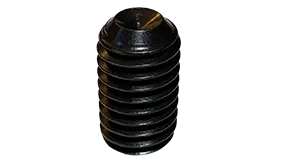
1/4-28 X 3/8" Nylon Pellet Cup Point Socket Set Screws | Alloy Steel (100 / Pkg.)
Which should you choose?
Best for
- High-vibration machinery and equipment
- Applications requiring frequent disassembly and reuse
- Cup point set screws that need extra locking security
Not for
- Low-cost, one-time installations where patch screws suffice
- Very small quantities where bulk packs are impractical
- Situations where frequent adjustment is expected and patch wear is acceptable