Quick answer
The Northern Olympic Tri-Grip Plates 60kg Set gives you two each of 5kg, 10kg, and 15kg plates — 60kg total. Buy it if your main lifts sit in the 40–80kg range and you already own or plan to buy a standard Olympic bar; add smaller plates separately if you need fine jumps.
What the 60kg total actually covers
Sixty kilograms of plates is a mid-range starting point, not a full home gym. With a 20kg Olympic bar, the set lets you load up to 80kg total. That handles overhead press, rows, and lighter squat and deadlift sessions for many lifters, but it runs out quickly on deadlifts and heavy squats once you progress.
The pair structure matters more than the total. Two of each size means every weight you load is symmetrical, and you can build 5kg steps by combining plates: 5, 10, 15, 20, 25, 30kg per side and so on. What you cannot do is make a 2.5kg jump, because the set contains no fractional plates.
Tri-Grip versus plain cast iron: the real difference
Tri-grip refers to the molded grip openings in the plate, which make it easier to pick up, carry, and slide onto a bar or peg. That is a handling advantage, not a loading or durability claim. The Northern set is cast iron with a rubber coating, so it sits between bare cast iron and full bumper plates: it protects floors better than uncoated iron, but it is not a bumper plate designed for dropping from overhead.
If you plan to do Olympic lifts with misses, bumper plates are the safer category. If you train primarily with a bar on a rack or floor and want easier handling, the tri-grip design is the practical choice.
The gap you will likely hit first
The missing 2.5kg and 1.25kg plates are the limitation most buyers notice within weeks. Linear progression on press and squat often needs jumps smaller than 5kg per side. Plan to buy fractional plates alongside this set, or accept that you will repeat weights longer between increases.
The set also assumes an Olympic bar with 2-inch sleeves. If you own a standard 1-inch bar, these plates will not fit, and no adapter makes that safe for loaded lifting.
Decision rules for the 60kg Tri-Grip set
- Check your current working weights: If your heaviest squat or deadlift working set is under roughly 60kg of plates (80kg total with a 20kg bar), this set covers you now. If you are already near that, buy a larger set or plan an immediate add-on pair. Write down your top working weight per lift before ordering.
- Confirm your bar sleeve diameter: These are Olympic plates for 2-inch sleeves. Measure your bar sleeve before buying; a 1-inch standard bar is a hard no.
- Budget for fractional plates: The set has no 2.5kg or 1.25kg plates, so small progressive jumps are impossible out of the box. Add a pair of smaller plates at the same time if you follow linear progression. Treat the add-on pair as part of the purchase cost, not a later upgrade.
- Match plate type to your lifting style: Choose this rubber-coated cast iron set for rack and floor work. Choose bumper plates instead if you drop the bar from overhead or train Olympic lifts with frequent misses.
Product facts
-
Olympic Tri-Grip Plates - 5kg/10kg/15kg x 2 (60kg Set): Cast-iron plates with a rubber coating and tri-grip openings, sold as 5kg, 10kg, and 15kg pairs for 60kg total. The rubber coating and grip cutouts make loading and unloading easier than bare iron, while the fixed pairs set your available weight jumps.
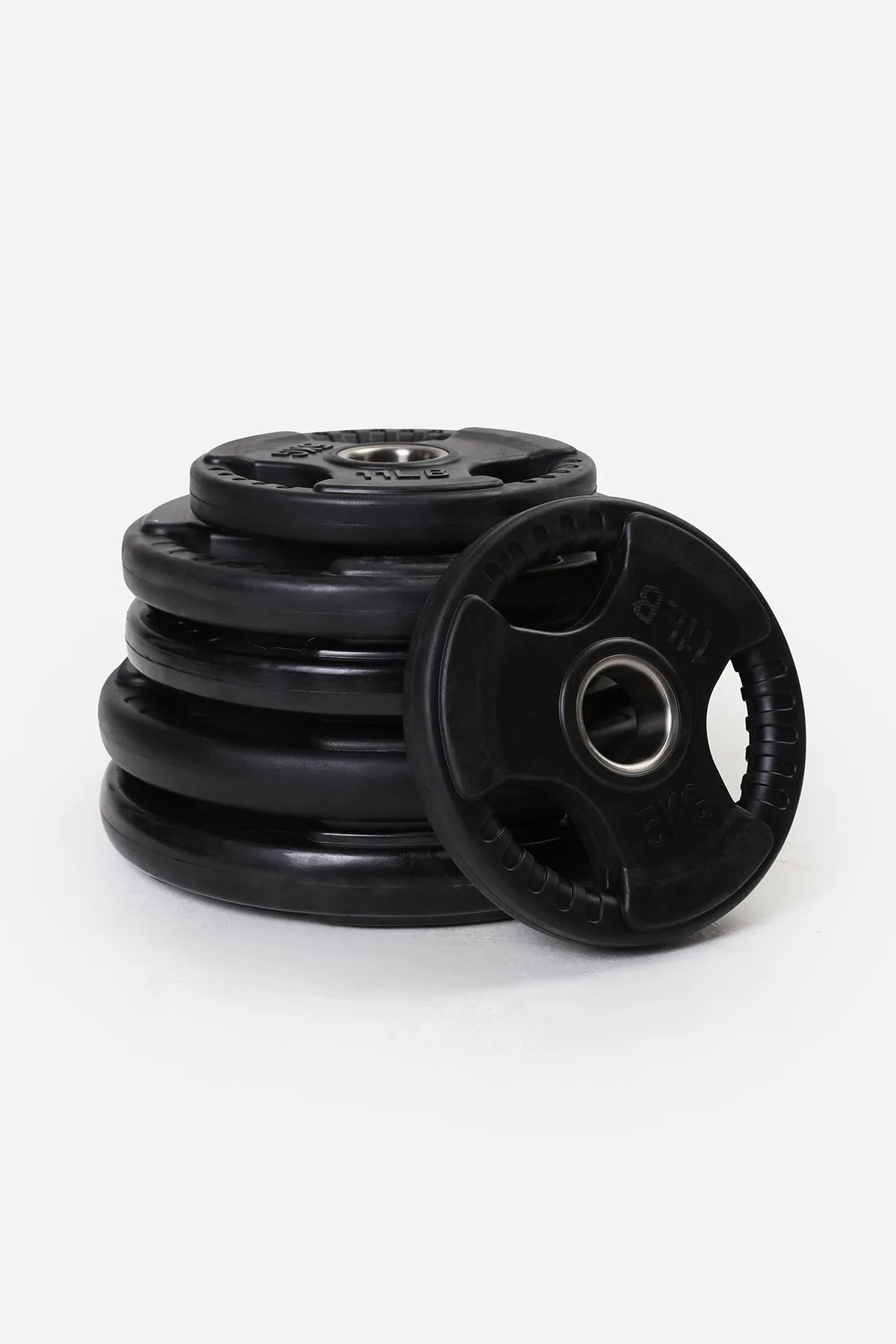
Olympic Tri-Grip Plates - 5kg/10kg/15kg x 2 (60kg Set)
Who should buy this set
Best for
- Home lifters whose press, row, and squat working weights fit within 80kg total
- Buyers who want easier plate handling from tri-grip cutouts and a rubber coating
- Anyone starting a home gym who will add plates as strength grows
Not for
- Deadlifters or squatters already working near or above 80kg total
- Olympic weightlifters who need bumper plates for dropped lifts
- Lifters who need 2.5kg or smaller jumps and will not buy fractional plates