Why source water decides what your espresso tastes like
Coffee is mostly water, so the minerals and dissolved solids in your supply shape extraction, flavor, and how hard your equipment has to work. The Optipure 200/16 Coffee/Espresso Reverse Osmosis System is built around that idea: give a coffee program full control over its source water and remove the variables that compromise extraction quality, flavor, and machine longevity.
This guide is for the buyer weighing a commercial RO system rather than a cartridge-only filter. It focuses on what the supplied record confirms, where the practical limits sit, and the questions to settle before you order.
What the 200/16 is designed to treat
The system combines several treatment stages in one integrated installation. According to the supplied product information, it addresses:
- TDS (total dissolved solids): The RO membrane removes dissolved solids at the molecular level, with near-total TDS reduction for full control over water chemistry.
- Chlorine: Chlorine is addressed as part of the multi-stage filtration, alongside the other water variables listed.
- Scale minerals: Near-complete removal of scale-forming minerals protects boilers, group heads, and heating elements, which can mean fewer descaling cycles and longer equipment life.
- Sediment: Sediment is handled within the same integrated system, so you are not assembling separate treatment steps.
The Optipure 200/16 at a glance
-
Optipure 200/16 Coffee/ Espresso Reverse Osmosis System: Multi-stage filtration addresses TDS, chlorine, scale minerals, and sediment in a single integrated system. One installation covers the main water variables instead of stacking separate filters.
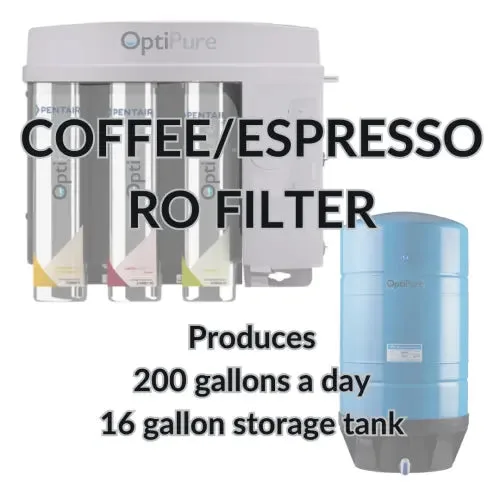
Optipure 200/16 Coffee/ Espresso Reverse Osmosis System
-
Optipure 200/16 Coffee/ Espresso Reverse Osmosis System: The reverse osmosis membrane removes dissolved solids, heavy metals, and hardness minerals at the molecular level. This is the core of the system's near-total TDS reduction and the reason it can give you control over water chemistry.
-
Optipure 200/16 Coffee/ Espresso Reverse Osmosis System: Rated for commercial water volumes, with consistent output quality across the daily demand of a working cafe. Throughput is the first practical checkpoint for a busy bar; the record frames this unit around commercial demand rather than light use.
-
Optipure 200/16 Coffee/ Espresso Reverse Osmosis System: Under-counter form factor with standard plumbing connections for professional installation in commercial environments. Plan for under-counter space and a professional install rather than a DIY hookup.
The trade-off: control over water chemistry versus simplicity
RO gives you the most control over dissolved solids, but it also changes how you think about your water. Near-total TDS reduction means the output is very low in dissolved minerals, which is the point for consistency and scale protection. If your coffee program depends on a specific mineral profile, that is a conversation to have before installation, because the supplied record does not include a remineralization stage or target mineral ranges.
The record also does not list cartridge capacity, flow rate, recovery ratio, or replacement intervals. Those are exactly the numbers a buyer would normally use to compare RO systems, so treat them as open questions to confirm with the dealer rather than assumptions. The absence of those figures in the supplied information is not evidence that the system lacks them; it simply means they are not confirmed here.
A practical pre-purchase sequence
Work through these in order so the decision rests on your water and your bar, not on a spec sheet alone.
- 1. Test your incoming water: Establish TDS, hardness, chlorine, and sediment levels. The system is built to address all four, but your starting numbers tell you how much work it will do.
- 2. Confirm daily volume against commercial rating: The 200/16 is rated for commercial water volumes and consistent output across a working cafe's daily demand. Match that to your actual peak-day usage.
- 3. Plan the under-counter install: The unit uses an under-counter form factor with standard plumbing connections and calls for professional installation. Check space, drain access, and who will do the work.
- 4. Ask about cartridge capacity and service: The supplied record does not state cartridge capacity or replacement intervals. Get those numbers, plus ongoing support details, before you commit.
Where the 200/16 fits and where it may not
This system makes the most sense for a coffee program that wants full control over source water and is prepared to install and maintain a commercial RO unit under the counter. The scale protection and near-total TDS reduction are aimed at protecting boilers, group heads, and heating elements, which is a long-term equipment decision as much as a flavor one.
It is a less obvious fit if you want a simple cartridge swap, if you are not ready for professional installation, or if you need published capacity and flow figures to compare options. In those cases, confirm the missing details first or look at a filtration approach that matches your constraints. The catalog price is USD 3,238.31 against a comparison price of USD 4,561.00, and financing is available through Click Lease and other financing partners for qualifying purchases.
Support before and after the sale
Coffee Machine Depot is an authorized dealer with hands-on experience across the machines it sells, and the team helps with selection, installation guidance, and ongoing support. If you are unsure whether the 200/16 matches your water report or your bar's volume, call 323-592-3303 before ordering. That conversation is the right place to settle the capacity and service questions the supplied record leaves open.