Quick answer
Buy an oral airway kit only if you are trained to insert and monitor an oropharyngeal airway, and choose sizes that match the people you are most likely to treat. Store it clean, dry, and within reach of your other airway management supplies.
Why sizing is the main buying decision
An oropharyngeal airway that is too short can push the tongue back instead of holding it forward, while one that is too long can press on the airway structures. Because fit depends on the distance from the mouth to the angle of the jaw, an oral airway kit buying guide should start with the size range you need rather than the number of pieces in the kit.
What to look for in an airway kit beyond size
Check the airway material and construction before you buy. A reinforced bite block helps resist collapse if the person bites down, and a non-brittle finish supports easier insertion. Perforated openings matter because they keep a ventilating channel open and allow suction catheter access even if the airway shifts or is partly blocked.
Storage and placement trade-offs
Keep the airway in a clean, dry pouch or compartment so it stays free of dust and moisture, and place it where you can reach it without unpacking the whole first aid kit. If you carry a size range, label each size clearly; loose airways of similar length are hard to tell apart under pressure.
When an oral airway kit is not the right purchase
If no one in your group has airway training, spend the budget on basic bleeding control, CPR barriers, and a way to call emergency services instead. An oral airway is an adjunct for trained responders, not a substitute for positioning, suction, or professional help.
Decision rules for buying and carrying an oral airway kit
- Training check first: Buy only if you have current training in airway insertion and monitoring; otherwise choose a first aid kit focused on bleeding control and CPR barriers. Training is the deciding factor, not kit contents.
- Size range rule: Choose a kit that covers the sizes for the people you most often treat, and do not rely on one universal size. Check the available size options before ordering. Match sizes to your likely patients, not to the kit's piece count.
- Construction check: Look for a reinforced bite block, a non-brittle finish, and perforated openings that permit suction access. These features affect function if the airway shifts or the person bites.
- Storage rule: Store the kit clean and dry, label each size, and keep it with your other airway management supplies so it is reachable without unpacking everything. Label sizes before an emergency, not during one.
Product facts to know
-
Oral Airway Kit: The Oral Airway Kit is made of polypropylene with a reinforced bite block and perforated midway openings. The bite block helps prevent airway collapse, while the perforations keep a ventilating channel and suction access available if the airway shifts.
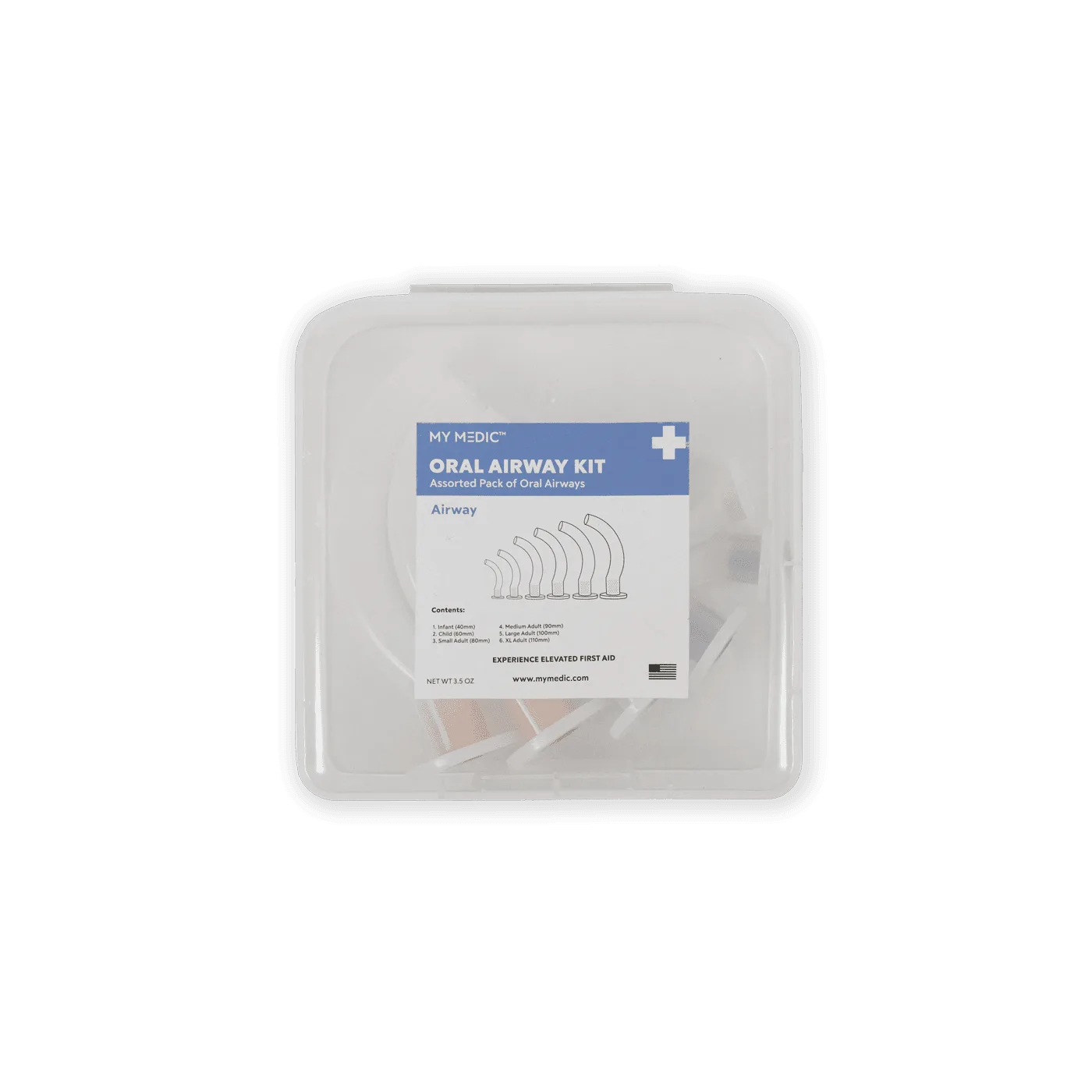
Oral Airway Kit
Who should buy an oral airway kit
Best for
- Trained responders who need a compact range of oropharyngeal airway sizes
- Workplaces or teams that already carry airway management supplies and suction
Not for
- Untrained households that should prioritize bleeding control and CPR barriers
- Anyone looking for a substitute for suction, positioning, or emergency medical care