Why washcloth claims deserve a closer look
Bathtime advice travels fast, and much of it sounds authoritative without ever being checked against a label. Organic cotton baby washcloths are a good example: shoppers hear that organic means gentler, that terry is always more absorbent, or that a three-pack is all one baby needs. Some of those ideas hold up. Others are assumptions dressed up as facts.
The honest way to sort them is to compare each claim with what a product record actually states. The Organic Cotton Woven Terry Solid Washcloths 3 Pack in Pink Sand gives us a concrete example to work from, and it also shows where the supplied information stops short.
Three claims worth testing
- Myth: organic cotton automatically means a softer feel: Organic describes how the cotton is grown, not how the finished cloth feels. Softness comes from how the fabric is constructed. This washcloth is described as woven terry, with a smooth side and a loop side, and the record notes combed and ring-spun cotton for softness. Those construction details, not the organic label alone, are what the evidence supports.
- Myth: terry and woven are opposites: The product name itself combines the two terms: woven terry. Terry refers to the looped surface; woven refers to how the cloth is made. A washcloth can be both, which is why treating terry vs woven washcloths as a strict either-or misses what the record actually says.
- Myth: a three-pack covers every bath: A three-pack gives you three cloths at a time. How many baby washcloths you need depends on how often you bathe your baby, how many cloths you use per bath, and how often you run laundry. The supplied record does not recommend a quantity, so treat any fixed number as a personal routine decision, not a product instruction.
What the washcloth record confirms
-
Organic Cotton Woven Terry Solid Washcloths 3 Pack - Pink Sand: Dimensions: 10" x 10" A stated size lets you judge whether the cloth suits your hand and your usual washing routine, rather than guessing from a photo.
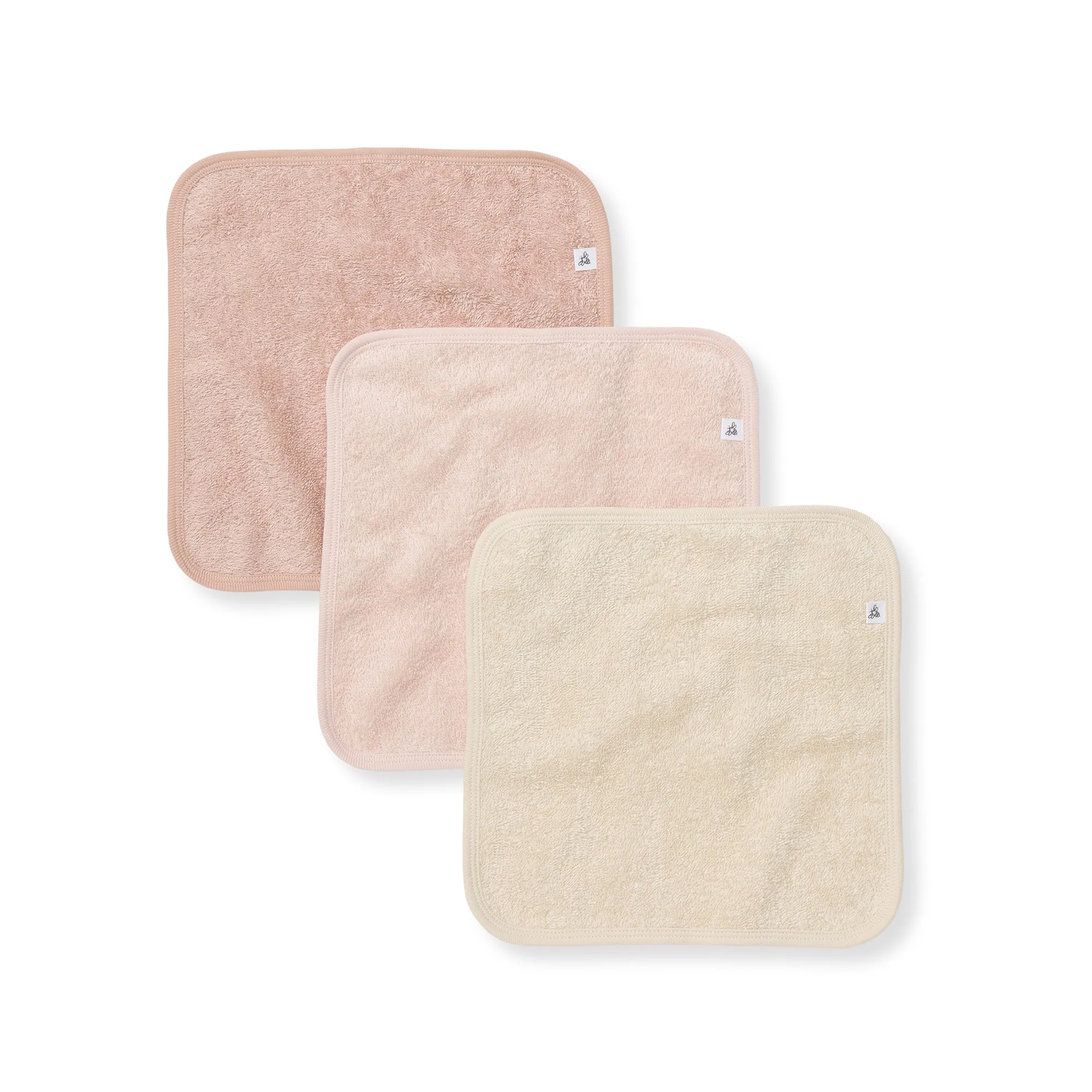
Organic Cotton Woven Terry Solid Washcloths 3 Pack - Pink Sand
-
Organic Cotton Woven Terry Solid Washcloths 3 Pack - Pink Sand: 100% organic cotton This is the fiber content the record lists. It tells you what the cloth is made of, not how it will perform for every baby.
-
Organic Cotton Woven Terry Solid Washcloths 3 Pack - Pink Sand: Soft and absorbent woven terry; smooth on one side, loop on the other The two-sided construction is the clearest evidence for how the cloth is built, and it explains why terry and woven are not mutually exclusive.
-
Organic Cotton Woven Terry Solid Washcloths 3 Pack - Pink Sand: Combed and ring-spun for durability, softness and no-pill washing This is the care-related claim the record makes. It supports expectations about washing, but it is not a full laundering instruction.
-
Organic Cotton Woven Terry Solid Washcloths 3 Pack - Pink Sand: Set of three washcloths; Style # LY31824-PKS; Made in India The pack count and origin are stated facts you can compare against other options, without inferring anything about age suitability.
What the record does not settle
Several popular claims cannot be confirmed from the supplied information. The record does not state an age range, so it does not establish newborn suitability. It also gives no washing temperature, detergent guidance, or drying method. The no-pill washing note supports a durability expectation, but it is not a set of baby washcloth care tips in itself.
That gap matters because care advice is easy to invent. If you want specific laundering instructions, check the care label on the cloth you receive rather than relying on a general article. The same caution applies to absorbency comparisons: the record calls the cloth absorbent, but it does not rank it against other washcloth styles.
How to use the evidence when you shop
Once the myths are set aside, the decision becomes practical. Use the stated facts to narrow your choice, and leave room for what the record does not say.
- Match the size to your routine: The 10" x 10" dimension is the only size evidence supplied. Hold that against how you plan to use the cloth, rather than assuming bigger or smaller is better.
- Decide whether the two-sided texture helps: A smooth side and a loop side give you two surfaces in one cloth. If you prefer a single texture, that is a reason to look at other options.
- Plan your laundry around the pack count: Three cloths per pack is a starting point. If you bathe daily and use a fresh cloth each time, you will need more than one pack to avoid constant washing. The record does not set a number, so base it on your own habits.
- Treat care claims as expectations, not instructions: The combed and ring-spun construction is linked to no-pill washing in the record. Use that as a durability expectation and follow the label for actual washing steps.