Start with the gate, not the whole castle
The Ostheimer Castle Portcullis is a single, working castle piece: a wooden gate with a pulley and red cord that raises and lowers the portcullis. It is designed to fit into the wider Ostheimer and Kinderkram castle system, so you do not need the entire castle assembled to begin play. Setting up the portcullis first gives children a clear, hands-on focus—opening and closing the gate—before you add towers, walls, or figures.
This guide walks through what the portcullis does, how to place it for knight play, and how to build a simple medieval small world around it. It also covers what the supplied product information confirms and what it leaves open, so you can decide whether this piece fits your play setup.
What the Ostheimer Castle Portcullis includes
-
Ostheimer Castle Portcullis: The model has a fully functioning pulley with a red cord. The pulley is the main play feature: children can raise and lower the portcullis by pulling the cord, which makes the gate interactive rather than a static backdrop.
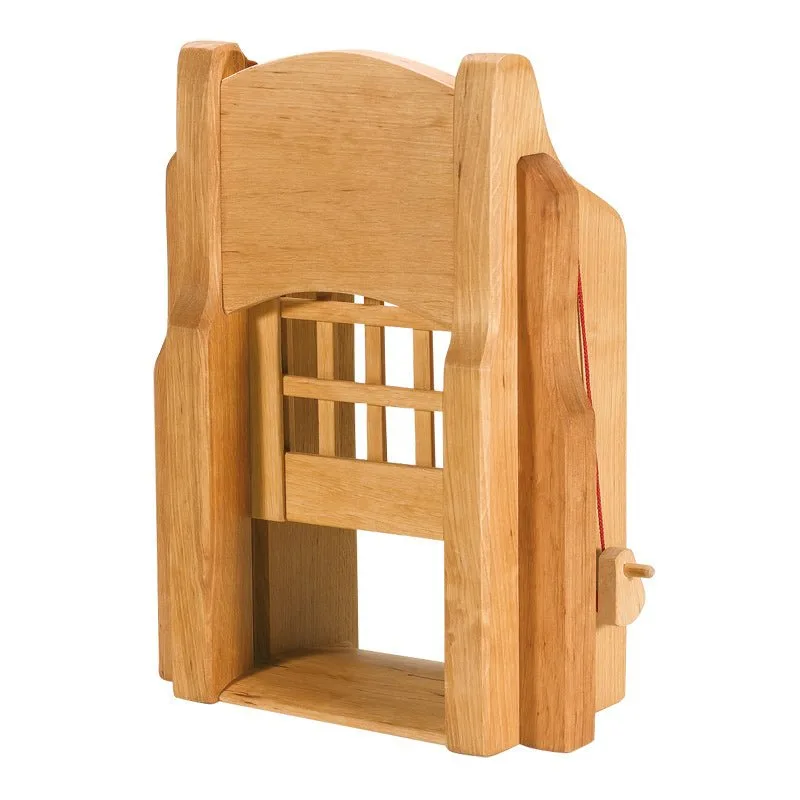
Ostheimer Castle Portcullis
-
Ostheimer Castle Portcullis: Height: 31 cm. This helps you judge whether the gate will sit at a comfortable height for your child and whether it fits the space you have for a castle setup.
-
Ostheimer Castle Portcullis: All Ostheimer and Kinderkram castle parts are compatible. You can add the portcullis to an existing castle collection or start with this piece and expand later, mixing brands within the compatible system.
-
Ostheimer Castle Portcullis: Hand-crafted from solid Alder wood from sustainable domestic forestry. This tells you the material and construction style, which matters if you prefer natural materials and want a piece that can be passed down.
Setting up the portcullis for play
The supplied information does not include assembly instructions or a required sequence, so treat these as practical starting points rather than manufacturer steps. Adjust them to your space and your child’s age.
- Clear a flat play surface: The portcullis is 31 cm tall and works with a pulley cord. A stable, flat area gives the gate room to stand and lets the cord move freely.
- Place the gate at the entrance to your castle layout: Position the portcullis where a castle entrance would logically sit—at the front of a wall or between two towers if you have them. This makes the gate the focal point of entry and exit play.
- Check the pulley movement before play: Raise and lower the portcullis yourself first to confirm the red cord runs smoothly and the gate moves without catching. The supplied information does not specify cord length or pulley maintenance, so simply observe how it behaves.
- Introduce the gate through a simple story: The product description notes that children become acquainted with castles, knights, and princesses through stories. Start with a short scenario—arriving at the castle, asking to be let in, raising the gate—so the child has a reason to use the pulley.
Building a medieval small world around the gate
The portcullis works best as part of a small world: a compact scene where children arrange figures and pieces to tell a story. Because all Ostheimer and Kinderkram castle parts are compatible, you can build that world gradually. Start with the portcullis and a few figures, then add towers, walls, or other castle pieces as your collection grows.
For knight play, place the gate where it can be approached from both sides—one side as the outside world, the other as the castle courtyard. A simple path of blocks or a drawbridge made from a flat wooden piece can extend the story. The supplied information does not include specific figures or accessories, so use what you already have and let the gate anchor the scene.
Portcullis vs. other castle pieces: what this gate adds
If you are deciding between the portcullis and another castle accessory, consider what kind of play each supports. The comparison below is based only on the supplied information for the portcullis; it does not describe other products.
- Interactive gate play: The portcullis is the piece to choose if you want a moving part—a gate that opens and closes—rather than a static wall or tower.
- Storytelling focus: The pulley cord gives children a clear action to build stories around: raising the gate to welcome a visitor, lowering it for defense, or practicing the motion itself.
- Expansion within a compatible system: Because Ostheimer and Kinderkram castle parts are compatible, the portcullis can be a first purchase or an addition to an existing set. The supplied information does not specify which other pieces are available, so check the range if you want to expand.
What the supplied information does not settle
The supplied product record does not include an age recommendation, safety warnings, or care instructions. It also does not specify cord length, pulley materials, or assembly steps. If you need those details—especially for a younger child—check the product packaging or ask the retailer before buying.
The record also does not describe how the portcullis attaches to other castle pieces. The compatibility statement confirms that Ostheimer and Kinderkram castle parts work together, but the exact connection method is not detailed. If you already own a castle, compare the portcullis height (31 cm) and design with your existing setup to see how it might fit.
A quick buying checkpoint
- Ostheimer Castle Portcullis: The Ostheimer Wooden Portcullis is described as one of the most popular additions to the Ostheimer wooden castle. This suggests it is a commonly chosen piece for castle play, which may help you judge whether it fits the kind of setup you are building.
- Ostheimer Castle Portcullis: The engineering involves a fully functioning pulley with a red cord, a simplified version of the counterweight systems used in real castles. This gives you a concrete way to talk about the mechanism during play: the cord and pulley are the working parts your child will handle.