A board book you can turn into a shared routine
Our World: Philippines is a board book for very young readers that follows a day in the Philippines — riding the unicorn jeepney, stopping by the sari-sari, and cooling off with sweet halo-halo. The Filipino author Moor and illustrator team Happy Garaje draw on their own lived experiences, so the scenes feel like a place someone knows rather than a generic travel spread.
That makes it a good fit for a read-aloud guide: the book already gives you a sequence of daily moments, and you can add simple prompts and family habits around each one. The goal is not to quiz your child but to make the reading repeatable and easy to return to.
What the book actually gives you
-
Our World: Philippines: Board book format, part of the Our World series for very young readers. A board book suits babies and toddlers who handle books roughly, and the series label tells you the pacing is built for short attention spans.
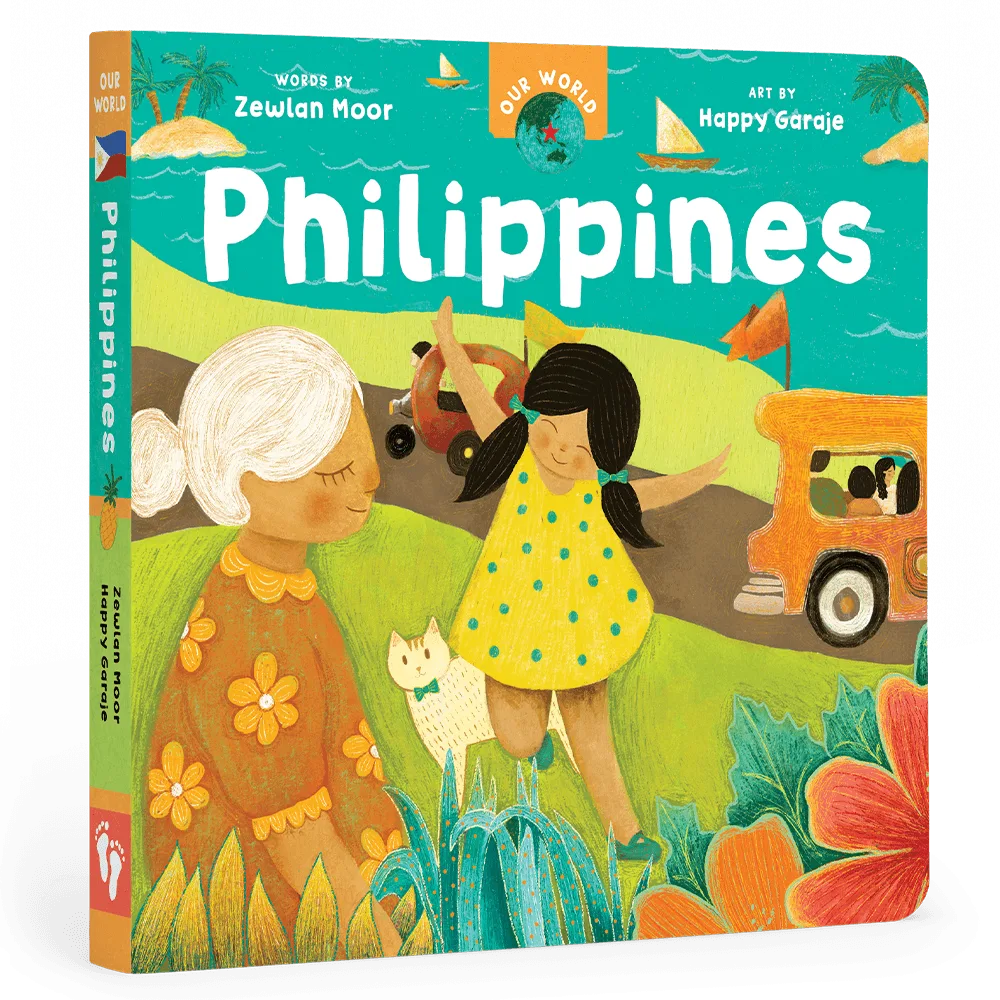
Our World: Philippines
-
Our World: Philippines: Includes educational endnotes. Endnotes give adults a place to check context or find a next step after the story ends, without interrupting the read-aloud.
-
Our World: Philippines: Written by Filipino author Moor and illustrated by Happy Garaje, drawing on lived experiences. That authorship and illustration background is the reason the jeepney, sari-sari, and halo-halo scenes read as everyday life rather than tourist highlights.
-
Our World: Philippines: The story moves through a day in the Philippines: the unicorn jeepney, the sari-sari, and halo-halo. Those three stops give you natural page anchors for a read-aloud routine, so you can pause at the same places each time.
A simple read-aloud routine, page by page
Keep the first reading straight through. The prompts below work best on a second or third pass, when your child already knows the shape of the day.
- Start with the cover and the greeting: The book opens with “Magandang umaga!” — a morning greeting. Say it together before you turn the page. Repeating one phrase each reading builds familiarity without turning the book into a lesson.
- Pause at the unicorn jeepney: Ask a simple observation question: what color is the jeepney, or who is riding in it. Keep it to one question so the story keeps moving.
- Stop by the sari-sari: The sari-sari is a small neighborhood shop. Point to what is on the shelves and ask your child what they would pick. This is a natural place to talk about how people buy everyday things in another country.
- Cool off with halo-halo: Halo-halo is a sweet, mixed dessert. Ask whether it looks cold, sweet, or colorful — words your child already knows — rather than explaining the recipe.
- Finish with the endnotes: The educational endnotes are for you, not for the child mid-story. Read them after your child has moved on, then bring one fact back into the next reading.
Family read-aloud habits that make it stick
- Pick a fixed time slot: A board book this short fits into a morning start or a pre-nap wind-down. The same slot each day does more for routine than a longer, irregular session.
- Reread the same three stops: The jeepney, sari-sari, and halo-halo pages are your anchors. Repeating the same pages lets your child anticipate what comes next, which is the point of a read-aloud habit.
- Let your child turn the pages: Board books are built for hands-on use. Handing over page-turning keeps a very young reader involved without requiring them to sit still.
- Keep one phrase in rotation: Use “Magandang umaga!” as your opening each time. One repeated phrase from the book is enough to make the reading feel like a ritual.
Using the book for Philippines culture for kids
The book is a glimpse, not a tour guide — the School Library Journal quote supplied with the book describes the series as “more poetry than a tour guide.” Treat it that way. The jeepney, sari-sari, and halo-halo pages introduce three everyday things; they do not explain the history behind them.
If you want to extend the reading, use the endnotes as your starting point and keep the conversation at your child's level. For a very young reader, naming what is on the page and connecting it to their own day — a ride in the car, a trip to a shop, a cold treat — does more than a geography lesson.
What the supplied information does not confirm
The supplied record does not list a page count, exact dimensions, or a recommended age range beyond “very young readers.” It also does not describe the endnotes' contents. If you need those details for a classroom or gift decision, check the physical book or the publisher's listing before buying.
The record confirms the format as a board book and the price shown in the catalog at the time of writing, but prices and availability can change. Use the current product page for the latest details.