Why tiny medals punish a broad brush
Medals, ribbon bars, and cap patches are some of the smallest details on a miniature, and they are also the first place a viewer looks for a story. A single stray brushstroke can turn a crisp ribbon into a smear, so the job rewards a narrow brush, a light touch, and colors that stay where you put them.
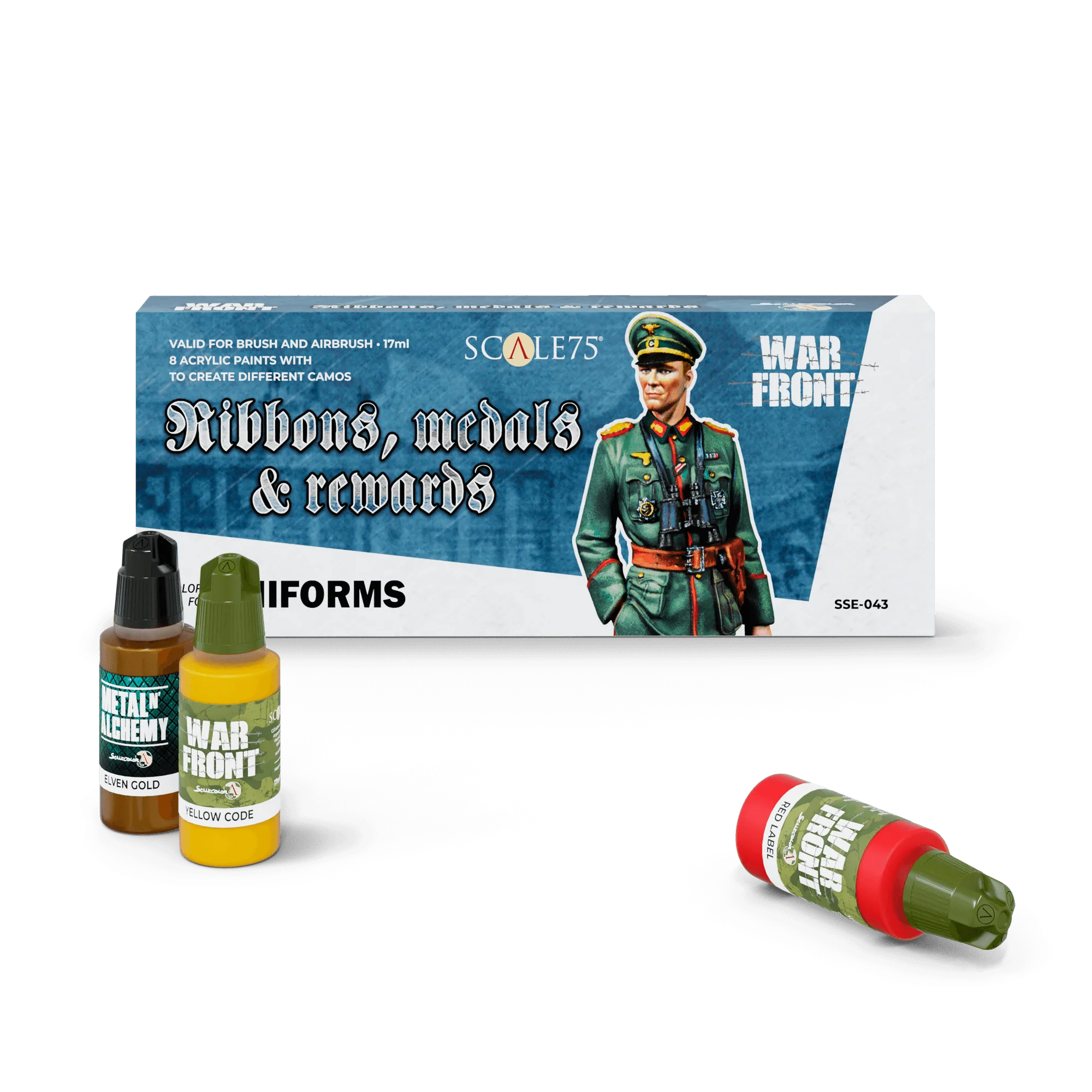
The RIBBONS, MEDALS AND REWARDS set gives you eight acrylic colors aimed at exactly this kind of work: five matte colors for the cloth and base layers, and three metallics for the metal itself. The catalog lists the set for decorating badges, medals, cap patches, and other items found on military uniforms, which is a useful reminder that the same colors can serve both the award and the uniform around it.
What the set actually contains
-
RIBBONS, MEDALS AND REWARDS: Set of 8 acrylic colors: 5 with a matte finish and 3 metallic. The matte colors suit ribbon cloth and uniform patches, while the metallics are the obvious choice for medal faces and trim.
RIBBONS, MEDALS AND REWARDS
-
RIBBONS, MEDALS AND REWARDS: Contains SW15 Flat Black, SW53 Red label, SW54 Yellow Code, SW58 White, SC41 Black Forest Green, SC63 Black Metal, SC65 Heavy Metal, and SC74 Elven Gold. This is a compact palette for award detailing: black, red, yellow, white, and green for ribbons and patches, plus three metals for the medal itself.
A brush-first order for a single medal
Work from the largest area to the smallest, and let each layer dry before adding the next. The steps below use only the colors in the set and the preparation notes supplied with it.
- Prepare the paint before you open it: The catalog says to pierce the paint can's cap before use and recommends inserting a small ball or stirrer into the can to help mix the paint. Do that first so the metallics are properly stirred rather than half settled.
- Block in the ribbon or patch with a matte color: Choose from SW15 Flat Black, SW53 Red label, SW54 Yellow Code, SW58 White, or SC41 Black Forest Green. Keep the brush narrow and follow the ribbon's direction so the strokes disappear into the shape.
- Add the ribbon's contrast stripe or edge: Use a second matte color from the same five to suggest the ribbon's pattern. Work one stripe at a time and reload the brush before the paint starts to drag.
- Paint the medal face with a metallic: SC63 Black Metal, SC65 Heavy Metal, and SC74 Elven Gold are the three metallics in the set. Apply them over a dry matte base rather than wet paint, and keep the layer thin so the detail underneath still reads.
- Finish the small metal highlights last: A touch of Heavy Metal or Elven Gold on a raised edge or clasp catches the eye without covering the ribbon. Stop while the metal still looks like metal, not a painted blob.
Matching the five matte colors to common award details
The set does not include a chart of real-world ribbon patterns, so treat these as starting points rather than official color matches.
- SW53 Red label: A strong choice for a central ribbon stripe or a red patch background where you want the award to read from across the table.
- SW54 Yellow Code: Useful for a narrow ribbon edge or a contrasting stripe next to red or black, where a small amount of warmth helps the detail stand out.
- SW58 White: Works for a pale ribbon field or a thin edge line. Keep it thin, because white shows every uneven brushstroke on a tiny surface.
- SW15 Flat Black: A reliable base for dark ribbons, shadow lines, and the recessed areas around a medal face.
- SC41 Black Forest Green: A muted green for ribbon fields or uniform patches where pure black would look too harsh at miniature scale.
Where the supplied information stops
The catalog confirms the eight colors, their matte or metallic finish, and the preparation notes for the can. It does not supply thinning ratios, drying times, coverage estimates, or a recommended brush size, so those choices are yours to test on a spare surface before committing to a finished figure.
The same caution applies to historical accuracy: the set is described for decorating badges, medals, cap patches, and other items found on military uniforms, but the supplied information does not map specific colors to specific real-world awards. If a particular ribbon pattern matters to your project, check a reference you trust rather than assuming the nearest color in the box is correct.