Quick answer
Choose the Panasonic Leica 35-100mm f/2.8 if you shoot Micro Four Thirds and need a versatile telephoto zoom for portraits and events. Choose the Nikon 24mm f/1.8 if you use an F-mount DSLR and want a bright, wide-angle prime for landscapes and low-light street scenes.
Zoom vs prime: what changes your shooting
The Panasonic Leica 35-100mm f/2.8 is a constant-aperture telephoto zoom built for Micro Four Thirds mirrorless cameras. Its 35-100mm range covers classic portrait focal lengths, and the constant f/2.8 keeps exposure steady as you zoom. That flexibility suits event work where you cannot easily change lenses.
The Nikon 24mm f/1.8 is a wide-angle prime for F-mount DSLRs, compatible with both FX and DX formats. Its bright f/1.8 aperture lets in more light than the zoom's f/2.8, which helps in dim conditions and gives you a wider field of view for landscapes and interiors.
Why the f/1.8 aperture matters for low light
A wider aperture means more light reaches the sensor. The Nikon 24mm f/1.8's f/1.8 opening is about one stop faster than the Panasonic's f/2.8, so you can shoot in darker scenes without raising ISO as much. That advantage is most noticeable when you are hand-holding in evening light or indoors without flash.
The Panasonic's f/2.8 is still a solid choice for many situations, and its constant aperture means you do not lose light as you zoom. But if low-light performance is your top priority, the prime's wider opening gives it a clear edge.
Focal length and composition trade-offs
The 35-100mm zoom on Micro Four Thirds gives you a 70-200mm equivalent field of view, ideal for portraits with nice background compression. The 24mm prime on a full-frame body gives a wide 24mm view, great for capturing context in landscapes or tight indoor spaces.
A prime lens forces you to move your feet to frame the shot, which can be creative but also limiting. The zoom lets you adjust composition quickly without changing lenses, which is a big plus when your subject is moving.
How to choose: trade-offs to consider
- Camera system: The Panasonic fits Micro Four Thirds mirrorless cameras; the Nikon fits F-mount DSLRs. Your current system narrows the choice immediately. Check your camera mount before comparing specs.
- Subject and focal length: The 35-100mm zoom is a telephoto, great for portraits and distant subjects. The 24mm prime is wide-angle, best for landscapes, architecture, and group shots. Think about what you photograph most often.
- Low light performance: The Nikon's f/1.8 lets in more light than the Panasonic's f/2.8, giving you better hand-held performance in dim conditions. If you shoot at night, the prime has the advantage.
- Flexibility vs. simplicity: The zoom covers many focal lengths without changing lenses, ideal for events. The prime is lighter and simpler, but you must move to frame. Decide if you value versatility or minimalism.
Lens facts at a glance
-
Panasonic Leica DG Vario-Elmarit 35-100mm F/2.8 POWER O.I.S. Lens: The Panasonic Leica DG Vario-Elmarit 35-100mm f/2.8 is a telephoto zoom designed to Leica's quality standards for Micro Four Thirds mirrorless cameras, with a constant f/2.8 aperture. This gives you a versatile portrait-to-telephoto range with steady exposure, making it a reliable choice for events and portraits.
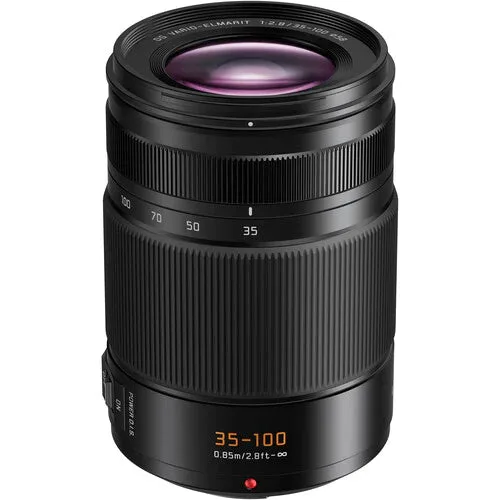
Panasonic Leica DG Vario-Elmarit 35-100mm F/2.8 POWER O.I.S. Lens
-
Nikon AF-S 24mm f/1.8G ED Lens: The Nikon AF-S 24mm f/1.8G ED is a wide-angle prime for F-mount DSLRs, suitable for FX and DX formats, with a bright f/1.8 aperture. The wide aperture lets in more light for low-light scenes, and the 24mm focal length captures broad landscapes and architecture.
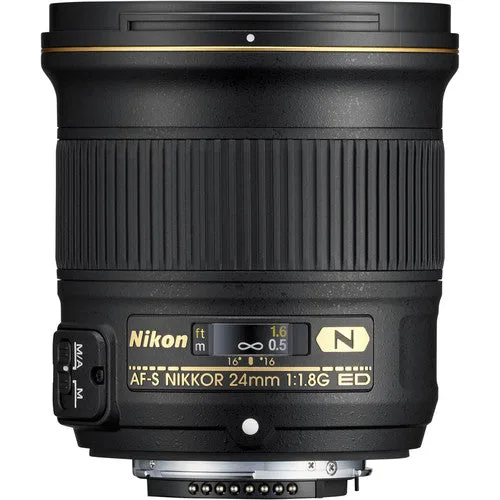
Nikon AF-S 24mm f/1.8G ED Lens
Who should buy which lens?
Best for
- Micro Four Thirds shooters who want a versatile telephoto zoom for portraits, events, and travel.
- Photographers who need a constant f/2.8 aperture for consistent exposure while zooming.
Not for
- Nikon F-mount DSLR users who need a wide-angle lens for landscapes or low-light street photography—consider the Nikon 24mm f/1.8 instead.