Start with the lens range, then build the rest of the kit
The Panasonic LUMIX FZ80D is a bridge camera built around one lens that covers a full-frame equivalent of 20-1200mm. That range is the reason to pack it for travel: you can frame a wide street scene and then zoom to a distant subject without changing lenses. Your setup should protect that flexibility rather than work against it.
The practical order is lens range first, stabilization second, power third, and file handling last. Get those four right and the camera behaves predictably in the field.
What the FZ80D record confirms
-
Panasonic LUMIX FZ80D Bridge Camera: Lumix DC Vario 60x zoom lens with a full-frame equivalent of 20-1200mm. This is the camera's core travel advantage: one body covers ultrawide landscapes and distant subjects.
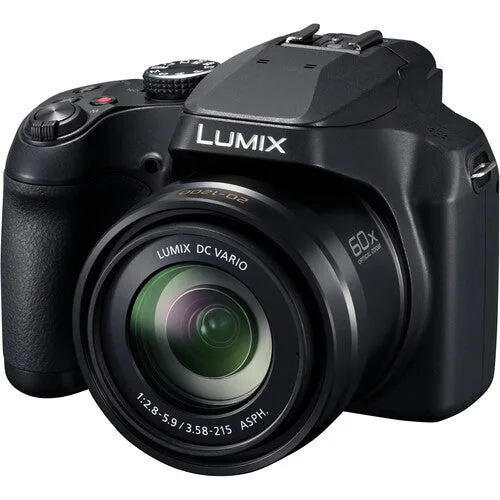
Panasonic LUMIX FZ80D Bridge Camera
-
Panasonic LUMIX FZ80D Bridge Camera: POWER O.I.S. (Optical Image Stabilization) counteracts camera shake. At the long end of the zoom, stabilization is the feature that keeps handheld travel shots usable.
-
Panasonic LUMIX FZ80D Bridge Camera: USB-C charging compatibility. You can plan a travel charging routine around a modern USB-C cable rather than carrying a proprietary charger.
A travel setup routine for the FZ80D
These steps follow the features confirmed in the supplied product record. Where the record does not specify a setting value, the step stays at the level of behavior rather than inventing a number.
- 1. Set the zoom range you actually use: Decide before the trip whether you shoot mostly wide, mostly telephoto, or both. The 20-1200mm equivalent range covers all three, so the goal is knowing where you start rather than carrying extra lenses.
- 2. Turn on POWER O.I.S. and practice at full zoom: The record confirms optical stabilization counteracts camera shake. At maximum zoom, small hand movements are magnified, so spend a few minutes at the long end before you rely on it for a once-in-a-trip shot.
- 3. Choose your viewing method: The FZ80D offers a 2.36m-dot OLED Live View Finder with 0.74x magnification and a 3.0" 1.84m-dot TFT LCD monitor. The viewfinder helps steady the camera against your face at long focal lengths; the LCD is easier for low or awkward angles.
- 4. Set up USB-C charging in your bag: Because the camera supports USB-C charging, pack one USB-C cable and confirm your power source before departure. The supplied record does not specify charging time or a required power adapter, so test your own setup at home.
- 5. Decide how you will use 4K Photo: The FZ80D records 4K video and can extract 8MP still images from footage using 4K Photo. If you shoot fast-moving subjects, this is a useful backup to continuous shooting at up to 10 frames per second.
- 6. Try Post Focus for tricky focus situations: Post Focus lets you adjust the focal point after taking the shot. It is worth testing before a trip where you expect layered scenes, such as markets or crowds, so you know how it behaves.
Long-zoom habits that make the range usable
- Stabilization is not a substitute for a steady stance: POWER O.I.S. counteracts shake, but at 1200mm equivalent every small movement is amplified. Brace against something solid when you can, and use the viewfinder for a more stable hold.
- Expect the aperture to matter at the long end: The supplied record does not list aperture values across the zoom range, so check the camera's display as you zoom. If light drops, raise ISO within the confirmed 80-3200 range, expandable to 6400.
- Use DFD autofocus for moving subjects: Panasonic's DFD (Depth-from-Defocus) technology provides quick and accurate autofocus. For fast action, pair it with continuous shooting at up to 10 frames per second.
- Keep the ISO range in mind: The 18.1MP MOS sensor has an ISO range of 80-3200, expandable to 6400. Know where your comfort limit is before a low-light travel evening.
Bridge camera vs DSLR for travel: what the FZ80D changes
A DSLR travel kit usually means a body plus at least two lenses to cover wide and long focal lengths. The FZ80D covers 20-1200mm equivalent in one body, which simplifies packing and eliminates lens changes in dusty or crowded places. The trade-off is that you cannot swap to a different lens for a specialized look, and the supplied record does not confirm DSLR-style optical or sensor specifications beyond the 18.1MP MOS sensor.
For travelers who value one camera and a small bag over lens flexibility, the bridge design is the practical choice. If your work depends on a specific lens characteristic, a DSLR or mirrorless system remains the more adaptable option.
What to confirm before you leave
The supplied record confirms USB-C charging compatibility but does not list a charging time, a required adapter wattage, or a battery model. Test your cable and power source at home rather than discovering an issue on the road. The record also does not specify a memory card type or a recommended card speed, so check the camera's documentation for card compatibility before buying new media.
The FZ80D's dial modes include Intelligent Auto, P, A, S, M, Creative Video, Custom 1 and 2, Scene Guide, and Creative Control. Set Custom 1 and Custom 2 to your two most common travel situations, such as a wide landscape mode and a long-zoom action mode, so you can switch without menu digging.