Start with the light the print already carries
The Parasol poster is an analog photograph of a parasol taken during a Swedish summer. Photographer Josefine Lundhall describes her approach: “I mostly shoot analog and I love to play around with shapes and forms, details and natural light when shooting.” That means the image already does the atmospheric work—you do not need to recreate a beach scene around it. Your job is to give it a wall where its natural light and shapes can read clearly.
Because the subject is a parasol, the print naturally leans warm-weather and coastal in feel, but it is a photograph rather than a graphic illustration. That distinction matters when you choose a frame and surrounding decor: a simple treatment usually lets the analog texture and the parasol’s form stay the focus.
Choose a size before you choose a wall
The Parasol poster is available in five sizes: 21x30, 30x40, 40x50, 50x70, and 70x100. The size you pick determines whether the print acts as a small accent or a room-defining piece, so decide that first.
- 21x30 or 30x40 for a first warm-weather print: These smaller sizes suit a secondary wall, a shelf backdrop, or a sunroom corner where you want a light touch of summer rather than a full statement. They are also easier to move between rooms if you are testing where the print feels right.
- 40x50 as a flexible middle size: This size can hold a narrow wall on its own or pair with a second print. In a sunroom or coastal-inspired room, it reads clearly without dominating the architecture.
- 50x70 or 70x100 for a deliberate focal point: The larger sizes turn the parasol photograph into the main event. Use them on a wall with enough empty space around the print so the shapes and natural light in the image are not crowded by furniture or other art.
Match the wall to the photograph’s quiet light
The Parasol poster is not a high-contrast graphic, so a busy wall can swallow it. Give it a relatively calm surface—painted drywall, a simple paneled wall, or a section of wall without heavy pattern. If the room already has strong stripes or a dense gallery wall, the print may compete rather than breathe.
For a sunroom, place the poster where indirect daylight reaches it but avoid a spot that receives harsh, constant direct sun unless you plan to frame it with glazing that protects the print. The supplied product information does not specify fade resistance or framing requirements, so treat those as decisions to confirm with your framer rather than assumptions.
What the Parasol poster actually is
-
Parasol: An analog photo of a parasol during Swedish summer, with a quote from photographer Josefine Lundhall about shooting analog and playing with shapes, forms, details, and natural light. This tells you the print’s mood is observational and light-led, not a saturated graphic—so styling should support that quiet, analog character.
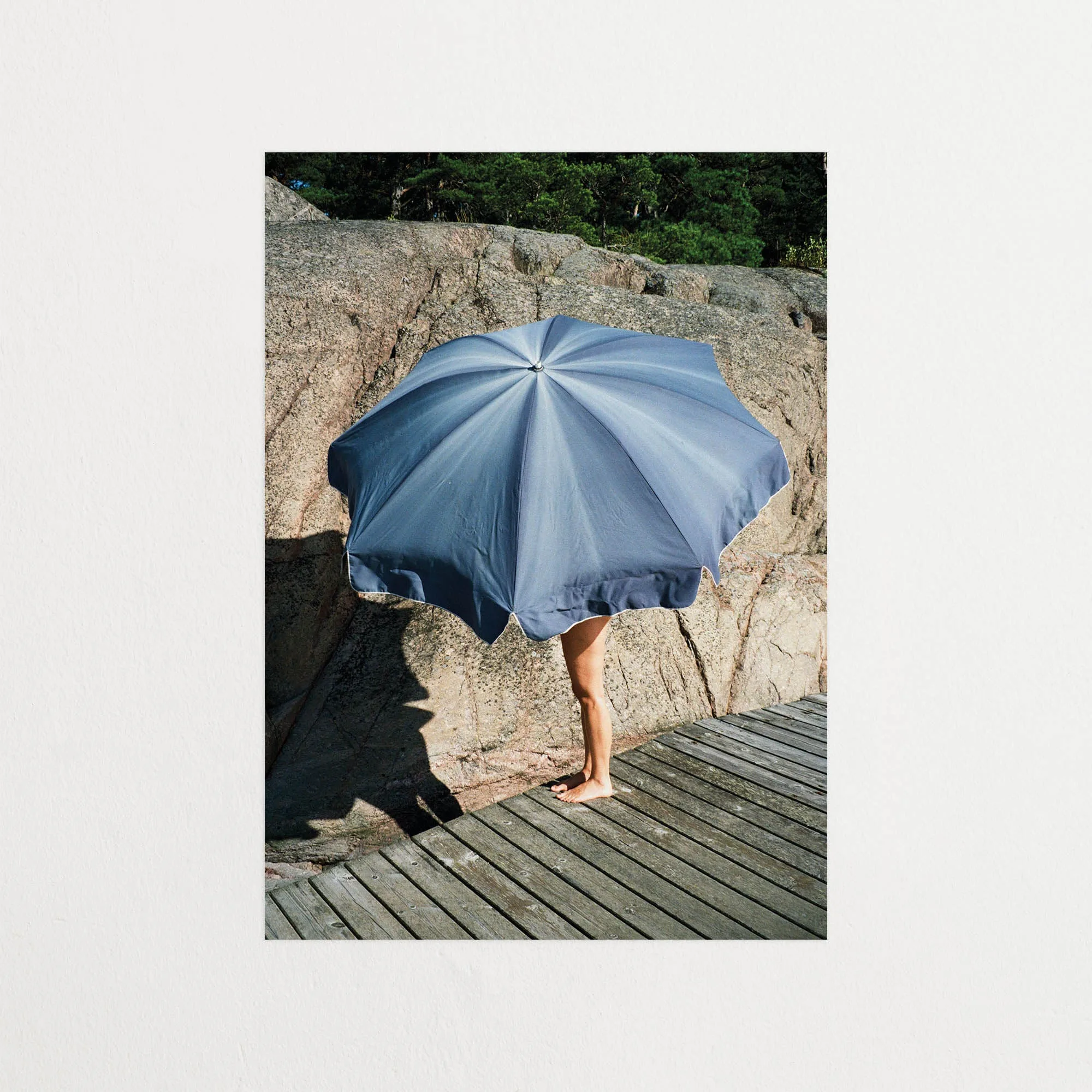
Parasol
-
Parasol: Available sizes: 21x30, 30x40, 40x50, 50x70, and 70x100. These are the only size options confirmed in the supplied record; choose among them based on wall scale rather than guessing at other dimensions.
Styling moves that keep the summer feeling indoors
The goal is to extend the print’s warm-weather ease without turning the room into a themed set. These moves work with the photograph rather than over it.
- Use a thin, light frame: A slim natural-wood or white frame lets the parasol’s shapes and the analog grain stay visible. A heavy dark frame can make the image feel more formal than its summer subject suggests.
- Keep nearby surfaces simple: A pale wall, a linen curtain, or a bare shelf edge gives the print room to read. Coastal poster ideas often pile on shells and rope; with this photograph, one textural element is usually enough.
- Repeat the light, not the literal subject: If you want the room to feel cohesive, echo the print’s soft natural light with a pale rug or a light wood side table rather than adding more parasol or beach imagery.
- Hang at a comfortable viewing height: The supplied product information does not include a recommended hanging height. Use your own eye level and the room’s furniture as the guide, and check the placement from the main seating area before committing to hardware.
Where the Parasol poster works—and where it may not
A sunroom is a natural fit: the print’s Swedish-summer subject and natural-light emphasis suit a room built around daylight. A coastal-inspired living room or a bedroom with pale walls also works, especially in the smaller sizes where the print acts as a gentle accent.
It is a weaker choice for a room with very dark walls and little natural light, where the analog photograph’s quiet tones may flatten, or for a maximalist gallery wall where its shapes will be lost among many competing frames. Those are not flaws in the print—they are placement trade-offs to weigh before you buy.
What to confirm before you hang it
The supplied record does not include framing specifications, hanging hardware, or care instructions for the Parasol poster. Before you commit to a frame or a wall, confirm those details with the retailer or a framer rather than assuming a standard. The size options and the photograph’s subject are the confirmed facts; the rest of the styling is yours to adapt to the room.