What this lion punch set actually does
A pendant blank cutter set is a die block plus shaped punches. You place annealed sheet metal on the block, position the punch, and strike the bevelled end with a mallet. The sharp cutting face shears the sheet into a repeatable lion silhouette — no sawing, filing or freehand layout.
This particular set gives you three lion sizes in one box: roughly 39.7 × 22.8 mm, 30.8 × 17.7 mm and 22.5 × 13.0 mm. That range covers pendants, charms and decorative metalwork where you want the same motif at different scales. The block measures about 76 × 76 mm, and both block and punches are hardened, tempered high-carbon tool steel.
How to cut a clean lion blank, strike by strike
The sequence below follows the supplied care and compatibility evidence for this set. Work on a solid bench that can take a firm mallet strike.
- 1. Anneal your metal first: The set is intended for non-ferrous sheet metal, and the supplied guidance says to anneal before punching. Soft metal shears cleanly; work-hardened sheet can distort or leave a ragged edge.
- 2. Check your gauge: Keep the sheet to 18 gauge (1.02 mm) or thinner. This is the stated cutting capacity of the set, so thicker stock is outside what the punches are confirmed to cut.
- 3. Apply cutting fluid: Use cutting fluid on the cutting face and the sheet. The supplied guidance links fluid with blanks that come away clean and ready for finishing.
- 4. Place the sheet on the die block: Lay the annealed sheet flat on the 76 × 76 mm block. Position the punch over the area you want to convert into a blank, leaving enough margin around the lion for the cutting face to work.
- 5. Strike the bevelled end once, firmly: Each punch has a sharp cutting face and a bevelled end for the mallet. The supplied description says one firm strike per blank, so aim for a single controlled blow rather than a series of taps.
- 6. Lift the blank and repeat: Remove the cut lion and reposition the sheet for the next strike. Because the shape is fixed by the punch, each blank repeats exactly — useful when you need a matched set of charms or pendants.
Sizes and steel in this set
-
Pendant Blank Cutter Set — Lion, 3 Steel Punches, 12-40 mm, Jewellery Sheet Metal: Includes three punch sizes: 39.7 mm, 30.8 mm and 22.5 mm (approximate heights). Three fixed sizes let you scale the same lion motif across a pendant, a charm and a smaller decorative element without changing tools.
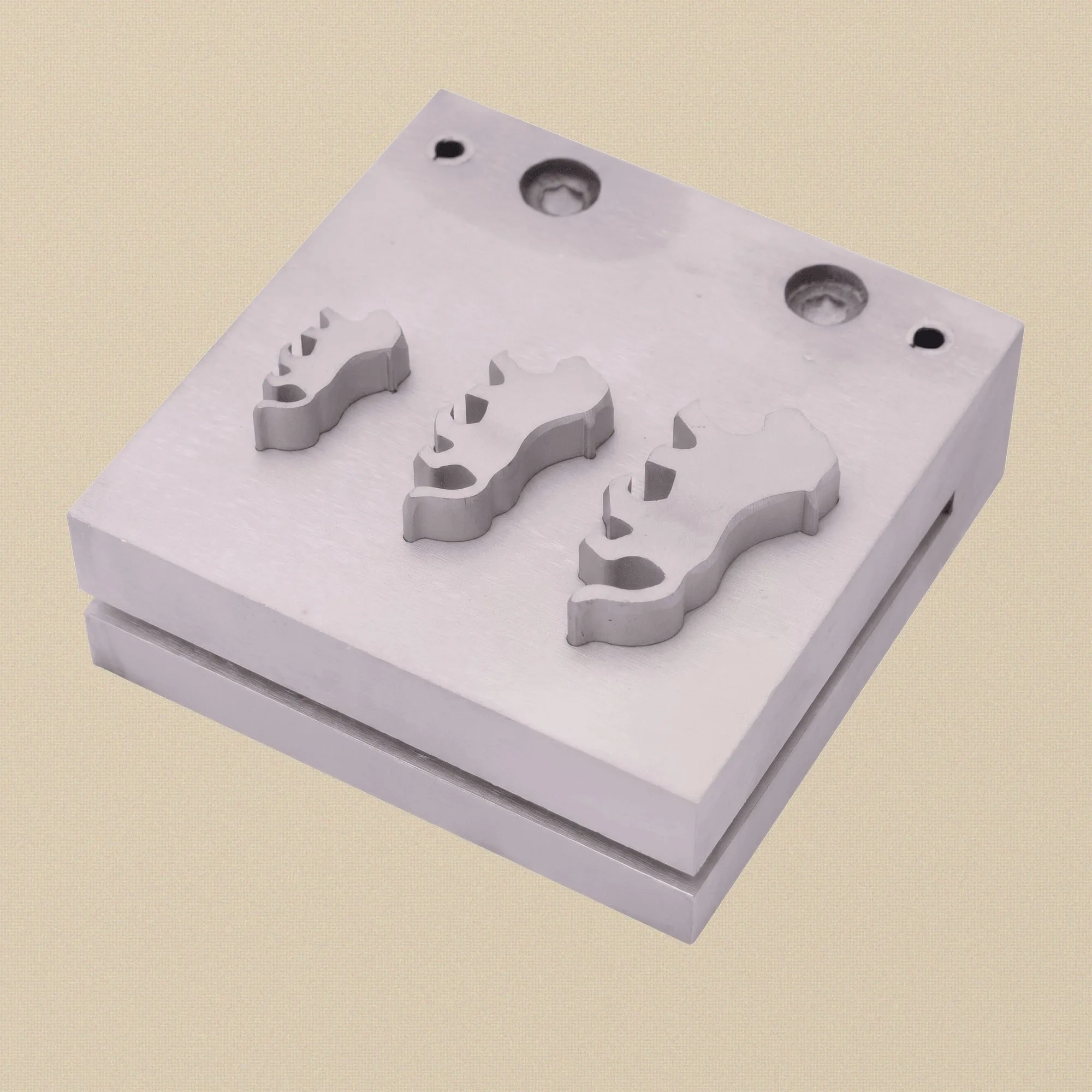
Pendant Blank Cutter Set — Lion, 3 Steel Punches, 12-40 mm, Jewellery Sheet Metal
-
Pendant Blank Cutter Set — Lion, 3 Steel Punches, 12-40 mm, Jewellery Sheet Metal: The solid steel die block measures approximately 76 x 76 mm (3 x 3 inches). The block footprint tells you how much bench space the set needs and how large a sheet area you can support per strike.
-
Pendant Blank Cutter Set — Lion, 3 Steel Punches, 12-40 mm, Jewellery Sheet Metal: Block and punches are machined from hardened and tempered high-carbon tool steel. That material choice is what allows a sharp cutting face to shear sheet metal repeatedly, provided you stay within the 18 gauge limit and use fluid.
Where the set earns its place — and where it does not
This is a production tool for one shape. If you make lion pendants, charms or matched decorative components in runs, the value is in repetition: the same silhouette every time, with no layout or sawing. It also removes the hand-cutting stage that the supplied description calls tedious.
The trade-off is flexibility. The set cuts non-ferrous sheet up to 18 gauge (1.02 mm) and nothing else is confirmed in the supplied information. It is not a general blank cutter for other silhouettes, and it is not a substitute for a disc cutter or a saw when you need a different outline. If your work changes shape often, a shaped blank cutter or a sawing setup will serve you better; if you need one motif at three sizes, this set is the direct route.
Keeping the punches and block ready for the next run
The supplied care evidence is short and specific: anneal the metal, stay at 18 gauge or thinner, and use cutting fluid. Those three habits protect the cutting face and give you clean blanks. After a session, wipe the block and punches and keep them dry — high-carbon tool steel is chosen for hardness and edge retention, not for corrosion resistance. Store the punches so the cutting faces are not knocking against each other.
If a strike does not cut cleanly, check the metal before blaming the tool: confirm it is annealed, confirm it is 18 gauge or thinner, and confirm you used fluid. Those are the variables the supplied evidence identifies. Do not force a second heavy strike on the same spot without rechecking the sheet.