Quick answer
Choose perforated leather baby sandals with touch fastening when you want breathable coverage and an adjustable fit for warm-weather outings. For early first steps, prioritize a flexible sole and a secure heel hold over extra cushioning.
Why perforated leather matters for warm days
Perforations add airflow without exposing the foot the way open sandals do. That makes perforated baby sandals a middle ground: more protection than strappy styles, less heat buildup than closed leather shoes.
The trade-off is that perforated leather still needs care. Wipe them after dusty park days and let them air-dry away from direct heat.
When touch fastening helps—and when it doesn't
Touch fastening baby sandals are quicker to put on a wriggling baby and easier to adjust over a high instep. But a strap that is too long or too stiff can rub, so check that the closed strap sits flat against the foot.
If your baby has very narrow feet, touch fastening alone may not give enough hold. Look for a style that also has a secure heel or ankle strap.
First steps: what to prioritize over perforation
For first steps sandals baby, sole flexibility and a close fit matter more than breathability. A sandal that is too long or too loose can make early walking harder.
Perforated leather sandals work best as everyday warm-weather footwear once your baby is cruising or taking confident steps. For the very first unsupported steps, consider a softer, more enclosed pre-walker shoe.
Decision rules for buying perforated leather baby sandals
- Check toe room first: Press the sandal tip while your baby stands: you want about a finger's width (roughly 1 cm) of space beyond the longest toe. If you can't feel any gap, size up. Recheck toe room every 6–8 weeks during rapid growth.
- Test the fastening: Fasten the touch fastening over the foot and try to slip the heel out. If the sandal lifts off easily, the strap is too loose or the shape is too wide for your baby's foot.
- Match the sole to the stage: For cruising and early steps, choose a sandal that bends easily at the ball of the foot. For confident walkers, a slightly firmer sole is fine.
- Decide on perforation vs. open sandals: Pick perforated leather when you want protection from playground surfaces and sun. Pick open sandals if your baby runs hot or you need quick drying after water play.
- Confirm the size chart before ordering: Measure both feet at the end of the day and compare to the product's size options. If your baby is between sizes, choose the larger size only if the fastening can tighten enough to hold the heel.
Product facts
-
BabyWalk Perforated Touch-Fastening Classic Leather Baby Sandals: Leather upper is soft and flexible, with a classic shape. A flexible leather upper is easier to adjust around growing feet and pairs with everyday outfits.
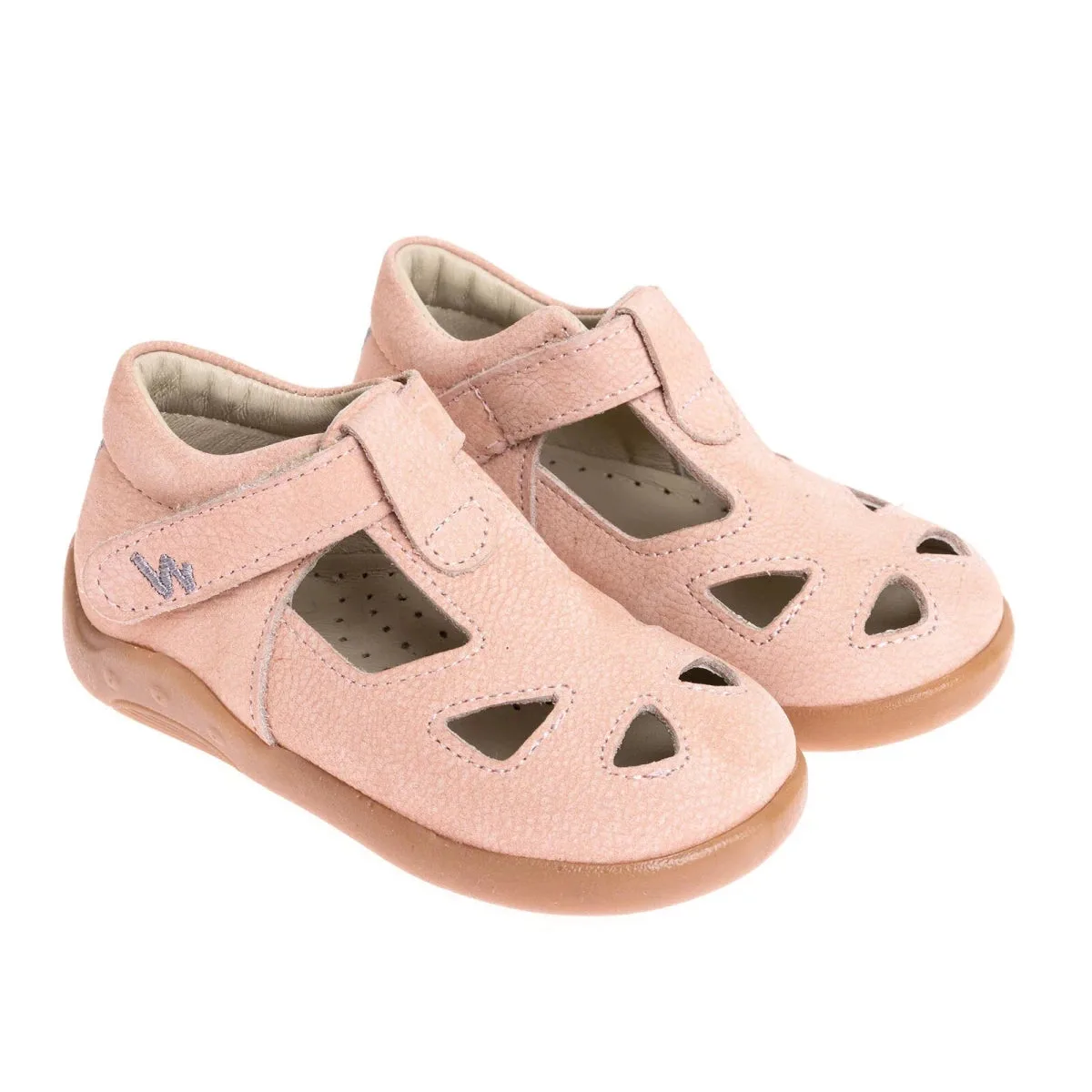
BabyWalk Perforated Touch-Fastening Classic Leather Baby Sandals
Who perforated leather baby sandals suit
Best for
- Babies cruising or taking first steps in warm weather
- Parents who want breathable coverage for park and stroller days
- Babies with average-width feet who need quick, adjustable fastening
Not for
- Very narrow feet that need a tighter heel hold than touch fastening provides
- Water play or muddy days where quick-drying open sandals are more practical
- Babies who are not yet standing, who need soft flexible pre-walkers instead