Quick answer
Name the cat, acknowledge the specific loss, and offer one concrete kind of help. Keep the message short, sincere, and free of comparisons or advice.
Why pet loss needs different wording than a human sympathy card
A friend grieving a cat often hears 'it was just a pet,' so your card should do the opposite: treat the loss as real. That means using the cat's name, referring to the daily routines they shared, and avoiding language that ranks grief. You do not need to explain the bond; simply acknowledging it is enough.
Pet sympathy card etiquette also allows more warmth and specificity than a formal condolence note. A short memory or a mention of the cat's personality can comfort more than a long paragraph of general sympathy.
What to leave out, even when you mean well
Skip 'at least you had them for years,' 'you can always adopt another,' and any timeline for feeling better. These phrases minimize the loss or rush the griever. Also avoid medical questions about how the cat died unless your friend brings it up first.
If you did not know the cat, say so honestly and focus on your friend's feelings rather than inventing a memory. A blank card gives you room to write only what is true.
How to write the card, step by step
- Open with the cat's name: Write 'I'm so sorry about [cat's name]' in the first line. Using the name signals that you see the loss as specific and real. Checkpoint: if you never knew the cat's name, ask a mutual friend before writing rather than guessing. A name in the first sentence does more than a whole paragraph of general sympathy.
- Add one true detail about the cat or the bond: Mention a habit, a photo, or a routine your friend shared with the cat, such as greeting them at the door. Keep it to one sentence. Checkpoint: do not invent a memory you do not have; a simple 'I know how much you loved [name]' is enough.
- Name the loss plainly: Use words like 'died' or 'loss' rather than 'passed on' if that matches your friend's style; plain language often feels more respectful than euphemism. Checkpoint: avoid 'just a cat' or 'fur baby' if you are unsure how your friend talks about the cat.
- Offer one specific, low-pressure help: Suggest something concrete, such as dropping off dinner or taking a walk together, and add 'no need to reply.' Checkpoint: do not offer help you cannot follow through on; one reliable offer beats several vague ones. A specific offer is easier to accept than 'let me know if you need anything.'
- Close simply and sign your name: End with 'Thinking of you' or 'With sympathy,' then sign. Leave the card blank inside until you are ready to write, and use a pen that will not smudge on the recycled paper. Checkpoint: reread once for any phrase that ranks or rushes the grief.
A card that fits the message
-
Sorry You Lost Your Friend (Cat) Greeting Card: Blank inside with a gold foil accent and a kraft envelope. The blank interior lets you write the cat's name and a personal memory without working around printed verses.
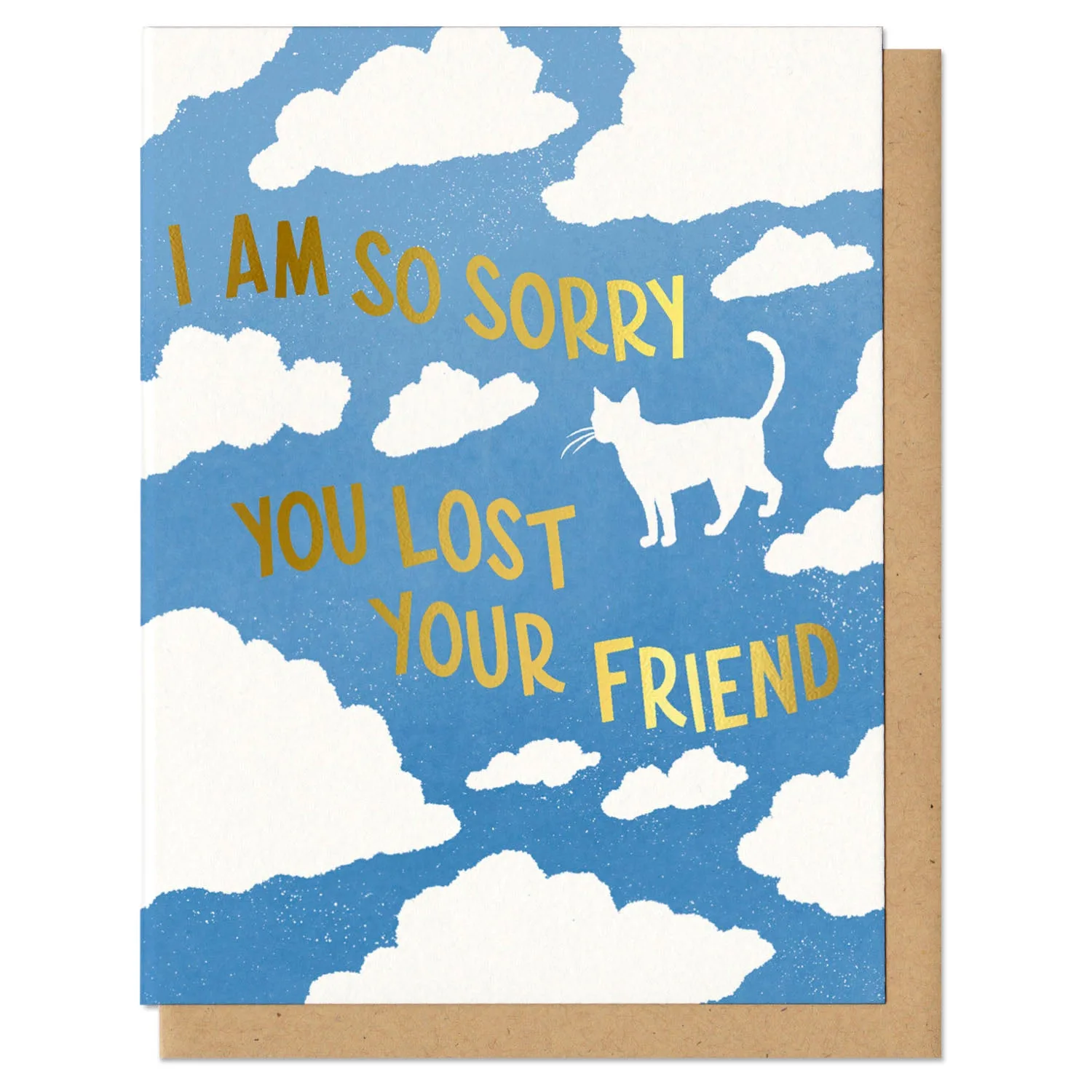
Sorry You Lost Your Friend (Cat) Greeting Card