
Quick answer
Start by letting your toddler explore the Peter Rabbit Letter P and Number 6 as tactile toys, then weave short, playful prompts into daily routines: trace the P, count to six, and link the characters to stories. Keep sessions brief and follow your child’s interest.
Why these two wooden toys work well together
The Peter Rabbit Letter P and Number 6 are part of a coordinated wooden range, so they share a consistent look and feel. That consistency helps toddlers focus on the shape and name of the symbol rather than being distracted by wildly different designs. The letter P features Peter Rabbit, while Number 6 features Jemima Puddle-Duck, giving you two familiar characters to anchor play.
Because both are made from FSC-certified wood, they are sturdy enough for handling by small hands. The painted pastel colours are visually appealing without being overstimulating, which supports focused play. Use them side by side to introduce the idea that letters and numbers are different kinds of symbols, even when they look similar in size.
When to keep play short and simple
Toddlers have short attention spans, so aim for 5–10 minute bursts rather than formal lessons. If your child loses interest, stop and return later. Forced repetition can backfire; instead, leave the toys accessible so your child can pick them up independently. This also applies if your child is closer to 3 or 4—they may be ready for slightly longer, more structured games, but still follow their lead.
How to play: step-by-step
- Introduce the toys through free exploration: Hand your toddler the Letter P and Number 6 and let them hold, turn, and inspect each one. Name the letter and number clearly: “This is P. This is six.” Avoid quizzing them at this stage—just label. Checkpoint: your child should be comfortable holding both toys before you move on.
- Trace the shapes with a finger: Guide your child’s finger around the curve of the P and the loop of the 6. Say the letter sound or count aloud as you trace. Common mistake: rushing the tracing—go slowly and let your child lead. Checkpoint: your child attempts to trace at least part of the shape on their own.
- Link the P to Peter Rabbit: Point to Peter Rabbit on the P and say, “P is for Peter.” Ask your child to find the P when you say “Peter Rabbit.” This builds letter recognition through a meaningful character connection. Checkpoint: your child looks at or points to the P when you name Peter Rabbit.
- Count to six with Jemima Puddle-Duck: Point to the 6 and say, “This is six.” Count six objects together—blocks, fingers, or toys. Then ask, “Can you find the six?” Common mistake: expecting perfect counting; focus on the number name and symbol. Checkpoint: your child says “six” or points to the number when prompted.
- Mix and match letters and numbers: Place the P and 6 side by side. Ask your child to hand you the letter or the number. This simple sorting game reinforces the difference between letters and numbers. Checkpoint: your child correctly identifies which is the letter and which is the number.
- Extend play with stories and songs: Use the characters to tell a short story: “Peter Rabbit found six carrots.” Sing a counting song or an alphabet song while holding the toys. Keep it playful and stop if interest fades. Checkpoint: your child stays engaged for at least one story or song.
Product facts
-
Peter Rabbit™ letter P: Features Peter Rabbit painted in pastel colours on FSC-certified wood. The familiar character and soft palette make the letter P inviting for toddlers to handle and trace.
Peter Rabbit™ letter P
-
Peter Rabbit™ Number 6: Features Jemima Puddle-Duck on FSC-certified wood. The character connection gives you a natural story hook when counting to six.
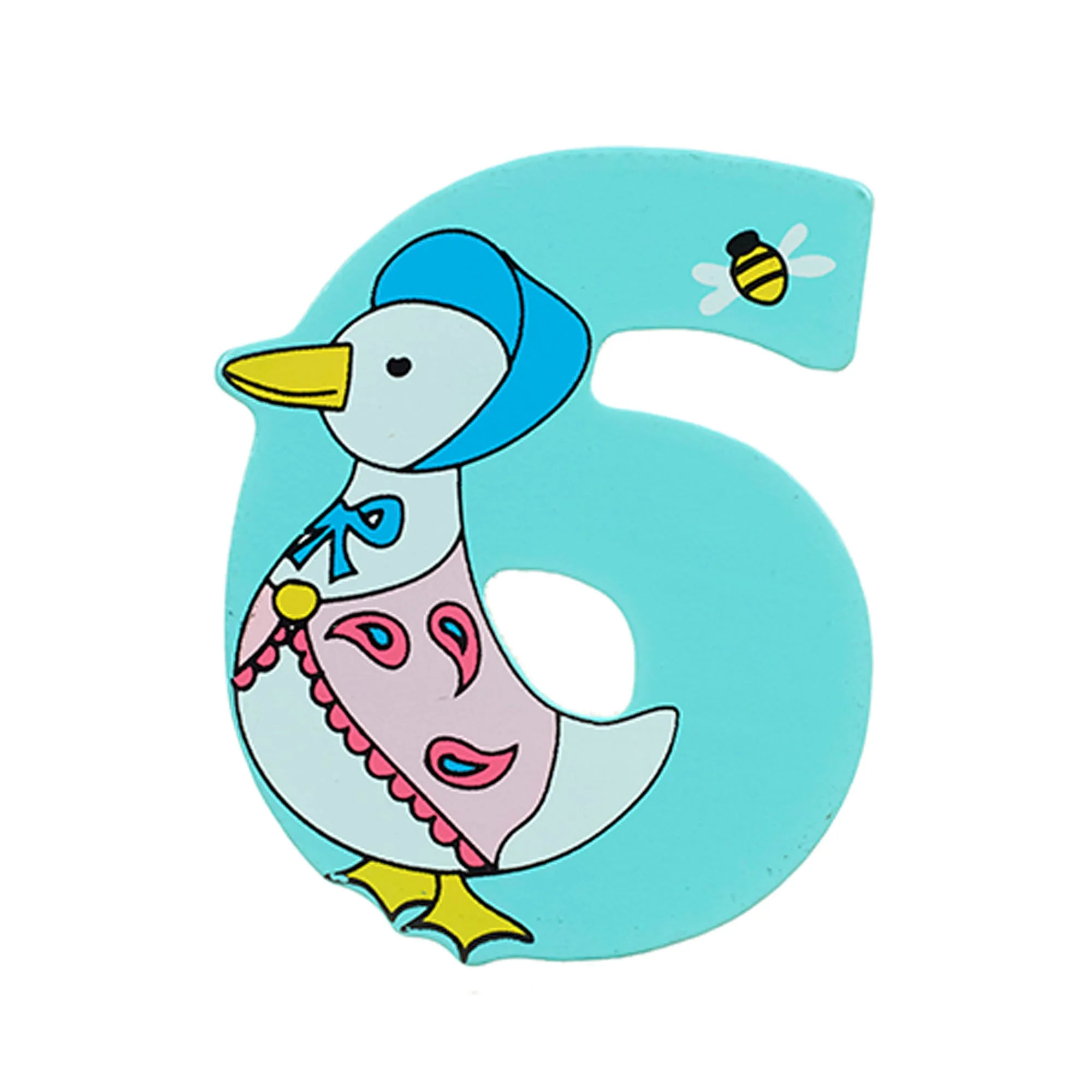
Peter Rabbit™ Number 6