The origin story, checked against the book's own record
PEZ is often remembered as an American candy-counter staple, but the supplied description of PEZ: Austrian Invention to American Icon traces it to Austria in 1927, when it began as compressed peppermint tablets marketed as an alternative to smoking. That claim is the spine of the book's title, and the catalog record supports it directly rather than leaving it as a marketing hook.
The same record describes the U.S. turn: upon arrival in 1952, PEZ added fruit flavors and three-dimensional character heads to top the dispensers. It also notes that the brand is now produced in Orange, Connecticut, and is available in over eighty countries. Those are the concrete timeline points a reader can check against the book's narrative—not independent verification of every page, but a clear statement of what the book sets out to cover.
What the catalog confirms about the book itself
-
PEZ: Austrian Invention to American Icon Book: Soft cover, 6" x 9", 205 pages. This is a portable, substantial paperback—useful if you are judging whether it reads like a shelf reference or a quick browse.
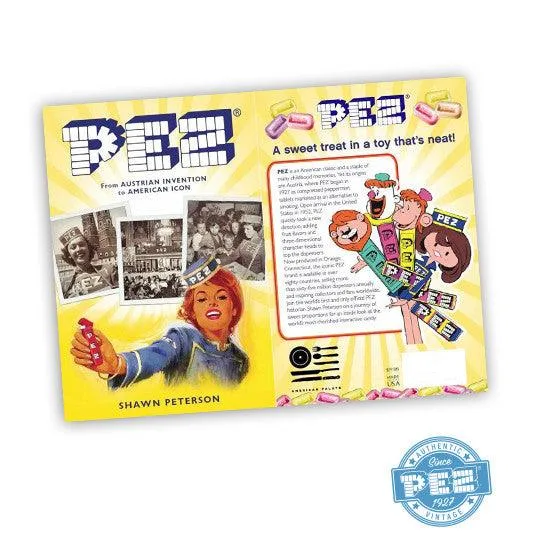
PEZ: Austrian Invention to American Icon Book
-
PEZ: Austrian Invention to American Icon Book: Written with Shawn Peterson, described as the world's first and only official PEZ historian. The book's authority claim rests on that role; the record does not list Peterson's credentials beyond it, so treat the title as context, not a guarantee of exhaustive research.
Where the 'official' label ends and uncertainty begins
The phrase 'official PEZ historian' is the strongest credibility signal in the supplied information, and it is worth separating from claims the record does not make. Nothing in the catalog states that the book is independently fact-checked, peer-reviewed, or updated for 2026. It also does not specify edition, publication date, or whether the 205 pages include an index or source notes.
That matters for a myth-busting read: the book can support the Austria-to-Connecticut arc because the catalog repeats it, but it cannot settle finer collector debates—like exactly which dispenser variations appeared in which year—unless those details are inside the pages. The honest position is that the supplied evidence confirms the broad story and the author's official role, not every specific claim a collector might want verified.
The collector claims the record does not settle
PEZ collector culture often hinges on production details, regional variations, and values. The supplied record gives scale—over eighty countries and more than sixty-five million dispensers sold annually—but it does not list specific dispensers, years of release, or collector pricing. So a reader hoping for a price guide or a variation checklist should not assume this book is that resource; the catalog simply does not say.
Likewise, the record does not describe photo counts, full-color printing, or whether the book covers modern character releases. Those are reasonable questions for a PEZ collector book, and the supplied information leaves them open. That absence is a limit of what we can confirm here, not proof the book omits them.
Who gets real value from this book
- The casually curious fan: If you know PEZ mainly as a childhood memory, the 205-page soft cover and the Austria-to-Orange, Connecticut narrative give you a structured story without requiring collector expertise.
- The gift-giver shopping for a PEZ memorabilia gift: The book's stated focus on the brand's history and its official-historian framing make it a plausible fit for someone who already collects PEZ or candy memorabilia—provided you are comfortable that edition and photo details are not confirmed in the catalog.
- The reader who wants a verified reference: If you need sourced dates for specific dispensers or a price guide, the supplied record does not establish that this book provides them. Treat it as a history narrative first.
A reasonable way to decide before you buy
Ask what you want the book to do. If the answer is 'tell me how PEZ went from Austrian peppermint tablets to American character-headed dispensers,' the catalog's description matches that job and the 6" x 9" soft cover is easy to keep on a shelf or give as a gift. If the answer is 'help me date and value a specific dispenser,' the supplied information does not confirm that level of detail, so check the book's contents or edition before relying on it for that purpose.
One practical note: the catalog lists a single Standard variant, so there is no alternate edition or format to compare within this record. That keeps the buying decision simple, but it also means any edition-specific question has to be answered by the book itself.