Quick answer
Choose the Plat Allongé Quartz if you regularly serve whole fish, long vegetable spears or shared starters and want a plate whose irregular, hand-shaped line becomes part of the table. Choose a round or rectangular platter instead if you need strict stacking, uniform portions or a very formal table setting.
Why an elongated plate changes the way food looks
A long plate gives fish, asparagus and other linear foods room to lie naturally instead of being bent or crowded onto a round surface. That extra length also creates a clear center and two ends, so you can leave space around the food rather than filling every centimeter.
The trade-off is footprint. An elongated plate takes up more table depth than a round plate of similar surface area, so measure your table and your storage before committing.
What the Quartz glaze does, and what it does not do
The Quartz finish is described as a timeless, glossy enamel with fine crazing. Crazing is part of the visual character, not a defect, but it means the surface is not perfectly uniform. If you want a mirror-smooth, identical finish on every piece, this is not the right choice.
The plate is also described as perfect-imperfect, with irregular lines and a trace of the ceramicist's hand. Expect slight variation in shape and glaze from piece to piece. That variation is the point, but it makes the plate a poor match for anyone who needs identical, stackable service pieces.
Where the long shape helps, and where it gets in the way
Long plates shine for whole baked fish, grilled fish, asparagus, spring onions, skewers and composed shared plates. They also work well as a centerpiece for a small selection of cheeses or sliced vegetables.
They are less practical for saucy dishes that need a rim, for individual portions that must look identical, or for tight cabinets. If your priority is everyday durability and easy stacking, a simpler rectangular or round plate will usually serve you better.
Decision rules for buying a long ceramic serving plate
- Match the plate to your most frequent long food: If you cook whole fish or long vegetable spears at least twice a month, an elongated plate earns its space. If most of your meals are stews, pastas or round tarts, a round platter will be used more often. Count your actual long-food meals before choosing length over versatility.
- Measure the table and the cabinet, not just the food: An elongated plate needs more front-to-back room on the table and more shelf depth in storage. Check both before buying; a plate that does not fit the cabinet tends to stay unused. Storage depth is the most common reason long plates get left behind.
- Decide whether variation is a feature or a problem: The Quartz plate is intentionally irregular, with a crazed glaze and visible hand-shaped lines. If you need matching sets for a formal table or strict stacking, choose a more uniform plate instead. Buy this plate for character, not for a perfectly repeatable set.
- Choose the Quartz finish for gloss, not for a pristine surface: The glossy Quartz enamel shows fine crazing by design. If you prefer a matte or perfectly smooth surface, look at other glazes rather than expecting this one to be uniform. Crazing is part of the finish, so do not treat it as a flaw after purchase.
Product facts
-
plat allongé quartz: The Plat Allongé Quartz is a ceramic elongated plate with a glossy, finely crazed Quartz enamel and irregular, organic lines. The glossy crazed surface and hand-shaped outline make it a display piece for fish and long vegetables, but each plate will vary slightly rather than looking factory-identical.
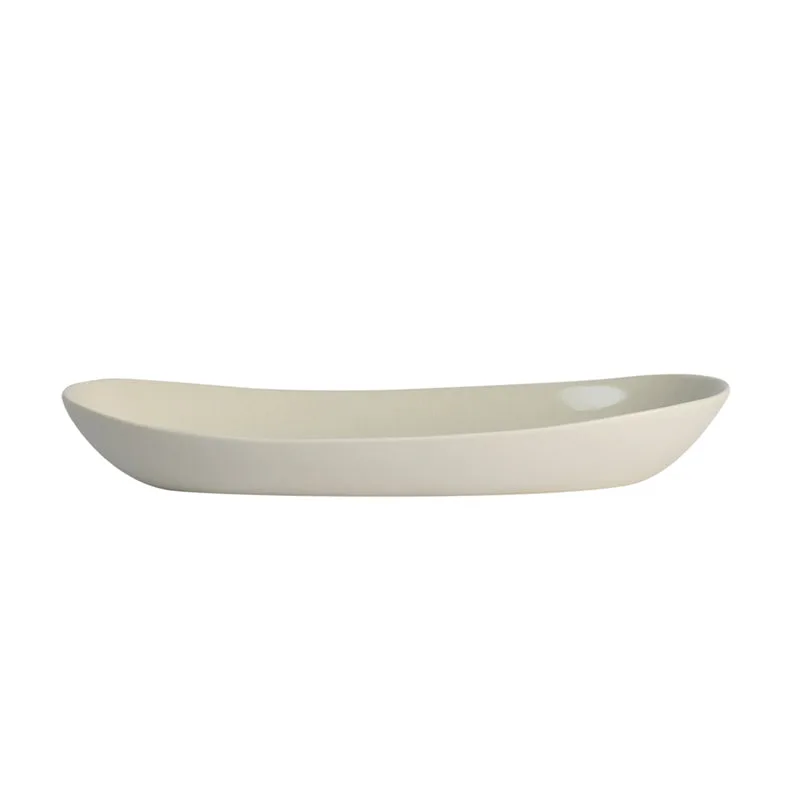
plat allongé quartz
Who should choose the Plat Allongé Quartz
Best for
- Home cooks who serve whole fish, grilled fish or long vegetables regularly
- Hosts who want a serving plate that looks handmade and slightly different each time
- Tables where a long centerpiece plate suits the layout
Not for
- Buyers who need identical, stackable plates for a matching set
- Anyone with shallow cabinets or a narrow table
- Formal settings that require perfectly uniform serving ware