Quick answer
Most pool cover pump failures are caused by a blocked intake, an air lock, or a tripped GFCI. Check these three things first before assuming the pump is broken.
Why pumps stop (and it's rarely the motor)
Submersible cover pumps are simple machines. A 1/3 HP or 1/2 HP motor moves water through an impeller and out a discharge hose. When the pump stops, the motor is usually fine — the problem is something blocking or confusing it. Debris, trapped air, and electrical faults account for roughly 9 out of 10 service calls. Before you order a replacement, run through the quick checks below.
Symptom → Cause → Fix
- Pump won't turn on: Check the water depth. The automatic switch needs at least 4/5" (about 20 mm) of water above the pump base. If the cover is nearly dry, the pump is working correctly. Also check that the power cord is plugged into a working GFCI outlet and that the breaker hasn't tripped. If water is below 4/5", wait for rain or manually add water to test. If the GFCI trips repeatedly, move to the next symptom.
- Pump runs but moves little or no water: Likely a clogged intake screen or an air lock. Remove the pump from the water and inspect the bottom screen for leaves, debris, or algae. Clean it with a brush or rinse it. For an air lock, tilt the pump underwater so trapped air bubbles escape from the discharge port, then restart. If cleaning and bleeding air don't restore flow, check the discharge hose for kinks or blockages.
- Pump cycles on and off rapidly: This usually means the water level is right at the switch threshold (around 4/5"). A small wave or wind shift can cause the pump to start and stop. It's not harmful but can be annoying. Lower the pump deeper into the water or add a short hose extension to move the discharge point farther away. If cycling continues even in deep water, the internal switch may be failing. Consider replacing the pump if it's more than 2-3 years old.
Pump specs that matter for troubleshooting
-
Hexago Automatic Swimming Pool Cover Pump, 1/3HP Submersible Water Pump with Check Valve Adapter & 33FT Power Cord, 2300GPH Water Removal Cover Pump for Pool, Hot Tubs, Rooftops and Water Beds: 1/3 HP motor, 2300 GPH, automatic switch activates at 4/5" water depth and shuts off at 2/5". If water doesn't reach 4/5", the pump won't start. That's not a failure — it's the intended behavior. Also, a low GPH rate means it may struggle if the cover is very large or the hose is long.
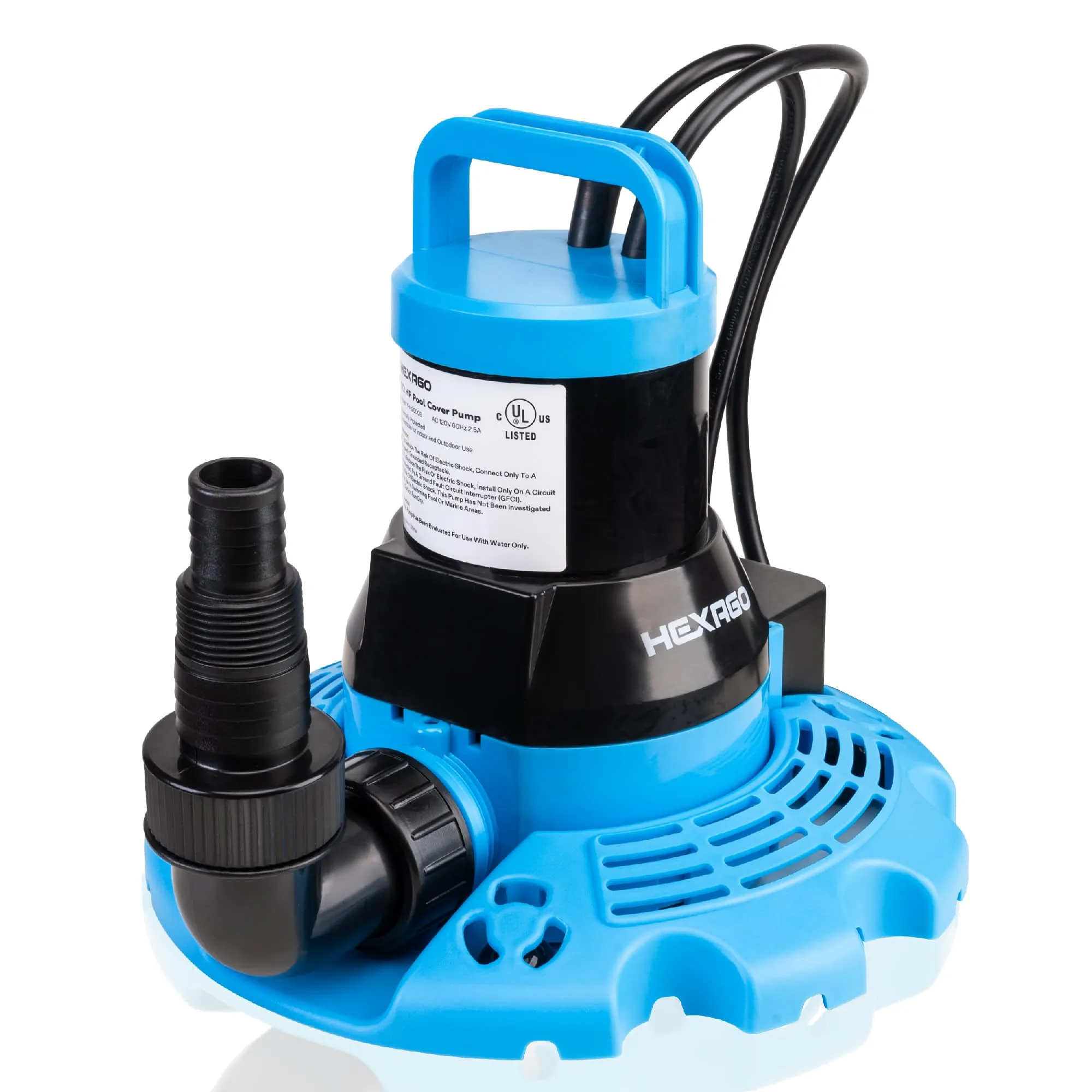
Hexago Automatic Swimming Pool Cover Pump, 1/3HP Submersible Water Pump with Check Valve Adapter & 33FT Power Cord, 2300GPH Water Removal Cover Pump for Pool, Hot Tubs, Rooftops and Water Beds
-
Hexago Automatic Swimming Pool Cover Pump, 1/2HP Submersible Water Pump with Check Valve Adapter & 33FT Power Cord, 3200GPH Water Removal Cover Pump for Pool, Hot Tubs, Rooftops and Water Beds: 1/2 HP motor, 3200 GPH, automatic switch activates at 4/5" water depth and shuts off at 2/5". Higher flow helps clear large covers faster, but the same auto-switch depth applies. If the pump doesn't start, check water depth first.
Hexago Automatic Swimming Pool Cover Pump, 1/2HP Submersible Water Pump with Check Valve Adapter & 33FT Power Cord, 3200GPH Water Removal Cover Pump for Pool, Hot Tubs, Rooftops and Water Beds