Quick answer
To fit a porkchop bowfront L-shaped desk with a pedestal, measure the full 71 by 96 inch footprint, then verify clearance for the right-side pedestal and CPU corner. Use painter's tape to outline the exact dimensions on your floor before buying.
Why the bowfront shape changes your measuring approach
A bowfront desk curves outward at the seating edge, so the widest point is not the back edge. When measuring, account for the deepest part of the curve, not just the straight back. This is especially important in tight rooms where the curve might encroach on walkways or door swings.
The porkchop bowfront L-shaped desk with full pedestal (right) combines a bowfront main desk with a return that extends to the right. The pedestal sits under the return, adding storage but also requiring legroom clearance. Measure both the desk footprint and the space needed to open pedestal drawers.
Common measuring mistakes to avoid
Many buyers measure only the wall length and forget to check the return depth. The 71x96 L-shaped desk needs 96 inches along the main wall and 71 inches along the side wall. If your room has obstacles like radiators or baseboards, measure from the wall surface, not the floor trim.
Another mistake is ignoring the right pedestal. Since the pedestal is on the right, you'll need clear space on that side for the drawers to open. Also, check that the CPU corner extension does not block access to power outlets or ventilation.
Step-by-step measuring process
- Measure the primary wall: Use a tape measure to record the length of the wall where the main desk will sit. The desk requires 96 inches along this wall. Checkpoint: ensure the measurement is taken at floor level and includes any baseboard protrusions. If the wall is shorter than 96 inches, consider a smaller desk or an alternative layout.
- Measure the side wall: Measure the perpendicular wall where the return will extend. The return requires 71 inches. Checkpoint: verify that the corner is square; if not, the desk may not sit flush. Account for any obstructions like outlets or switches that could interfere with the return.
- Mark the footprint with tape: Use painter's tape to outline the full 71x96 rectangle on the floor, including the bowfront curve (extend the tape outward at the center of the main desk). Checkpoint: walk around the outline to ensure comfortable clearance for chairs and traffic. Leave at least 36 inches of clearance in front of the desk for chair pull-out.
- Check pedestal clearance: The right pedestal requires space to open drawers. Measure from the right edge of the desk to the nearest wall or furniture; ensure at least 18-24 inches for drawer access. Checkpoint: confirm that the pedestal location does not block the CPU corner extension. If space is tight, consider a pedestal that opens to the front rather than the side.
- Verify delivery path: Measure doorways, hallways, and stairwells along the delivery route. The desk's largest component (likely the main top) may be up to 96 inches long. Checkpoint: ensure all passages are at least 2 inches wider than the package. If the path is too narrow, ask about disassembly options or choose a desk that ships in smaller sections.
Product facts
-
Porkchop-Bowfront L-Shaped Desk with Full Pedestal (Right)—71″x96″: Fully assembled dimensions are 71 x 96 inches. This means you need at least a 71 by 96 inch clear area, plus extra room for the bowfront curve and pedestal clearance.
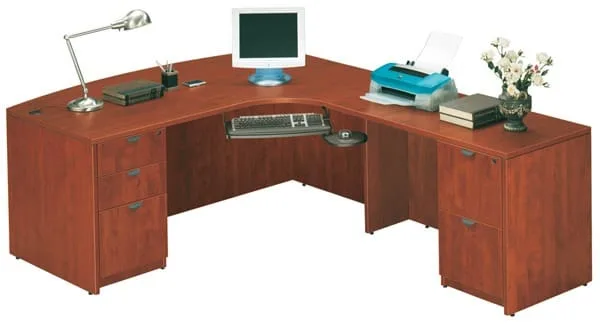
Porkchop-Bowfront L-Shaped Desk with Full Pedestal (Right)—71″x96″