Quick answer
mAh (milliampere-hour) measures how much charge a battery can store, not how many times it will refill your phone. A 16,000mAh power bank is a sensible middle ground for most people: enough for several phone charges or a tablet top-up without becoming a brick. If you only need one emergency phone charge, a smaller 10,000mAh bank is lighter and cheaper.
What mAh actually tells you (and what it doesn’t)
mAh is the battery’s storage rating. To estimate real-world recharges, divide the power bank’s mAh by your phone’s battery mAh, then knock off roughly 30–40% for conversion losses and heat. A 16,000mAh bank typically refills a 4,000mAh phone about three times, not four. That gap is normal, not a fault.
Capacity also says nothing about speed. A high-mAh bank with a low-amperage port can charge slower than a smaller bank with a fast USB-C port. Check the output rating (measured in amps or watts) alongside the mAh figure.
How to estimate the capacity you need
Start with your daily battery drain. If your phone drops to 20% by dinner, you need about one full charge in reserve. If you tether a tablet, add its battery size too. For a weekend trip without mains power, multiply your daily need by the number of days and add one buffer charge.
Then weigh that number against portability. A 16,000mAh bank is usually pocketable in a bag but noticeable in a jacket. A 20,000mAh+ bank often crosses into ‘leave it in the hotel’ territory. The best capacity is the one you’ll actually carry.
The trade-offs beyond mAh
Two banks with the same mAh can behave very differently. Look at the number of output ports, the maximum amps per port, and whether the bank supports pass-through charging (charging itself and a phone at once). If you share a bank with a partner, two ports matter more than raw capacity.
Eco-credentials are another factor. Some manufacturers now use recycled plastics or lower-impact packaging. That doesn’t change the mAh, but it can tip a close decision if sustainability is part of your buying criteria.
Decision rules for choosing power bank capacity
- You charge one phone and want a light bag: Choose 10,000mAh or less. You’ll get roughly two phone charges and barely notice the weight. Best for commuters and day trips.
- You want several charges or tablet top-ups: Aim for 16,000–16,800mAh. That covers a long weekend or a full day of heavy phone use plus a tablet. The sweet spot for most buyers.
- You need to charge two devices at once: Prioritise dual ports and a fast output (2.4A or higher) over chasing the highest mAh number. Shared use changes the spec that matters.
Two capacity examples from the Juice range
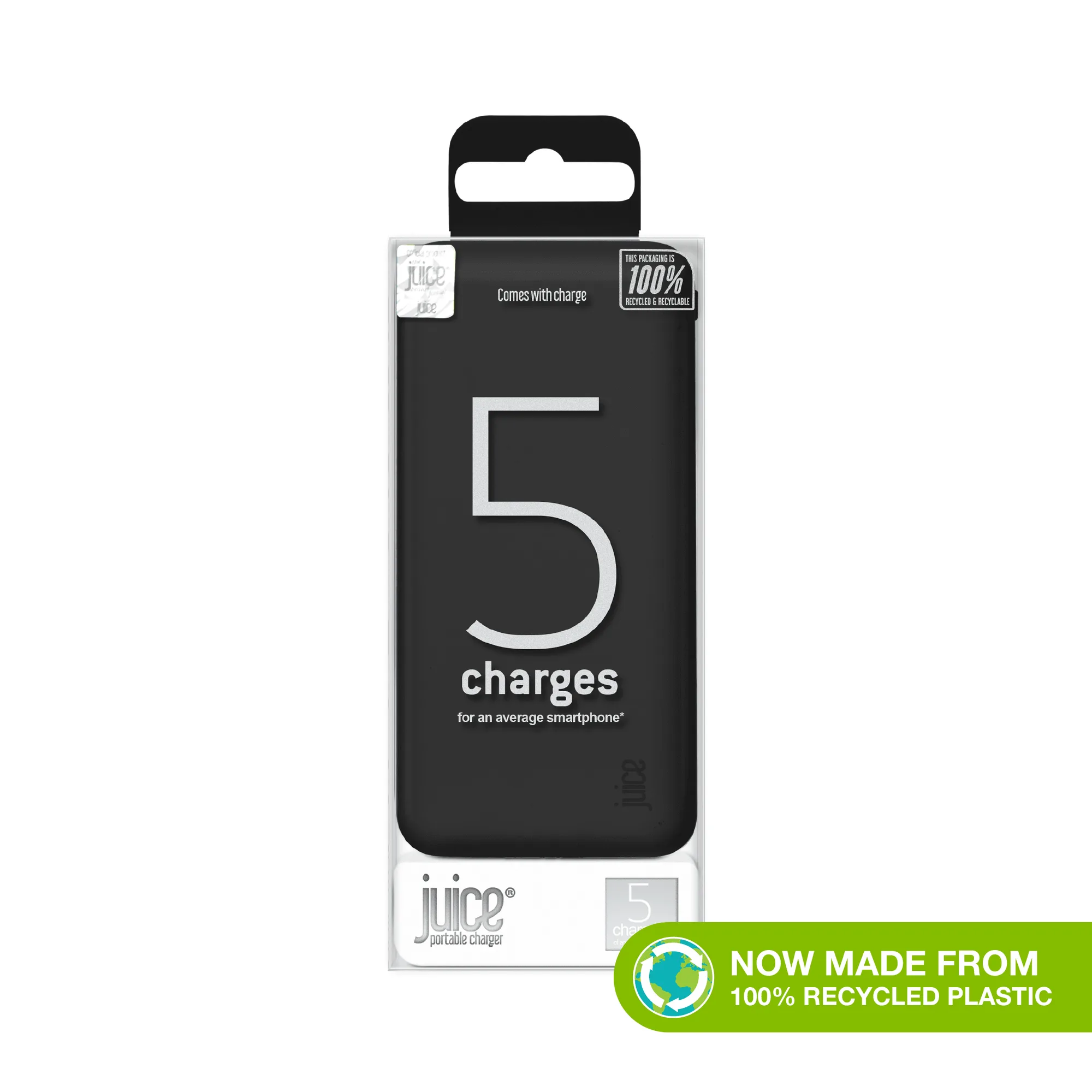
- Juice ECO 5 Charge Power Bank – 16,000mAh: 16,000 mAh capacity in a compact, eco-focused design with a black finish. A practical middle ground: enough for multiple phone charges or a tablet top-up, and small enough to carry daily.
- Juice Power Station XL Power Bank – 16,800mAh: 16,800 mAh with an integrated fast 2.4A USB port and the ability to charge two devices at once. Slightly more capacity and dual-device charging suit shared use or trips where you carry both a phone and a tablet.
Who this advice fits
Best for
- Anyone comparing power banks by mAh and unsure how many recharges that means
- Travellers who want one bank for a phone and a tablet
- Shoppers deciding between 10,000mAh and 16,000mAh
Not for
- Laptop users who need AC output or 60W+ USB-C power delivery
- Buyers who only need a single emergency top-up and want the smallest possible bank