Plan the table before you open the box
The Prairie Sky puzzle finishes at 50x70 cm (19.75x27.5"), so measure your work surface before you tip out 1000 pieces. A standard dining table works; a coffee table usually does not leave room for sorted piles around the assembled frame.
The box has a magnetic closure and includes a poster. Keep the poster out as your reference instead of passing the lid around, and use the lid itself as a tray for pieces you have not sorted yet.
What you are working with
-
Prairie Sky | 1000-Piece Puzzle | Designed in AB Canada: 1000 perfect-fit pieces with a matte, textured finish for less glare The matte surface matters here: a sunset scene is mostly soft gradients, and less glare makes it easier to read subtle color shifts under a lamp.
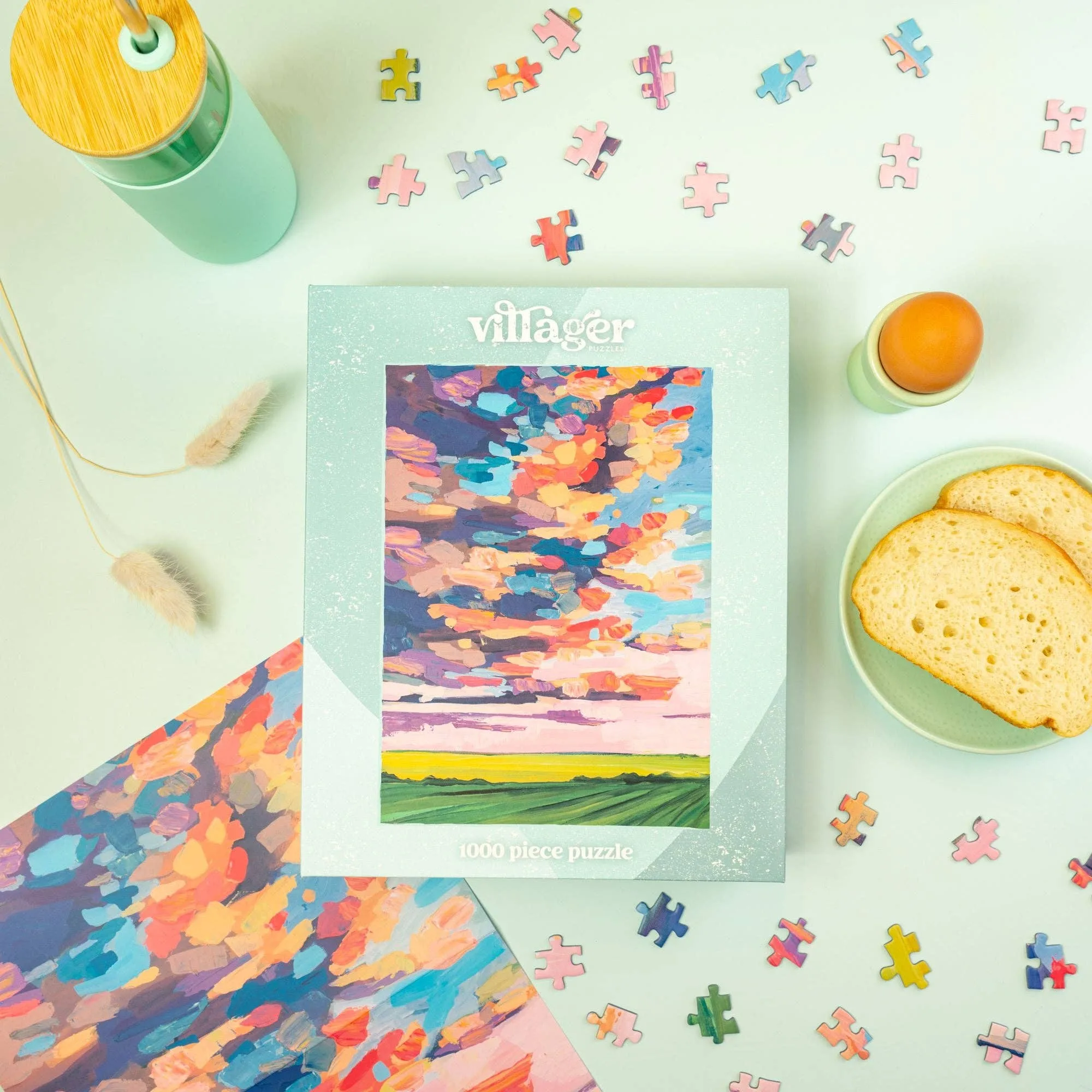
Prairie Sky | 1000-Piece Puzzle | Designed in AB Canada
-
Prairie Sky | 1000-Piece Puzzle | Designed in AB Canada: Painted by Edmonton artist Amy Dixon, showing open fields and cotton candy skies of the Canadian prairies Knowing the scene is sky above, fields below tells you the two big sorting groups before you look at a single piece.
A sky-first sorting plan
Work in two passes. The first pass is fast and rough; the second is where the real sorting happens.
- Pass 1: edges and orientation: Flip every piece picture-side up and pull out the border pieces. Set them aside as one pile rather than building the frame immediately.
- Pass 2: split sky from field: Sort the remaining pieces into sky and open field. The horizon line gives you a natural divider, so pieces with both sky and land belong in a third pile.
- Pass 3: grade the sky: The cotton candy sky shifts through warm tones. Sort sky pieces into light, mid and deep color bands and lay each band in its own row.
- Pass 4: field texture last: Open fields are the hardest section because the color repeats. Leave them until the sky and horizon are placed, then match pieces to the gaps that remain.
Using the matte finish and the poster together
- Light from the side, not overhead: A matte, textured finish reduces glare, but a lamp directly above still flattens contrast. Angle your light so color differences in the sky stay visible.
- Mark your place on the poster: The included poster is your map for the gradient bands. Compare a piece's tone against the poster rather than against the piece beside it.
- Build the horizon early: The line where sky meets field anchors both halves. Once it is placed, every sky piece has a reference edge to work toward.
When the open fields stall your progress
Large single-color areas are where most 1000-piece puzzles slow down, and the prairie fields are exactly that. Rather than forcing it, switch to assembling small clusters of two or three connected pieces wherever you find them, then slide those clusters into the frame as a group.
If you need a break, work the frame and the horizon instead. Coming back to the fields with fresh eyes often makes the texture differences easier to spot.
Storing a part-finished puzzle
The supplied product information does not include a storage mat or a roll-up method, so plan to leave the puzzle flat on a board you can move. A large sheet of cardboard under the puzzle lets you slide it off the table between sessions without disturbing the assembled sections.
The magnetic closure box is handy for keeping loose pieces contained, but the box is not described as a sorting tray system, so separate bowls or shallow containers will serve you better while you work.
Who this puzzle suits
The soft sunset palette makes this a good choice if you enjoy color-gradient sorting more than busy, high-detail scenes. If you prefer puzzles packed with distinct objects and patterns, the open fields may test your patience.
As a gift, the prairie theme and the Edmonton artist credit give it a local angle that pairs naturally with Canadian and prairie-themed decor. The supplied information does not list an age range or safety warnings, so check the box itself if you are buying for a child.