Quick Answer
Install the 10AN to ORB 90-degree swivel fitting by first lubricating the O-ring, then threading the ORB end into the port hand-tight, and finally tightening to the manufacturer's torque spec while holding the fitting body to avoid twisting the hose. Use the swivel feature to clock the 90-degree outlet for optimal hose routing before final torque.
Why the Swivel and 90-Degree Bend Matter for Routing
A 90-degree swivel fitting solves two common problems: tight spaces that won't accept a straight fitting, and the need to route a hose without kinks or sharp bends. The swivel allows the outlet to rotate independently of the threaded ORB end, so you can aim the hose in the best direction after the fitting is installed. This is especially useful for oil catch cans, valve covers, and fuel systems where clearance is limited. Without a swivel, you'd have to compromise on hose path or use additional adapters, which add potential leak points.
Key Differences Between AN Flare and ORB O-Ring Seals
AN flare fittings seal metal-to-metal at a 37-degree flare, while ORB (O-Ring Boss) fittings use an O-ring to seal against a flat port face. This means installation torque and technique differ: ORB fittings require a lubricated O-ring and should not be over-tightened, as that can damage the O-ring or distort the port. Always verify you have the correct port type—ORB ports are straight-threaded with a flat sealing surface, not tapered pipe thread. Mixing them up will cause leaks.
Step-by-Step Installation Guide
- Prepare the Port and Fitting: Clean the ORB port and inspect the O-ring for damage. Apply a thin coat of clean oil or assembly lube to the O-ring. Common mistake: installing dry, which can cause the O-ring to bind and leak. Always lubricate the O-ring before installation.
- Thread the ORB End by Hand: Carefully thread the ORB end into the port by hand until it seats. Do not use tools yet. Checkpoint: The fitting should turn smoothly without resistance; if it binds, stop and check for cross-threading. Hand-tight is the starting point for proper torque.
- Clock the 90-Degree Outlet: Rotate the swivel portion to aim the outlet in the desired direction for hose routing. Ensure the hose path avoids sharp bends and heat sources. Common mistake: finalizing the angle before tightening the ORB nut, which can change during torque. Set the angle after the ORB end is seated but before final torque.
- Torque the ORB End: Hold the fitting body stationary and tighten the ORB nut to the manufacturer's specification (consult your service manual). If no spec is available, use a torque wrench and apply moderate force—typically 15-20 ft-lbs for 10AN ORB, but verify with your application. Common mistake: over-tightening, which can crush the O-ring or damage threads. Always use a torque wrench and never guess.
- Connect the Hose and Check for Leaks: Attach the hose to the AN flare side using proper AN hose ends and tighten. Pressurize the system and check for leaks at both connections. Checkpoint: Re-torque if any seepage appears, but do not exceed spec. Perform a leak test before final assembly.
Product Facts
-
Precision Works 10AN Fitting -10AN to ORB O-Ring 90 Degree Swivel: Precision Works 10AN to ORB Adapter features a 90-degree angle and 360-degree swivel O-ring for leak-free installation. The swivel lets you route the hose after tightening the ORB end, reducing kinks and stress on the connection.
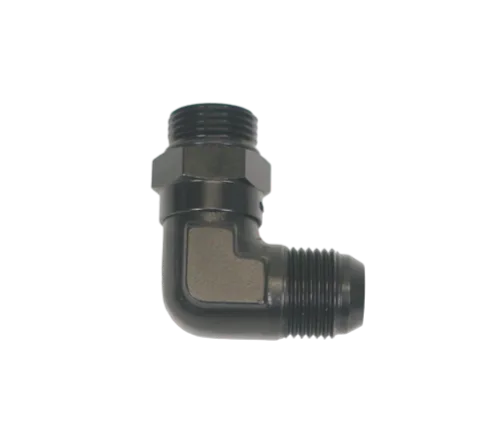
Precision Works 10AN Fitting -10AN to ORB O-Ring 90 Degree Swivel