Quick answer
Install the Precision Works H22 timing belt tensioner by removing the upper timing cover, relocating the alternator to the lower position, and replacing the stock tensioner with the billet unit. Do this at the same time as a timing belt service, and check for slack or noise before buttoning everything up.
Why the H22 tensioner deserves attention
The H22A4 and other H-series engines use a timing belt that relies on a tensioner to keep slack in check. Over time, the stock tensioner can lose its ability to hold tension, leading to a loose belt that may jump teeth or cause poor running. A worn tensioner often shows up as a ticking or rattling noise from the timing cover area, especially at idle. If you ignore it, the belt can wear prematurely or fail, which risks valve and piston damage on these interference engines.
The Precision Works tensioner is a CNC-machined 6061 billet aluminum piece with a hard anodized finish and an integrated walk block to prevent the belt from slipping sideways. It is designed for H22 and H23 VTEC (Blue Top) engines, but it requires two changes: the alternator must be relocated to the lower portion of the engine, and the timing belt cover must be removed or trimmed. That means this is not a direct stock replacement for every H-series car—check your alternator mounting and cover clearance before ordering.
When to replace the tensioner
Replace the tensioner whenever you replace the timing belt, or if you notice symptoms like a chirping or rattling noise from the timing cover, visible belt slack, or the belt walking toward the edge of the cam gears. On a Honda Prelude H22 timing service, it is cheap insurance to swap the tensioner while the belt is off. If the belt has oil contamination or the tensioner pulley feels rough when spun by hand, replacement is overdue. Do not reuse the old tensioner with a new belt—the spring and bearing may already be fatigued.
Tools and preparation
You will need basic hand tools, a torque wrench, a jack and jack stands, and a new timing belt if you are doing the full service. Because the Precision Works tensioner requires relocating the alternator, confirm you have the correct lower alternator bracket and belt for your setup. Also have a way to trim or remove the timing belt cover—some owners cut the cover for clearance, others leave it off entirely. Work on a cold engine, disconnect the battery, and set the engine to top dead center before removing the belt.
Step-by-step H22 tensioner install
- Set engine to top dead center: Rotate the crankshaft until the timing marks on the cam gears and crank pulley align. Remove the accessory belts and the upper timing cover. Common mistake: forcing the crank bolt the wrong way—always turn clockwise. Verify TDC marks before loosening anything.
- Relocate the alternator: Unbolt the alternator from its stock upper position and move it to the lower mounting point. You may need a different length belt and possibly a lower bracket. Check that the alternator clears the axle and hoses. Test-fit the alternator before installing the tensioner.
- Remove the stock tensioner: Loosen the tensioner bolt and remove the stock unit. Keep the bolt and any spacers for reuse if the Precision Works kit requires them. Inspect the block surface for debris. Clean the mounting surface so the new tensioner sits flush.
- Install the Precision Works tensioner: Bolt the billet tensioner into place finger-tight, then torque to the factory specification for the tensioner bolt. Make sure the integrated walk block faces the belt and does not contact the belt edges. Confirm the walk block orientation before final torque.
- Set belt tension: Route the timing belt according to the factory diagram, then adjust the tensioner so the belt has the specified deflection. Rotate the engine two full turns by hand and recheck the marks and tension. Recheck tension after rotating the engine—belts can settle.
- Trim or remove the timing cover: Because the new tensioner sits differently, the stock cover may not fit. Trim the cover for clearance or leave it off. If trimming, use a rotary tool and smooth the edges. Do not force the cover over the tensioner—it can crack.
- Reinstall accessories and start engine: Reinstall the alternator belt, crank pulley, and any covers. Reconnect the battery. Start the engine and listen for unusual noises. Check for belt tracking after a short run-in. Listen for a consistent idle—any ticking means recheck tension.
Product facts
-
Precision Works H22 H-Series Timing Belt Tensioner: Precision CNC machined 6061 billet aluminum with hard anodized finish and integrated walk block. The billet construction resists flex under load, and the walk block helps keep the belt aligned on high-rpm H-series builds.
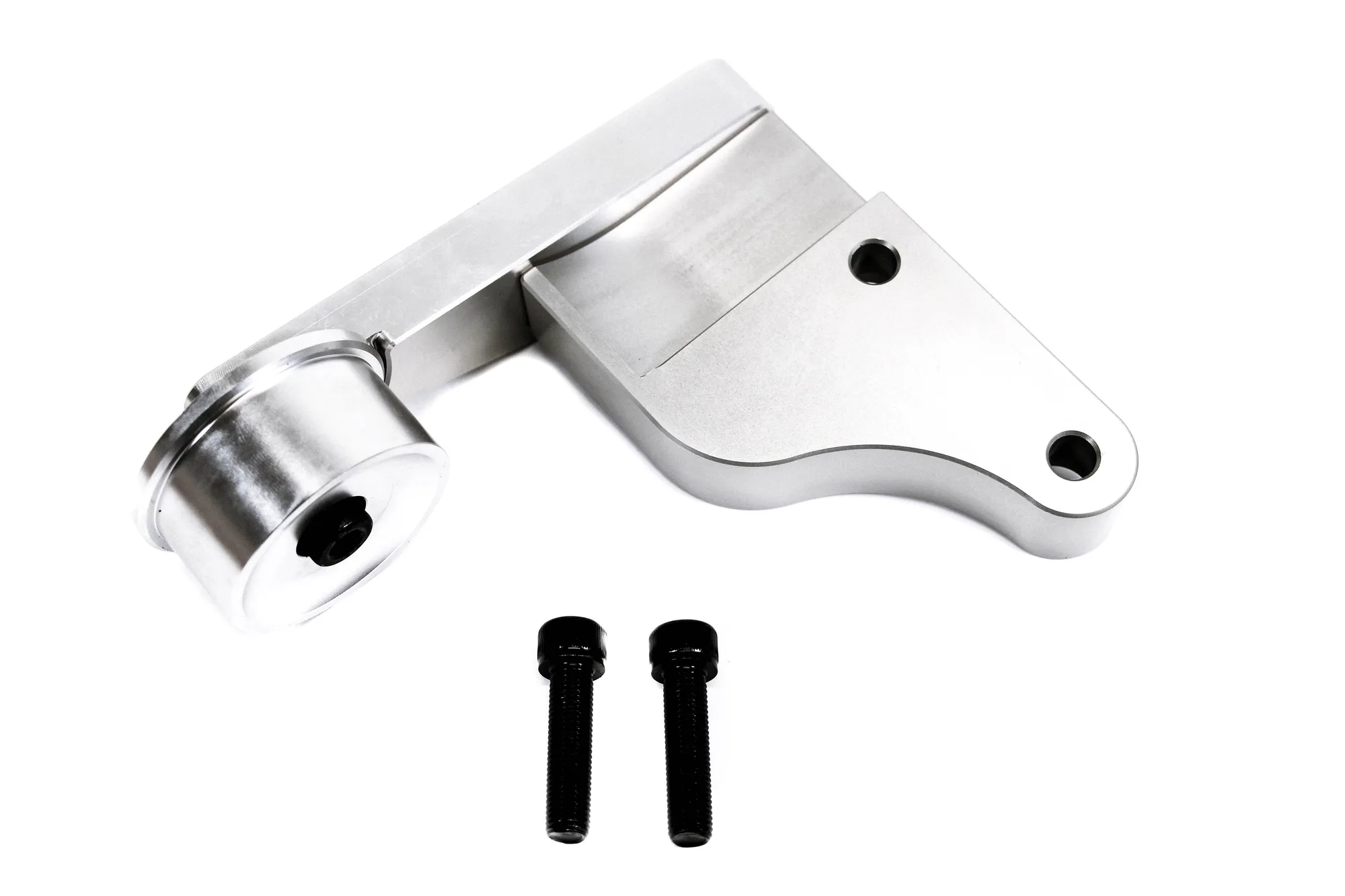
Precision Works H22 H-Series Timing Belt Tensioner
-
Precision Works H22 H-Series Timing Belt Tensioner: Fitment for Honda H-Series H22, H23 VTEC (Blue Top) engines; alternator must be relocated to the lower portion. Check your alternator mounting location before buying—this tensioner is not a direct bolt-on for every H22 car.