Quick answer
Choose a prescription warning label by the single handling instruction the patient must act on: use a take with food label for medications that require food, a refrigerate label for cold storage, a do not freeze label when freezing would damage the product, and an expiration date label when the beyond-use date must be visible on the package.
Why one clear sticker beats a crowded label
Auxiliary labels work best when each sticker communicates one instruction. Stacking several warnings on a small vial can bury the one detail a patient needs at the moment of use. Before you buy a roll, decide which handling messages your prescriptions actually require, then stock only those labels.
The four labels in this guide cover common storage and administration instructions, but they are not a complete warning system. Drowsiness warnings, shake well instructions, and external-use warnings are separate messages; this article focuses on the storage and food-related stickers because those are the ones most often confused with one another.
The trade-off between generic and specific labels
A generic refrigerate label tells the patient to keep the medication cold, but it does not say whether freezing is acceptable. If the product must never freeze, pair the refrigerate label with a do not freeze label or choose packaging that makes the storage range obvious. Adding the second sticker costs a little extra time at the counting station but prevents a patient from storing the medication in a freezer compartment.
Expiration date labels are the exception to the one-instruction rule: they carry a date that changes per fill, so they work only if your workflow includes writing or printing the date at dispensing. If your team cannot reliably date the label, a preprinted expiration sticker may create more confusion than it prevents.
Decision rules for choosing a warning sticker
- Medication requires food: Apply a take with food label when the prescription directions or product labeling state that the dose should be taken with food. Place it next to the directions panel, not over them. If the medication only needs to be taken with water, skip this sticker to avoid unnecessary clutter.
- Medication requires cold storage: Use a refrigerate label when the product must be kept cold. If freezing is also prohibited, add a do not freeze label beside it so the patient knows the lower temperature limit. Check whether the product can be frozen before choosing only one of the two storage stickers.
- Medication must not freeze: Apply a do not freeze label when the product labeling warns against freezing. This is especially important for liquids and suspensions that may be stored in a refrigerator with a freezer compartment. A do not freeze label does not replace a refrigerate label; use both when cold storage is required.
- Beyond-use date must be visible: Use an expiration date label when the patient needs to know when to discard the medication. Write or print the date clearly at dispensing, and place the sticker where it will not be covered by a cap or auxiliary label. If your workflow cannot reliably add the date, do not use a blank expiration sticker.
Product facts
-
"Take With Food" Label: Auxiliary label reading "Take With Food" and made in the USA A preprinted food reminder saves handwriting time and gives patients a consistent visual cue at the vial.
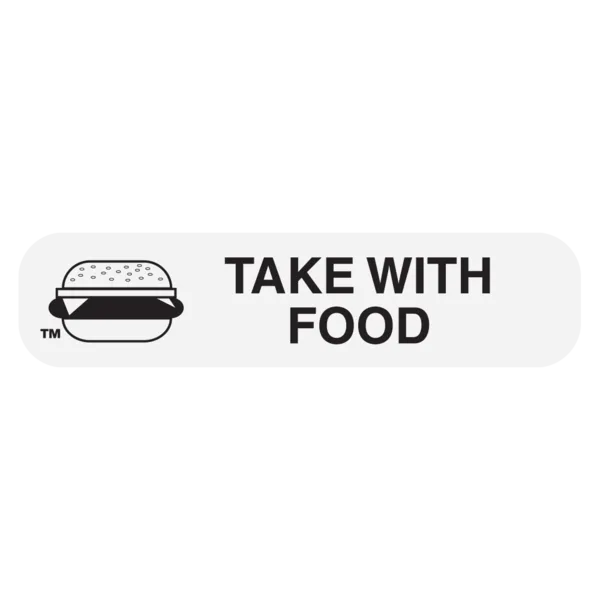
"Take With Food" Label
-
"DO NOT FREEZE" Label: Auxiliary label reading "DO NOT FREEZE" and made in the USA Use it when cold storage is required but freezing would damage the medication, so the patient knows the safe boundary.
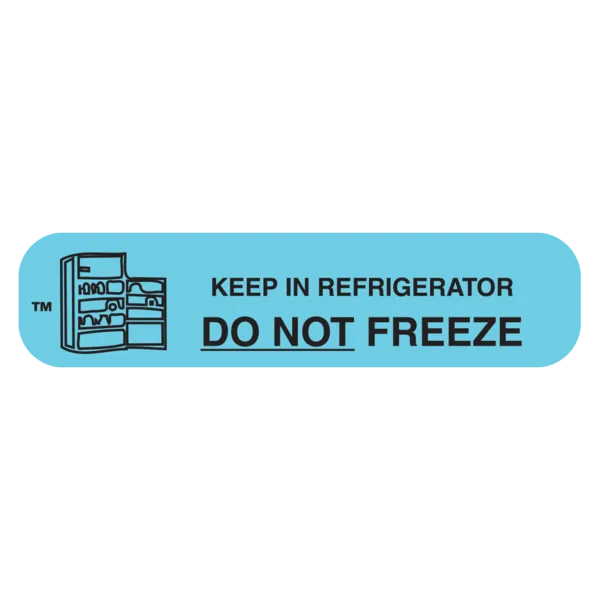
"DO NOT FREEZE" Label
-
"REFRIGERATE" Label: Auxiliary label reading "REFRIGERATE" for medication storage communication It gives a clear cold-storage instruction without requiring the patient to read the full prescription leaflet.
-
"EXPIRATION DATE" Label: Auxiliary label reading "EXPIRATION DATE" and made in the USA It creates a visible place to write the beyond-use date so patients can check whether an old package is still usable.
Who should stock which labels
Best for
- Pharmacies that dispense medications requiring food or cold-storage instructions
- Clinics and long-term care teams that need consistent auxiliary labeling across shifts
- Anyone buying prescription warning labels who wants preprinted, made-in-USA stickers
Not for
- Prescriptions that need drowsiness or shake-well warnings instead of storage instructions
- Workflows that cannot add a date to an expiration date label at dispensing
- Packaging that already carries clear manufacturer storage instructions and needs no auxiliary sticker
