Quick Answer
For a shallow-mount 8-inch subwoofer that fits under seats or in tight enclosures, the Rockford Fosgate Punch 8" P3S delivers punchy bass without sacrificing space. Match it with a mono amp that provides RMS power within its handling range, and use a sealed enclosure if you want accurate bass or a ported one if you want more output.
If you're short on space but still want real bass, a shallow-mount subwoofer is the practical answer. The Rockford Fosgate Punch 8" P3S is designed for enclosures as shallow as 3.5 inches, making it a strong candidate for under-seat installs, truck cabs, or any vehicle where a full-size sub won't fit.
This guide covers the key specs you need to know, how to choose the right enclosure, and how to match an amplifier so you get clean, reliable bass without wasting power or risking damage.
Key Specs of the Punch 8" P3S
The Punch 8" P3S is a shallow-mount subwoofer with a dual 4-ohm voice coil (DVC). That means you can wire it to a 2-ohm or 8-ohm load, giving you flexibility when matching an amplifier. It's rated to handle 300 watts RMS, so you'll want an amp that delivers that amount of power without distortion.
Because it's a shallow sub, the mounting depth is much less than a standard 8-inch sub. This opens up installation locations that would otherwise be impossible, but it also means you need to pay attention to the air space requirements. The P3S works best in a sealed enclosure with about 0.35 to 0.5 cubic feet, or a ported enclosure tuned around 35 Hz if you want more low-end punch.
- Check the mounting depth of your chosen location before buying an enclosure.
- If you're building a custom enclosure, use 3/4-inch MDF and seal all joints to avoid air leaks.
Enclosure Choices: Sealed vs. Ported
Sealed enclosures are the most common choice for shallow subs because they keep the overall size small and produce tight, accurate bass. They're also more forgiving if the enclosure is slightly larger or smaller than recommended. For the P3S, a sealed box is a safe bet if you listen to rock, jazz, or anything where you want punchy, defined bass.
Ported enclosures give you more output and deeper bass, but they need to be larger and tuned precisely. If you're building a ported box for the P3S, aim for around 0.6 cubic feet and tune the port to 35 Hz. This setup works well for hip-hop or electronic music, but it's less forgiving of mistakes and takes up more space.
- If space is really tight, go sealed—it's the most compact option.
- If you want maximum bass and have room for a larger box, consider ported.
Amplifier Matching for the P3S
The P3S handles 300 watts RMS, so you want an amp that delivers that amount of power at the impedance you choose. If you wire the sub to a 2-ohm load, look for a mono amp that's stable at 2 ohms and puts out about 300 watts. The Rockford Fosgate Punch 500 Watt Class-bd Mono Amplifier is a good match—it's rated for 500 watts into a 1-ohm load, but it also delivers solid power at 2 ohms, leaving you headroom to add another sub later.
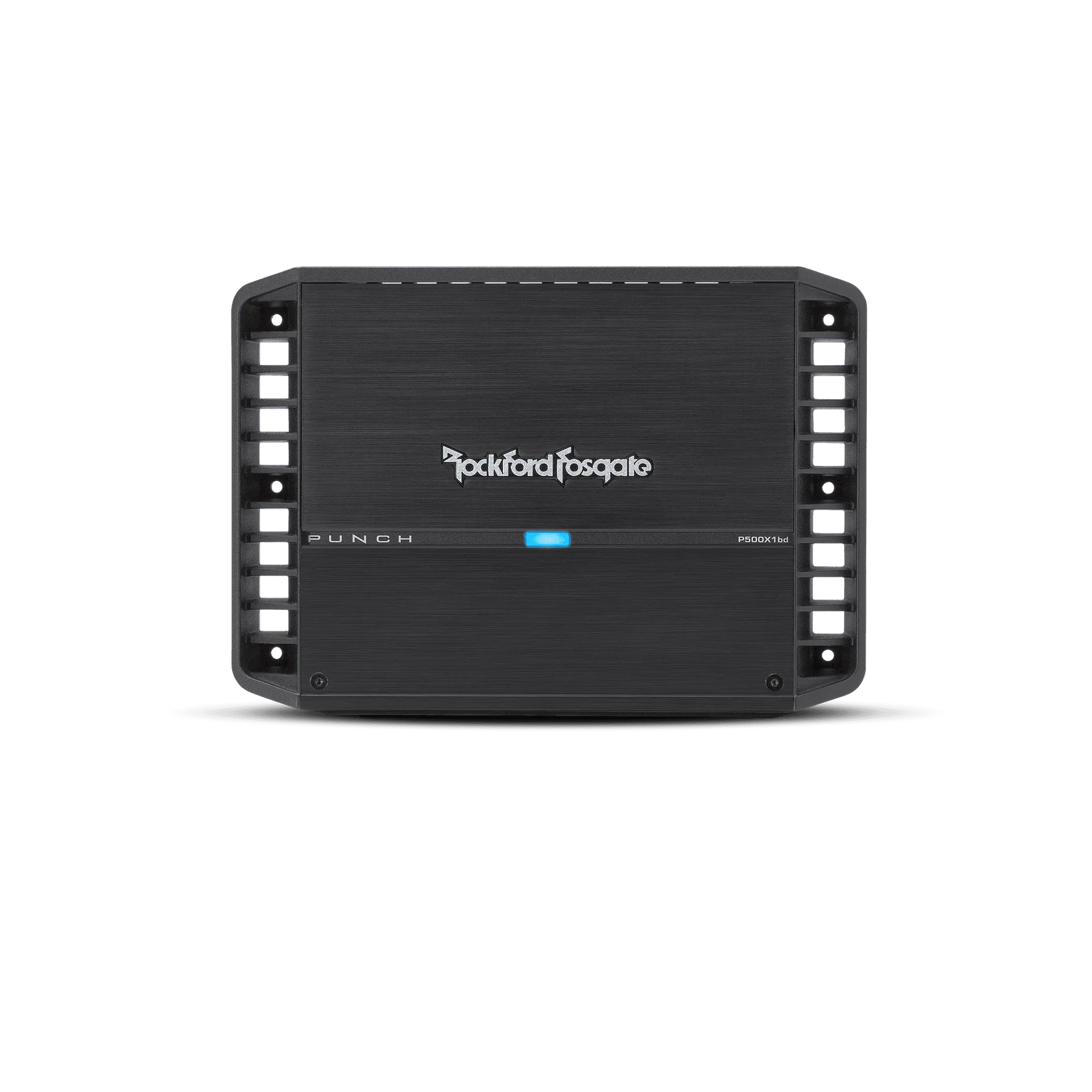
Punch 500 Watt Class-bd Mono Amplifier
If you prefer a smaller, more efficient amp, the Punch 500's Class-BD design is more efficient than traditional amps, which means less strain on your electrical system. That's a real benefit in vehicles with limited alternator capacity. Just make sure you set the gain properly to avoid clipping, which can damage the sub.
- Match the amp's RMS power to the sub's RMS rating, not the peak rating.
- Use a digital multimeter or an oscilloscope to set the gain correctly.
Wiring the P3S: 2-Ohm vs. 8-Ohm
Because the P3S has dual 4-ohm voice coils, you can wire it in parallel for a 2-ohm load or in series for an 8-ohm load. Most mono amps are stable at 2 ohms and deliver more power there, so parallel wiring is the common choice. Series wiring is useful if you're using a stereo amp and bridging it, or if you want to keep the load higher to protect a weaker amp.
When wiring, always use the correct gauge wire—at least 16 AWG for the sub leads—and make sure the connections are tight. Polarity matters: if you wire the coils out of phase, you'll get weak bass and possible distortion. Double-check your connections before powering up.
- Parallel wiring (2 ohms) is best for most mono amps.
- Series wiring (8 ohms) is safer for low-power amps or when bridging a stereo amp.
Decision Rules for the P3S
- If space is your #1 constraint: Choose the P3S and a sealed enclosure. The shallow mount depth lets you fit it under a seat or in a tight corner, and a sealed box keeps the overall size minimal. Sealed is the safest bet for tight spaces.
- If you want maximum bass output: Go with a ported enclosure tuned around 35 Hz. You'll get more low-end punch, but you'll need more air space, so measure your available area first. Ported adds output but requires more room.
- If you're matching an amplifier: Pick a mono amp that delivers 300 watts RMS at 2 ohms. The Punch 500 Watt Class-bd Mono Amplifier is a solid match and leaves room to add a second sub later. Match RMS, not peak, to avoid clipping.
Related Products to Consider
- Punch 500 Watt Class-bd Mono Amplifier: The Punch P500X1bd is a mono amplifier capable of 500 Watts into a 1-Ohm load. The Class-BD technology produces bass more efficiently over traditional amps, and its frequency response allows it to be optimized for subwoofers. This amp gives you plenty of headroom for the P3S, and its efficient design means less strain on your vehicle's electrical system—a real plus in tight installs.
- Punch 1,000 Watt 2-Channel Amplifier: The Punch P1000X2 is a 2-channel stereo amplifier capable of producing 500 Watts into each channel at 2-Ohms. The P1000X2 amplifier is great with full-range or component systems or can be bridged for use with several subwoofers. If you're planning to add more than one P3S sub later, this amp can be bridged to drive multiple subs, giving you flexibility as your system grows.
Is the P3S Right for You?
Best for
- Drivers who want bass in a truck, car, or boat with limited mounting depth.
- Anyone who prefers a sealed enclosure for accurate, punchy bass.
Not for
- If you have unlimited space and want the deepest possible bass, a larger 12-inch sub like the Punch 12" P2 or Prime 12" R2 will deliver more low-end extension.
- If you're on a tight budget, the Prime 12" R2 4-Ohm DVC Subwoofer is a more affordable alternative, though it's not shallow-mount.
The Rockford Fosgate Punch 8" P3S shallow subwoofer is a smart choice when space is tight but you still want quality bass. Pair it with a properly matched amp and the right enclosure, and you'll get years of reliable performance without sacrificing your cargo room.