Quick answer
Use the Quest Astra III Classroom Value Pack (Q5595) as a complete group kit: divide the 25 rockets into small build teams, assemble with the plastic fin-can first, then run a rotation of build, prep, and launch stations. The key is to treat the pack as a program, not a single event.
Why the Astra III works for group launches
The Astra III is part of Quest's Quick-Kit family, which means the fin can comes as a single plastic assembly. That design cuts the most common build error in group settings—misaligned fins—and lets inexperienced builders finish a rocket in less time. The pack includes 25 rockets, enough for a full class or scout troop without ordering extras.
However, the Quick-Kit design is best for groups that have already built at least one rocket before. If your participants are complete beginners, plan extra time for teaching basic concepts like stability and recovery, or choose a simpler starter kit first.
What the pack does not include
The catalog lists the rockets and fin-can assembly but does not specify motors, launch pads, or recovery wadding. Those are separate purchases. Before you commit to a launch date, confirm you have enough launch equipment for your group size. A single pad and controller will work for 25 rockets only if you rotate flyers in small batches. Also check the motor requirements for the Astra III—the product page does not state them, so verify before buying motors.
Step-by-step launch plan for 25 rockets
- 1. Set up build teams and stations: Divide participants into teams of 2–3, with each team responsible for 1–2 rockets. Set up separate tables for parts sorting, fin-can assembly, and body-tube prep. Common mistake: letting all teams crowd one table, which leads to lost parts and glue on the wrong surfaces. Checkpoint: each team has a labeled parts tray before any glue is opened.
- 2. Assemble the fin can first: Because the Astra III uses a plastic fin-can assembly, have each team snap or glue the fin can to the body tube before attaching the launch lug or recovery system. This order prevents fins from being knocked loose while handling the tube. Common mistake: attaching the shock cord before the fin can is secure, which can pull the can out of alignment. Checkpoint: every fin can is fully seated and cannot be wiggled by hand.
- 3. Install recovery and motor mount: Following the kit instructions, attach the shock cord and parachute, then install the motor mount. Use a dab of glue on the shock cord anchor to keep it from pulling through. Common mistake: forgetting to tie the shock cord to the motor mount before gluing, which requires cutting the tube to fix. Checkpoint: tug gently on the shock cord—it should not pull free.
- 4. Run a pre-launch safety check: Before any rocket goes to the pad, inspect each one for a secure fin can, a freely moving parachute, and a clean motor mount. Verify that the launch lug is straight and not blocked by glue. Common mistake: skipping the parachute check, which leads to a nose-dive landing. Checkpoint: every rocket passes a 10-second shake test—no rattles, no loose parts.
- 5. Rotate launch crews in small batches: With 25 rockets, launch in groups of 3–5 flyers. Assign one adult to the launch controller and one to the pad. Each flyer preps their own rocket, loads it on the pad, and retrieves it after flight. Common mistake: letting a crowd gather at the pad, which slows down the rotation and increases distraction. Checkpoint: keep a sign-up sheet so every participant gets a turn before the session ends.
- 6. Debrief and reset for the next group: After each batch, collect spent motors and wadding, and check rockets for damage. If you have multiple classes or troops, store completed rockets in a labeled box by team. Common mistake: mixing up rockets between groups, which causes confusion at the next launch. Checkpoint: each rocket has the builder's name on a fin or tube.
Product facts
-
Quest Astra III™ Classroom Value Pack 25 Rockets - Q5595: The Astra III Classroom Value Pack includes 25 rockets and is designed for schools, camps, clubs, and youth groups including Civil Air Patrol, 4H, Starbase, and Scouting's Space Exploration Merit Badge. This pack is sized for a full class or troop, so you can plan one kit per participant without over-ordering.
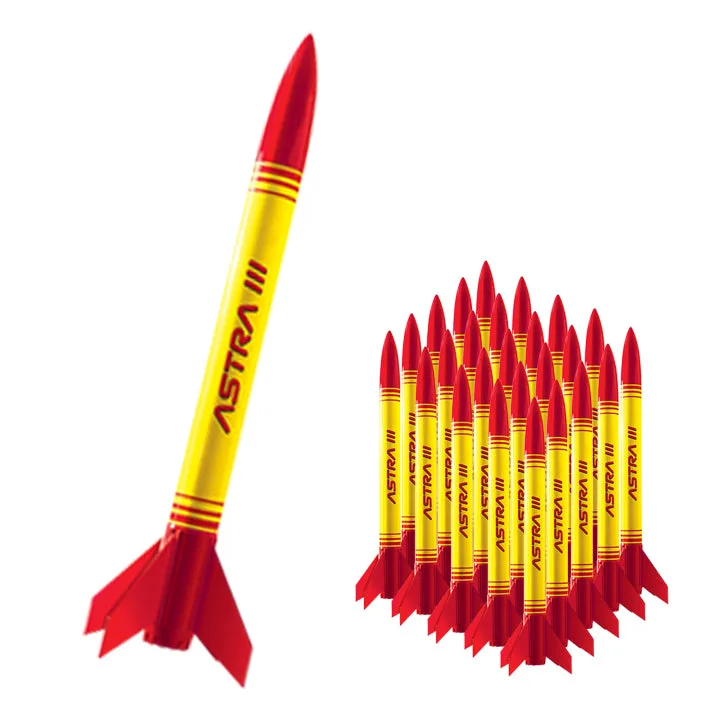
Quest Astra III™ Classroom Value Pack 25 Rockets - Q5595