Red Dot vs RACI: Two Ways to Aim Your Telescope
When you set up your telescope, a finder helps you point it at the right spot in the sky. Two common types are the red dot finder and the RACI (Right Angle Correct Image) finder scope. Each works differently and suits different observing styles. This comparison looks at their key features—magnification, image orientation, ease of alignment, and typical use cases—so you can choose the one that fits your needs.
The red dot finder projects a non-magnified red dot onto a clear glass window. You simply move the telescope until the dot aligns with your target. The RACI finder is a small telescope that magnifies the view and corrects the image orientation, making it easier to match what you see to a star chart.
Two Different Approaches to Finding Objects
-
Red Dot Finder - No Base (F001): The Stellarvue F1 Red Dot Reflex Finder Sight features a large 1.25" clear glass viewing frame with a non-magnified window where a superimposed red dot aligns your optics to the target. No magnification means you see the same field of view as your unaided eye, making it fast and intuitive to point the telescope at bright stars and planets.
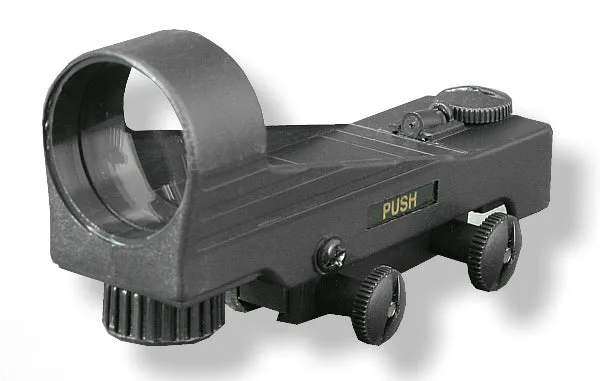
Red Dot Finder - No Base (F001)
-
10x60mm RACI Finder Scope (90 deg erect image prism, variable illuminator, eyepiece): The Altair Astro 10x60mm finder scope is a larger and more powerful upgrade to standard 8x50 finders. It gathers more light, resulting in a brighter image delivering almost half again as much light to your eye. 10x magnification and a 60mm objective let you see fainter stars and detail, which is helpful for locating deep-sky objects or centering a target precisely for astrophotography.
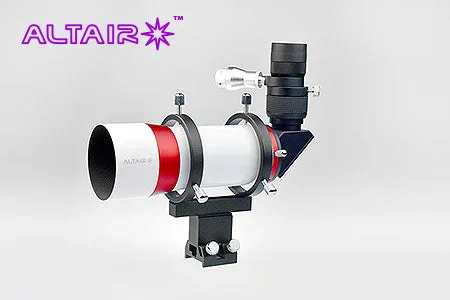
10x60mm RACI Finder Scope (90 deg erect image prism, variable illuminator, eyepiece)
Key Differences at a Glance
- Magnification: Red dot finder: none (1x). RACI finder: 10x magnification, showing more stars and detail.
- Image Orientation: Red dot finder: direct view, no correction. RACI finder: right-angle and correct image (not mirror-reversed), so the view matches a star chart.
- Ease of Alignment: Red dot finder: finger adjustment screws, no tools needed. RACI finder: 6x nylon-tipped adjustment screws in the tube rings, plus a helical focuser and rotating rear assembly for fine-tuning.
- Batteries / Power: Red dot finder: requires a standard CR2032 battery (purchased separately). RACI finder: requires 2x LR44 or GPA76 batteries for the variable illuminator (not included).
- Weight and Size: Red dot finder: lightweight, compact design. RACI finder: 955g, larger tube and bracket.
Choosing the Right Finder for Your Observing Style
If you primarily observe bright objects like the Moon, planets, and bright stars, a red dot finder offers a quick, intuitive way to aim. Its non-magnified view lets you sweep the sky and align the dot in seconds. It is especially handy for GoTo telescope owners who need to set alignment stars quickly, as noted in the product details.
For those who hunt fainter deep-sky objects or need precise centering for astrophotography, a RACI finder's magnification and correct image make a real difference. The 10x60mm model gathers more light than a standard 8x50, revealing many more objects. The illuminated crosshair helps you center targets accurately, and the right-angle eyepiece keeps your neck comfortable when pointing high overhead.
There is no single best choice—it depends on what you observe and how you like to work. Many astronomers eventually use both: a red dot finder for quick aiming and a RACI finder for detailed star-hopping.