Quick Answer
To tackle the Red-Roofed Cabin 2000-piece puzzle, start by sorting pieces into distinct color groups—blues, browns, and greens—then build the cabin and sky first for anchor points, and use the water and trees as fill-in sections.
Why Color Sorting Matters for Large Scenes
The Red-Roofed Cabin puzzle features bold colors: the red roof, lush greens, blues from sky and water, and browns from the creature and cabin. Sorting by these color families reduces the search area dramatically, making each piece easier to place. For a 2000-piece puzzle, this initial step can save hours of frustration.
A common mistake is trying to assemble the whole puzzle at once without a plan. Instead, break the image into manageable zones—cabin, sky, water, trees, and wildlife—and tackle them one at a time. This approach keeps you focused and prevents overwhelm.
Trade-Off: Starting with the Cabin vs. the Border
Many solvers begin with the border, but for this puzzle, starting with the cabin can be more effective. The red roof and distinct shape give you a strong visual anchor, and the cabin's edges connect to the border pieces you'll find later. However, if you prefer a more traditional approach, building the border first still works—just be prepared to revisit it as you fill in the scene.
The trade-off is that starting with the cabin means you'll need to sort out the red and brown pieces early, which can be a smaller subset than the full border. This can speed up your initial progress, but you'll still need to locate border pieces later. Choose the method that feels most intuitive to you.
Step-by-Step Build Strategy
- Sort by Color Families: Separate all pieces into groups: reds/browns (cabin and creature), blues (sky and water), greens (trees and bushes), and any remaining neutral pieces. Use trays or boxes to keep groups organized. Checkpoint: Each group should be clearly distinct; if you spot a piece that doesn't fit, set it aside in a 'maybe' pile.
- Assemble the Cabin First: Start with the red roof and brown cabin structure. Use the image on the box as a reference to place pieces that match the cabin's shape and color. This gives you a strong anchor point. Checkpoint: The cabin should be fully assembled before moving on; if you're missing pieces, scan the 'maybe' pile.
- Build the Sky and Water: Next, work on the blue sections—the sky above and the water below. These areas often have gradient or subtle variations, so focus on piece shapes and the direction of the blue tones. Checkpoint: The sky and water should connect to the cabin's edges; verify that the blue pieces align smoothly with the cabin.
- Fill in Trees and Bushes: Tackle the green areas last. Since these are the most challenging, work in small sections, using the box image to identify distinct bush clusters or tree shapes. Match pieces by leaf patterns and color intensity. Checkpoint: Each green section should blend naturally; if a piece seems out of place, compare it to the box image to confirm the exact spot.
- Connect Sections and Finish: Once all major sections are built, connect them by finding edge pieces that bridge the areas. Finally, add the border pieces to complete the puzzle. This step is easier now that you know where each section fits. Checkpoint: The puzzle should be fully assembled; if any pieces remain, check the 'maybe' pile and re-sort if needed.
About the Red-Roofed Cabin Puzzle
-
Red-Roofed Cabin | 2000 Piece: The wildlife have come out to play by the babbling brook while someone inside the Red Roofed Cabin is keeping warm with a fire. This 2000 piece puzzle is bold in colour and a beauty when assembled. The bold color separation makes it easier to sort pieces into distinct groups, which is key for a large puzzle build.
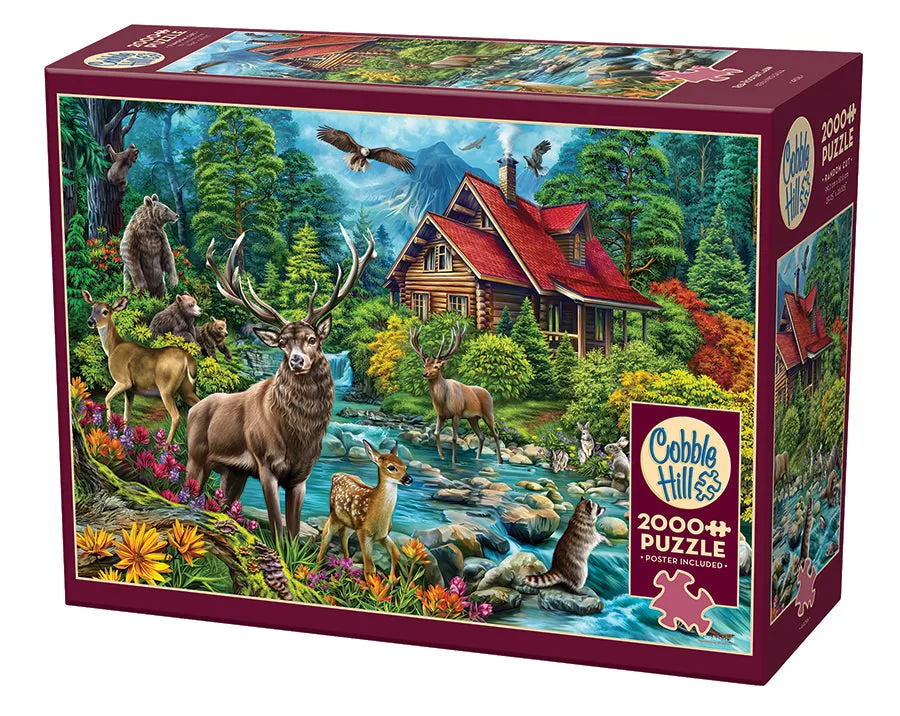
Red-Roofed Cabin | 2000 Piece
-
Red-Roofed Cabin | 2000 Piece: The lush green bushes and trees will be a good challenge with the blues from the sky and water and browns from the creature. Anticipating these challenging areas helps you plan your assembly order—tackle the easier sections first and save the trickier textures for later.