What a colour remover can and cannot do
When semi-permanent dye looks patchy or too dark, the instinct is often to reach for bleach. But bleach lightens the hair itself, which is a bigger commitment than many people need. A colour remover works differently: it targets old and faded dye so you can move on to a new shade without lightening your natural base.
Danger Jones Colour Remover is formulated to remove old and faded semi-permanent hair dye. It is not a lightener, and the supplied information does not claim it will lift permanent colour or turn dark hair blonde. Think of it as a reset step before your next colour, not a blank canvas guarantee.
What the Danger Jones Colour Remover listing confirms
-
Colour Remover for Semi-Permanent Hair Dye 43g: Danger Jones Colour Remover gets rid of old and faded hair dyes. This is the core job: it is a dye remover, not a bleach alternative for lightening virgin hair.
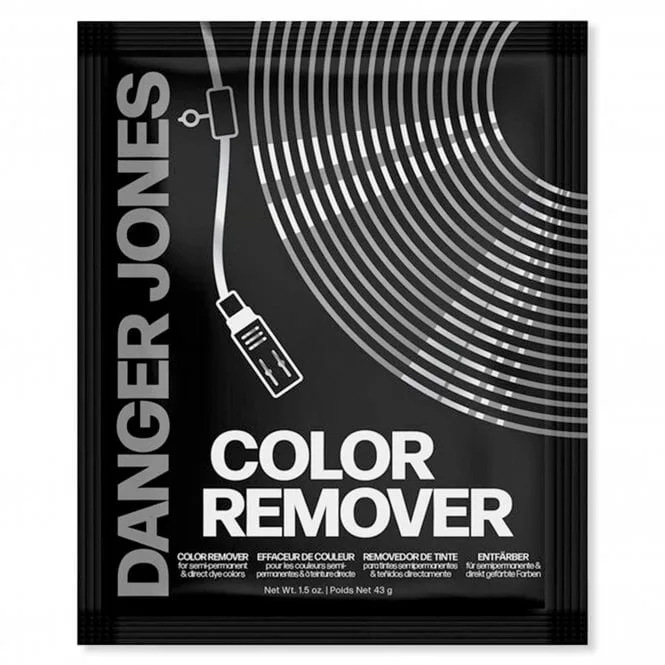
Colour Remover for Semi-Permanent Hair Dye 43g
-
Colour Remover for Semi-Permanent Hair Dye 43g: The formula includes Aloe Vera, Argan Oil and Jojoba Oil. These ingredients are listed for moisture and conditioning, which matters when you want to avoid the dryness often associated with stripping colour.
-
Colour Remover for Semi-Permanent Hair Dye 43g: Danger Jones Colour Remover can be used at the same time as a hair lightener. If your plan genuinely needs lightening, the listing allows for combined use, but that is a separate decision from a no-bleach removal.
When a no-bleach removal makes sense
A colour remover is most useful when you want to fade or remove semi-permanent dye that has gone muddy, uneven, or simply too intense. It is also a sensible first step if you plan to re-colour in a similar depth and just need the old layer out of the way.
It is less useful if your goal is to go several shades lighter than your natural colour. The supplied information does not describe the remover as a lightener, so do not expect it to replace bleach for that job. If you are unsure which situation you are in, a patch test and a small strand check will tell you more than guesswork.
How to use Danger Jones Colour Remover
The listing supplies a clear order of work. Follow it rather than improvising, especially around mixing and timing.
- Patch test first: The listing says to always carry out a patch test before application. Do this before you commit to a full head.
- Mix powder and developer 1:3: Mix the powder and developer in a 1:3 ratio in a non-metallic bowl. The listing names Danger Jones Deluxe Cream Developer in 5 or 10 Volume as best.
- Apply to dry hair: Apply to dry hair and distribute evenly over the areas with semi-permanent dye. Avoid applying to your natural hair colour.
- Process at room temperature: Process for up to 30 minutes, checking every 5 minutes. The listing does not recommend using heat to speed up processing.
- Rinse and finish: Rinse, shampoo, condition and tone hair as the listing directs.
Why heat and natural hair are the two boundaries to respect
Two supplied cautions are easy to skip and worth repeating. First, avoid applying the remover to your natural hair colour. The product is intended for the dyed areas, and spreading it onto untreated hair adds risk without a stated benefit.
Second, do not use heat to reduce processing time. It is tempting when you are impatient, but the listing explicitly says it is not recommended. Stick to room temperature and the 30-minute maximum, checking every five minutes so you can stop if the hair responds faster than expected.
Fading stubborn dye: what to try before a full removal
If the colour is only slightly too strong, a full removal may be more than you need. The supplied information does not include a separate fading protocol, so these are general checkpoints rather than manufacturer instructions.
- Wash and observe: Semi-permanent dye fades over time with regular washing. Give it a few cycles before deciding on a remover.
- Check the patchy areas: Note where the dye is heaviest. Even distribution matters more than speed when you apply the remover.
- Do not layer removers: The listing gives one application process. Repeating it back-to-back is not described, so space out any further colour work and reassess.
What the listing does not settle for you
The supplied information does not state how many applications are needed for a given starting shade, how the remover performs on permanent dye, or how it interacts with every possible developer. It also does not promise a specific final colour result. Those are real limits, not flaws.
If your hair is heavily compromised, previously lightened, or you are unsure about mixing and timing, a professional consultation is the safer route. The remover is a useful tool for the right job, but it is not a universal reset button.