Quick Answer
Use Riley Blake's Cath Kidston Signature Stripe in Pink as a bold accent or background in a patchwork quilt. The 100% cotton fabric holds crisp seams and coordinates easily with solids or prints.
Why Stripe Fabric Works for Quilts
Stripes add movement and direction to a quilt top. They can create optical illusions, frame blocks, or unify a scrappy layout. The Cath Kidston Signature Stripe in Pink features a fine pink stripe on a light ground, making it versatile for both modern and traditional designs.
Because this fabric is 100% cotton and 43/44 inches wide, it behaves predictably under the needle. It also prewashes well without distortion, though you should always test a swatch for colorfastness.
Trade-Offs When Using Stripes
Stripes require careful cutting to keep the lines straight. If you cut off-grain, the stripe will appear wavy in the finished block. Also, directional prints can create visual tension if not planned—some quilters love this effect, while others prefer uniformity.
The pink hue in this collection is soft and rosy, so it pairs best with neutral backgrounds (white, cream, gray) or complementary colors like mint green or navy. Avoid pairing it with orange or warm red, which can clash.
Step-by-Step Quilt Project with Stripe Fabric
- Plan Your Layout: Decide whether the stripe will run vertically, horizontally, or diagonally in your blocks. Sketch a simple grid or use design software to avoid surprises. A common mistake is mixing stripe directions without a clear pattern, which can look chaotic. Stick to one stripe direction per block for a cohesive look.
- Cut Strips on Grain: Use a rotary cutter and a long ruler to cut strips parallel to the selvage. Align the stripe with the ruler's grid lines. Cutting off-grain causes the stripe to distort when sewn. Check that the cut edge is perpendicular to the fold. Press the fabric before cutting to ensure accurate alignment.
- Piece Blocks Carefully: When sewing stripe pieces together, use a scant 1/4-inch seam allowance and pin at each stripe intersection to prevent shifting. A common mistake is stretching the fabric while feeding it through the machine, which makes stripes misalign. Use a walking foot for long seams to keep layers even.
- Press Seams Open or to One Side: Press seams open to reduce bulk when stripes meet at a point. For strip-pieced blocks, press seams toward the darker fabric. Avoid ironing over the stripe lines—use a pressing cloth if needed to avoid shine. Let the block cool flat before trimming to prevent distortion.
- Quilt and Bind: Choose a quilting design that complements the stripe direction—straight-line quilting parallel to the stripe is a safe choice. When binding, cut bias strips if you want a striped binding that wraps corners neatly. A common mistake is using a contrasting binding color that fights with the pink stripe. Match the binding to the lightest color in the stripe for a seamless edge.
Featured Fabric
-
RILEY BLAKE - Cath Kidston Signature Collection - Stripe - Pink: 100% cotton quilting fabric, 43/44 inches wide, sold by the quarter yard. Machine wash cold; tumble dry low. The generous width gives you more usable yardage per quarter-yard cut, and the cotton content ensures it presses flat for accurate piecing.
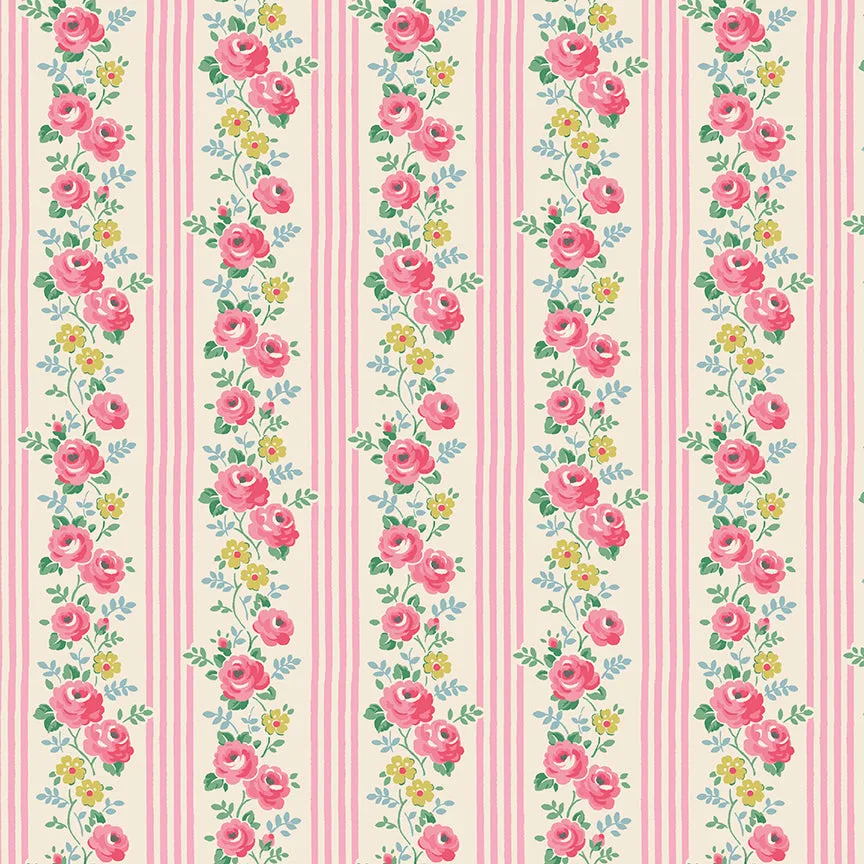
RILEY BLAKE - Cath Kidston Signature Collection - Stripe - Pink