Start with two measurements, not guesswork
The Rock Harness Long is built for power transfer when pulling, so a close, even fit matters more than it does on a casual walking harness. Before you touch the straps, measure your dog’s neck and chest circumference. The size chart gives a range for each size, and your dog needs to fall inside both ranges for that size to work.
For example, size M covers a neck of 43–60 cm and a chest of 58–84 cm. Size L covers a neck of 51–69 cm and a chest of 72–102 cm. If your dog sits between sizes, the supplied chart recommends choosing the size that matches your dog best rather than sizing up for growth. The harness is highly adjustable around the neck and chest, but the size range still sets the limit.
Size ranges and weight for the Rock Harness Long
-
Rock harness long: Available in sizes XS–XL, with neck and chest ranges from 29–36 cm neck / 40–56 cm chest (XS) up to 60–84 cm neck / 74–108 cm chest (XL). Harness weight ranges from 168 g (XS) to 451 g (XL). Use these ranges to pick the correct size before adjusting; the weight difference also matters if you are counting grams for racing.
Rock harness long
Put the harness on and set the four buckles
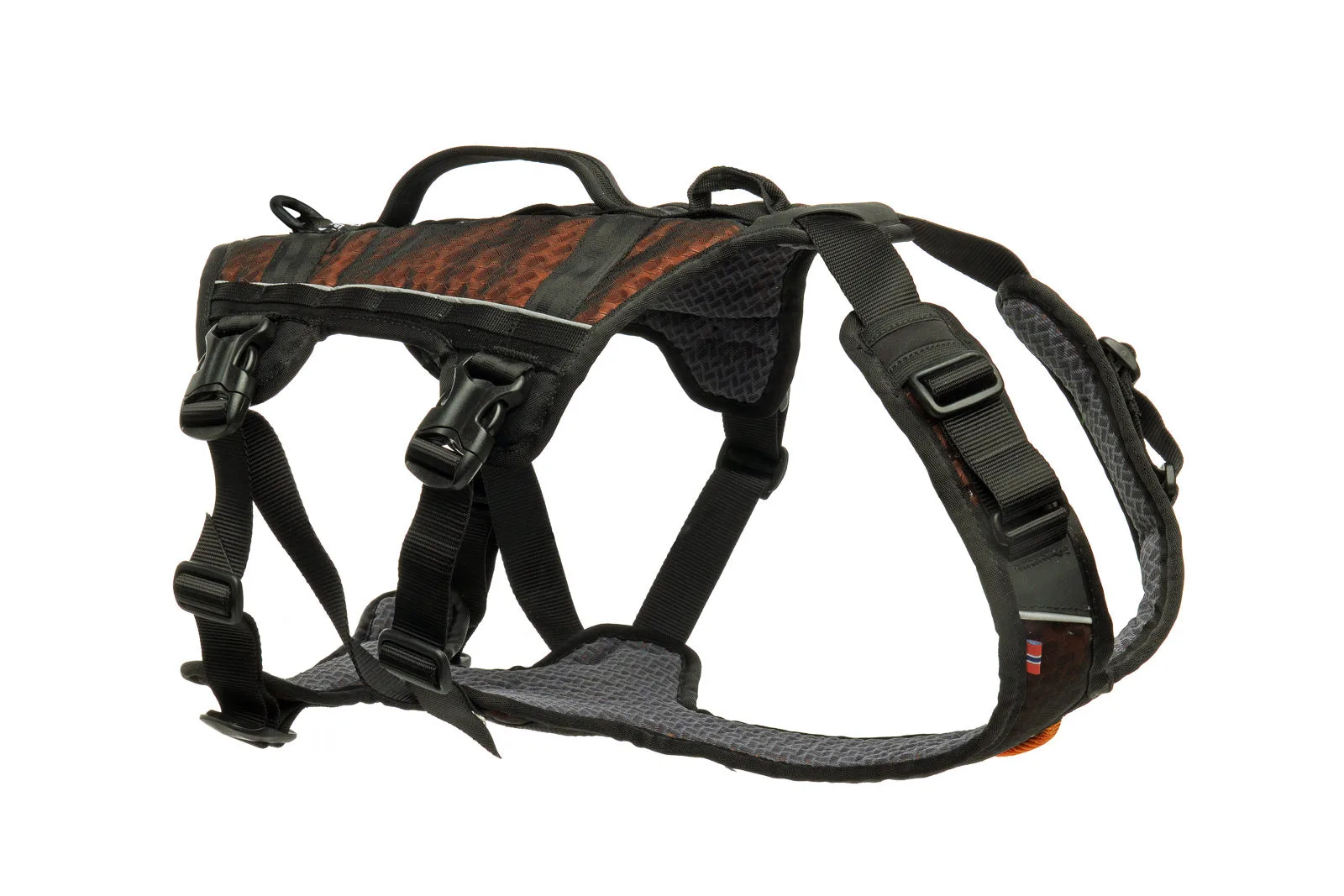
- Open all four side-release buckles: The Rock Harness Long has four side-release buckles, which let you open the harness wide instead of pulling it over your dog’s head. Lay it over your dog’s back with the belly panel underneath.
- Close the buckles loosely first: Fasten the buckles without tightening the straps. This lets you see where the harness sits before you change the fit.
- Adjust the neck opening: Tighten or loosen the neck straps so the opening sits comfortably around the neck without riding up. The harness is highly adjustable around the neck, so make small changes on both sides.
- Adjust the chest straps: Tighten the chest straps until the harness feels secure but still allows normal movement. The support strap at the base distributes pressure evenly at top and bottom for power transfer, so an even fit matters more than a very tight one.
- Check the belly panel: When you assist your dog, their weight is distributed evenly over the entire belly panel. Make sure the panel sits flat under the belly and is not twisted.
How a well-fitted harness should feel
A good fit keeps the chest strap clear of the front of the shoulder and the neck opening clear of the throat. You should be able to slide a flat hand under the chest straps without forcing it, but the harness should not slide side to side when your dog trots. Because the Rock Harness Long is designed for pulling, a loose harness will shift and rub; a harness that is too tight will restrict movement.
The harness has reflective piping and Hypalon reinforcement, but those features only help if the harness stays in place. After your first run, check for rubbing behind the front legs and around the neck. Small strap adjustments on both sides are usually enough to solve it.
Which leash point should you use?
- Back D-ring for pulling sports: The standard leash connection point at your dog’s back is the one to use for canicross, bikejoring, skijoring and other activities where you want power transfer. The support strap and belly panel are designed to distribute load in this setup.
- Front no-pull point for everyday control: If you don’t want your dog to pull at all, there is a no-pull attachment point in front in addition to the back connection. Use this for daily walks or busy environments where you need more control.
- Neck loop for close control: A leash can also be attached to the loop at your dog’s neck, for example to provide control at a race or in busy environments. This is a handling aid, not a pulling setup.
Adjusting for narrow or deep-chested dogs
The Rock Harness Long is highly adjustable around the neck and chest, which helps on dogs that fall between standard sizes. A narrow dog may need the chest straps taken in more than the neck straps; a deep-chested dog may need the opposite. Adjust one pair of straps at a time and walk your dog after each change so you can see whether the harness stays centred.
The handle on the back is useful for assisting your dog over obstacles or lifting them briefly. It is not a substitute for a proper fit: if the harness rotates when you use the handle, the chest straps are probably too loose.
Care that keeps the fit consistent
- Rock harness long: Wash guide: 40 degrees normal wash. Washing at the recommended temperature helps preserve the HexiVent material and webbing so the harness keeps its shape and adjustment.