Quick answer
Use a 17 cm santoku with a gentle down-and-forward push cut, keep the blade off hard surfaces, and sharpen it only when a tomato skin starts to resist. Wash and dry it by hand after every use.
Why the santoku's shape changes your cuts
A santoku's broad blade and relatively flat edge profile encourage a straight down-and-forward motion rather than the rocking curve of a Western chef's knife. That makes it efficient for slicing vegetables and dicing, but it also means you should not force a rocking chop through tough items. Let the edge do the work with a controlled push, and keep the tip off the board unless you are deliberately using it for detail work.
When a santoku is the wrong tool
A 17 cm santoku is a versatile everyday blade, but it is not a cleaver or a heavy chopping knife. Avoid hacking through bones, frozen food, or dense root vegetables with a twisting motion. For those tasks, use a heavier knife and keep the santoku for slicing, dicing, and mincing. If you need a long slicing knife for large roasts, a santoku's shorter blade will feel limited.
Everyday care that prevents most damage
Hand wash the blade with mild soap and warm water, then dry it immediately with a soft cloth. Do not leave it soaking in the sink or put it in the dishwasher, where heat and detergent can dull the edge and damage the handle over time. Store it in a knife block, on a magnetic strip, or in a blade guard so the edge does not knock against other utensils.
Step-by-step: cutting, sharpening and care
- Set up a stable cutting board: Place a damp towel under a non-slip board and keep the board clear of clutter. Common mistake: using a glass or stone board, which dulls the edge quickly. Checkpoint: the board should not slide when you press it.
- Grip the handle with a pinch grip: Pinch the blade just ahead of the handle between thumb and forefinger, then wrap the remaining fingers around the handle. This gives you control over the blade angle. Common mistake: holding the handle like a hammer, which makes the tip wander.
- Use a down-and-forward push cut: Guide the knife with your knuckles curled back and move the blade down and slightly forward through the food. Do not rock the blade aggressively or twist it in the cut. Checkpoint: the blade should pass through the food without sideways pressure. Stop and reset if you feel the edge twisting; a straight push keeps the edge aligned.
- Test sharpness before sharpening: Try slicing a ripe tomato or a sheet of paper. If the blade slides instead of biting, it is time to sharpen. Do not sharpen on a fixed schedule; over-sharpening removes metal unnecessarily.
- Sharpen at a consistent angle: Use a whetstone or a sharpener designed for Japanese-style blades, and maintain a steady angle on each side. Make light, even passes rather than heavy pressure. Common mistake: sharpening only one side or using a pull-through sharpener that can chip a hard edge. Checkpoint: the edge should feel consistently sharp along its full length. If you are unsure of the angle, practice on a cheap knife first or use a guided sharpener.
- Wash and dry by hand immediately: Rinse the blade with warm water and mild soap, then dry it with a soft cloth before putting it away. Do not leave it wet or soaking. Checkpoint: the blade and handle should be completely dry before storage.
Product facts
-
Santoku knife, blade 17 cm: The Westmark Santoku knife has a 17 cm blade and a santoku-style blade for multi-purpose cutting. That length is short enough for precise control on a home cutting board but long enough for most everyday slicing and dicing tasks.
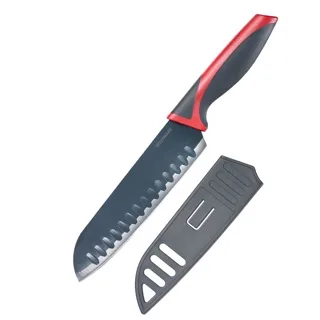
Santoku knife, blade 17 cm