Quick answer
Place the Sebra Puslebord with drawers against a wall in the room where you change most often, keep the 14 cm raised edge clear, and load the two drawers by change frequency so everything you need is within arm's reach at the roughly 89 cm work height.
Placement decisions that matter before you build
The Puslebord is a floor-standing unit, so its placement is a furniture decision, not just a décor one. Choose a wall that lets you stand square to the 89 cm work surface rather than reaching across a bed or cot. Avoid putting it where a door swings into your standing space, and keep the top of the unit away from windows with cords or loose curtains.
Because the two drawers open toward you, leave enough floor space in front to pull them out fully while you are standing at the table. If the nursery is tight, measure that clearance before you commit to a corner.
What the two drawers change about your routine
A changing table with drawers keeps supplies out of sight but still at hand, which matters most during night changes when you do not want to switch on a bright overhead light. The trade-off is that deep drawers can become a catch-all. Decide what belongs in each drawer before you fill them, and keep the top surface for the few items you use on every change.
The Stone Grey finish is part of Sebra's classic furniture collection, so it can sit alongside other pieces from the same range rather than looking like a standalone baby item. That helps if the changing station shares a room with a crib or dresser.
Setting up your Sebra Puslebord step by step
- Measure the standing zone: Stand where you would change the baby and check that you can face the table squarely with the drawers fully open. Common mistake: measuring only the unit's footprint and forgetting the drawer pull-out space. Mark the floor with tape for a day to test the spot before filling the drawers.
- Check the work height against you: The Puslebord's work surface is about 89 cm high. Compare that with your own standing elbow height; if you are much taller or shorter, decide whether a different changing surface suits you better before committing.
- Clear the raised edge: Keep the 14 cm tremmekant free of tall bottles and stacked items so it can do its job. Common mistake: using the edge as a shelf and losing the fall protection it provides.
- Assign the two drawers by frequency: Put everyday nappies, wipes and a change of clothes in the drawer nearest your changing hand, and reserve the second drawer for backup stock, spare bedding or out-of-season clothing. Common mistake: splitting one category across both drawers so you search twice. Label the drawers on the inside of the front panel until the habit sticks.
- Set up the top surface for one change: Keep only what you use every time on the changing surface, and store the rest in the drawers. Common mistake: leaving creams and powders within a baby's reach once they start grabbing.
- Plan the night-change route: Check that you can reach the Puslebord, open the everyday drawer and get back to the crib without stepping over anything. Common mistake: placing the unit so far from the crib that night changes wake the baby more than necessary.
Product facts
-
Sebra Puslebord, skuffer - Sebra Care - Stone grey: The Puslebord has a 14 cm high raised edge around the changing surface. That lip helps stop nappies, wipes and creams from rolling off the top while you are working.
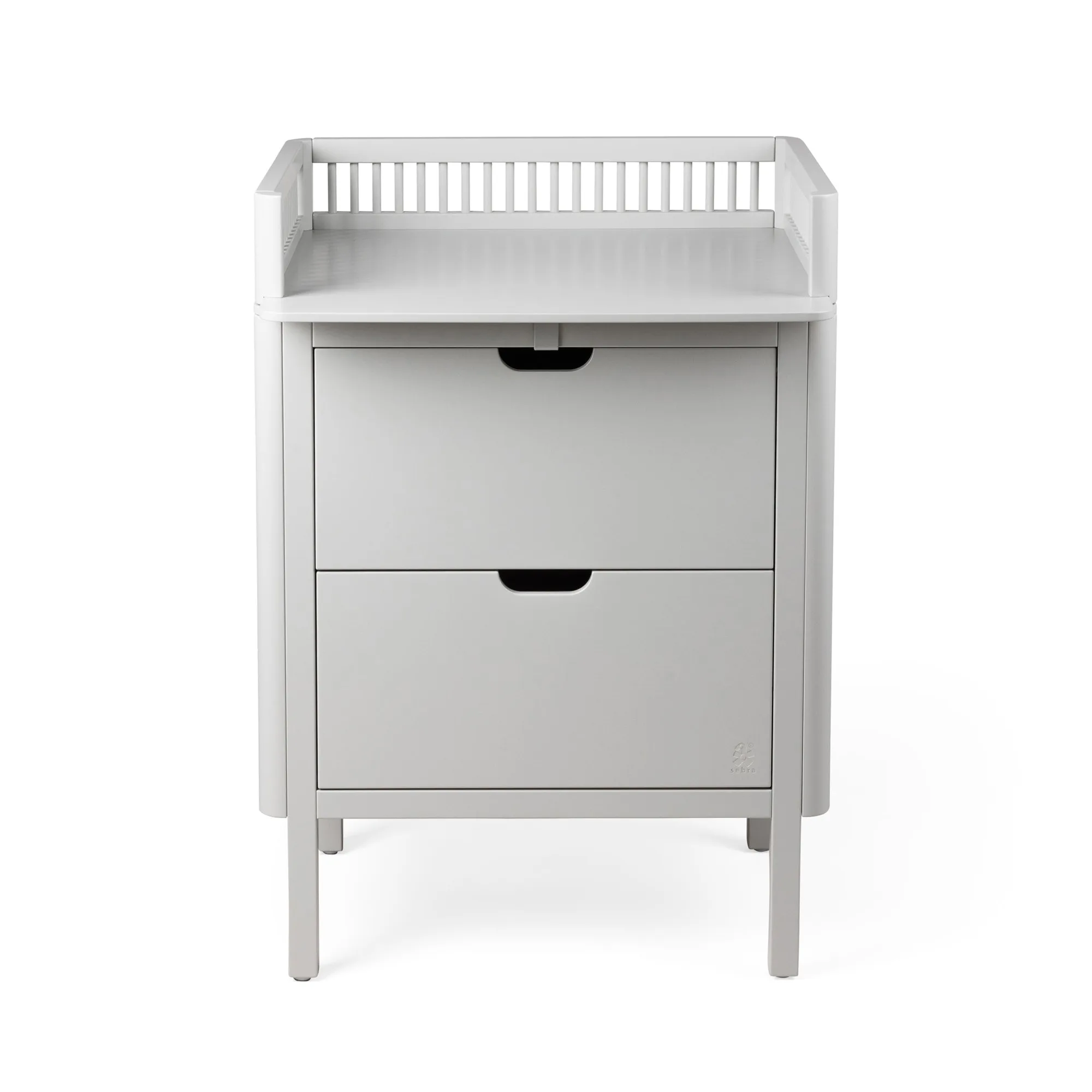
Sebra Puslebord, skuffer - Sebra Care - Stone grey
-
Sebra Puslebord, skuffer - Sebra Care - Stone grey: The work height is approximately 89 cm, and the unit has two spacious drawers. The height is designed for a comfortable standing position, while the drawers hold the bulk of your supplies out of sight.
-
Sebra Puslebord, skuffer - Sebra Care - Stone grey: It is made from certified wood and carries the EU Ecolabel. If you are choosing nursery furniture with environmental certification in mind, this is a documented part of the product.