When bugs are the problem, not the weather
You do not always need a full tent. On fair-weather nights, in open shelters, or when you want to sleep under the stars without becoming dinner, the problem is insects and mice—not rain or wind. The Serenity Ultralight NetTent is built for exactly that situation: a solo net shelter that keeps pests out without adding a full tent's weight or complexity.
At 11 oz (312 g), the Serenity packs to 10" x 5" and gives you 15 ft² (1.4 m²) of floor space. It uses one 45" pole (sold separately) and six stakes (also sold separately), so you can set it up almost anywhere. The question is whether a net tent or a bug bivy better matches how you camp. This review walks through the trade-offs so you can decide.
What the Serenity NetTent actually is
-
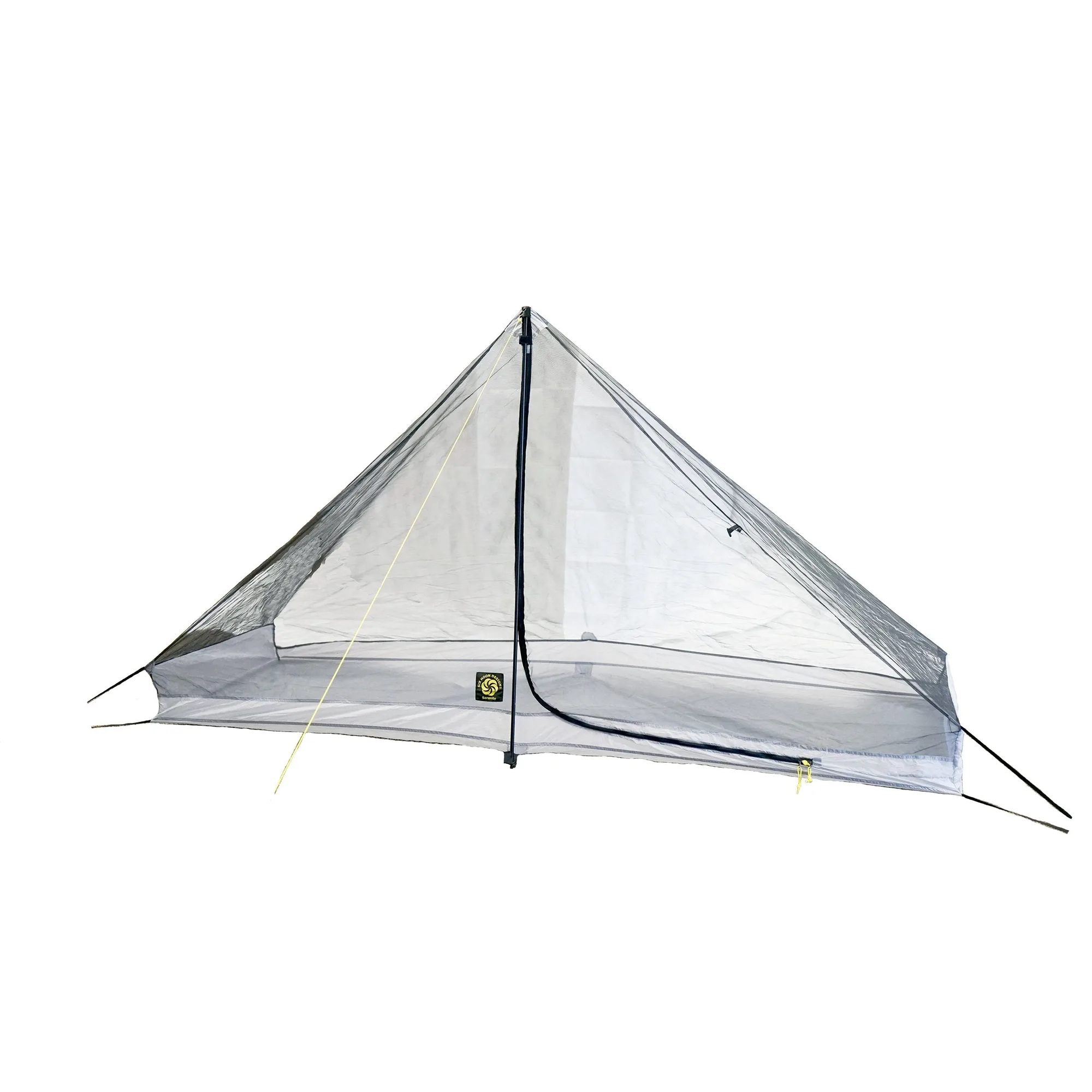
Serenity Ultralight NetTent: 11 OZ – 312 G SOLO NETTENT – USES ONE 45” POLE This is the core spec: a solo net shelter that relies on a single pole you supply.
Serenity Ultralight NetTent
-
Serenity Ultralight NetTent: Floor Dimensions: 84" X 26" - 214 X 66 cm The narrow, long floor tells you it is a solo sleeping space, not a roomy tent.
-
Serenity Ultralight NetTent: Floor Space: 15 ft 2 - 1.4 m 2 Enough for one person and a sleeping pad, but not for gear sprawl.
-
Serenity Ultralight NetTent: Pack Size: 10" X 5" Small enough to carry even when you are not sure you will need it.
Why a net tent instead of a bug bivy
A bug bivy is essentially a sleeping bag cover with netting. It is light and simple, but it can feel confining, and you often have to shimmy in and out through a long tube. The Serenity takes a different approach: it is a small net tent with a full zippered side entry and a bathtub floor, so you step in rather than wiggle in. The oversized door makes entry and exit easier, and you do not need to detach it from a cape or tarp when leaving.
The Serenity also stands alone on clear nights. Set it up by itself for bug protection and star gazing, or quick-connect it to a Gatewood Cape or Deschutes Tarp to create a lightweight double-wall shelter. That flexibility is the main reason to choose a net tent over a bivy: you get a livable interior and the option to pair it with a tarp when weather turns.
Serenity NetTent vs. a typical bug bivy
- Entry and exit: Serenity has a full zippered side entry and an oversized door; a bivy often requires shimmying through a long tube.
- Interior space: Serenity offers 84" x 26" floor and 15 ft²; bivies are typically closer to the sleeping bag profile.
- Standalone use: Serenity can be set up by itself with one 45" pole; many bivies require stakes or a tarp for structure.
- Tarp compatibility: Serenity quick-connects to Gatewood Cape or Deschutes Tarp; bivies may or may not integrate with a specific tarp.
- Weight: Serenity is 11 oz (312 g) without stakes or pole; bivies vary, but the Serenity's weight is competitive for a floored net tent.
The floor question: net tent without a floor?
The Serenity does have a floor—a bathtub floor with 3" sides and 8" ends—so it is not a floorless net tent. That bathtub design helps keep crawling insects out and adds a layer between you and damp ground. The raised ends also lengthen the floor and lift the netting off your face, which makes the narrow dimensions more comfortable than they look on paper.
If you are specifically looking for a floorless net tent to shave weight, the Serenity is not that. But for many backpackers, the bathtub floor is worth the few extra ounces because it turns a simple bug net into a more complete sleeping space.
Where the Serenity fits: shelters, fair weather, and solo trips
The Serenity shines in open shelters. On the Appalachian Trail, hikers often spend nights in three-sided shelters where mice and bugs are a reality. The Serenity hangs from the roof and keeps mice at bay, and its small footprint means you will not crowd your neighbors. It is also a great solution for a bug-free night of camping in fair weather, when you want airflow but not pests.
Used with the Gatewood Cape or Deschutes Tarp, it becomes a double-wall shelter for trips where rain is possible. On nice nights, set it up alone and you have a star-gazing shelter. The trade-off is that it is not a standalone weatherproof tent: it is netting, so it will not protect you from rain or wind on its own. For those conditions, pair it with a tarp.
Setup details that affect your kit
- Serenity Ultralight NetTent: Uses one 45” pole (sold separately) You need to supply the pole; it is not included.
- Serenity Ultralight NetTent: Stakes: 6 (sold separately) Plan to carry six stakes; they are not in the box.
- Serenity Ultralight NetTent: Ships With: NetTent, Stuff Sacks, Guy lines The package includes the net tent, stuff sacks, and guy lines, but no pole or stakes.
- Serenity Ultralight NetTent: Weight does not include stakes or pole. The 11 oz (312 g) figure is for the net tent alone; your total shelter weight will be higher.
Materials and care notes
The Serenity uses ultra-light No-See-Um netting, a 30D silicone-coated nylon floor, and a #3 YKK zipper. These materials are chosen for low weight and packability. The supplied information does not include specific care instructions, so follow general practices for ultralight gear: keep it away from sharp objects, store it dry, and avoid unnecessary abrasion. For detailed care, check the manufacturer's documentation.
Is the Serenity right for your backpacking style?
Choose the Serenity if you are a solo backpacker who often sleeps in open shelters or camps in fair weather, and you want a lightweight, standalone bug net that can also pair with a tarp. It is ideal for Appalachian Trail shelter users, star gazers, and anyone who wants a simple solution to bugs and pests without carrying a full tent.
Look elsewhere if you need a self-supporting shelter for rainy or windy conditions, or if you want a floorless net tent to minimize weight. The Serenity is a specialized tool: it solves the bug problem elegantly, but it is not a do-everything tent. At 11 oz and with a small packed size, it is easy to add to your kit when bugs are the main concern.