Why the Sigma 10-20mm f/3.5 EX DC HSM stands out for Nikon shooters
If you shoot landscapes, architecture, or tight interiors with a Nikon APS-C DSLR, an ultra-wide zoom is often the most practical tool. The Sigma 10-20mm f/3.5 EX DC HSM gives you a full-frame equivalent field of view that is wide enough to exaggerate foregrounds and keep entire buildings in frame from close range. Follow the supplied product instructions for exact specifications.
What makes this lens different from earlier ultra-wide zooms is the constant f/3.5 aperture. You do not lose light as you zoom in, which simplifies exposure when working with manual flash or shooting in dim conditions. For Nikon users who own bodies like the D40, D60, D3000, or D5000, the built-in HSM motor ensures autofocus works without needing a screw-drive in the camera body.
Key specifications that shape your shooting
The lens covers a 102.4° to 63.8° angle of view, with a minimum focusing distance of 24 cm (9.4 in). That close focus lets you exaggerate perspective by placing a subject near the front element while the background recedes dramatically. The filter thread accepts standard polarizers and ND filters, though that size is larger than typical walkaround zooms.
At 520 g (18.3 oz) and 88.2 mm long, the lens is compact enough for a day bag but not a pocket lens. The petal-type hood helps control flare when the sun is near the frame edge, and the inner focusing system keeps the front element from rotating, so a circular polarizer stays oriented as you focus.
Optical and compatibility details
-
Sigma 10-20mm f/3.5 EX DC HSM Nikon Mount: With an F3.5 aperture throughout the entire zoom range, the Sigma 10-20mm f/3.5 is perfect for low light photography. You can shoot indoors or at dusk without switching to a slower aperture as you zoom, giving you consistent shutter speeds and depth of field control.
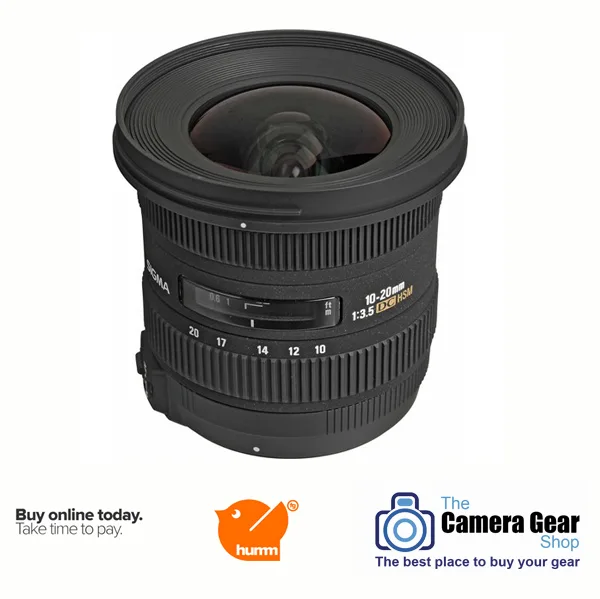
Sigma 10-20mm f/3.5 EX DC HSM Nikon Mount
-
Sigma 10-20mm f/3.5 EX DC HSM Nikon Mount: Nikon Mount Built in motor lens: compatible with D40, D40x, D60, D3000, D5000 If you own one of these entry-level Nikon DSLRs, the lens will autofocus without needing a body with a built-in focus motor. Older Nikon bodies without HSM support will still work but only in manual focus.
-
Sigma 10-20mm f/3.5 EX DC HSM Nikon Mount: Vignetting will occur if the lens is used with 35mm SLR cameras or digital cameras with image sensors larger than APS-C size. This is a DC (digital) lens designed exclusively for APS-C sensors. On full-frame or film bodies, heavy dark corners will appear, so it is not a cross-format option.
Trade-offs to weigh before buying
The constant f/3.5 aperture is the main selling point, but it is not as fast as an f/2.8 ultra-wide. If you regularly shoot handheld in very low light, you may still need to raise ISO or use a tripod. The lens also uses 13 elements in 10 groups with four aspherical lenses, which helps control distortion, but no image stabilization is built in, so camera shake at slower shutter speeds is your responsibility.
Compatibility is straightforward for Nikon DX bodies with HSM support, but if you use a Pentax mount version or an older Nikon body without HSM, autofocus will not function. The supplied information confirms that for Pentax mounts, autofocus is unavailable if the body lacks HSM; the same limitation may apply to Nikon bodies that do not support HSM, so check your camera's compatibility before purchasing.
What comes in the box and first steps
The lens ships with a petal-type hood, front and rear caps, a soft lens case, and an instruction manual. The manual may be an English softcopy or hardcopy depending on stock. There are no filters or cleaning cloths included, so budget for a protective or polarizing filter if you shoot in dusty or coastal conditions.
Before mounting, confirm your camera body is listed as compatible with the built-in HSM motor. For Nikon, the D40, D40x, D60, D3000, and D5000 are confirmed, but many newer DX bodies also support HSM. If your camera lacks HSM, you will need to focus manually, which is workable for static subjects but less convenient for events or action.