Quick answer
Choose the Sigma 35mm f/1.4 Art for a classic wide perspective and lower price, or the Sigma 40mm f/1.4 Art for superior optical correction and a slightly tighter field of view. Your decision depends on whether you prioritize budget and versatility or absolute image quality at the edges.
Focal length difference matters more than you think
The 35mm lens gives you a true wide-normal view, great for environmental portraits, street photography, and landscapes where you want to include more context. The 40mm lens sits closer to a standard focal length, offering a slightly more compressed look that many portrait and wedding photographers prefer for isolating subjects without the distortion of a wider lens.
Neither focal length is inherently better, but the 5mm difference changes how you frame a scene. If you often shoot indoors or in tight spaces, the 35mm will feel more flexible. If you shoot portraits or detail shots, the 40mm's narrower view helps simplify composition.
Optical design and price: a clear trade-off
The Sigma 35mm f/1.4 Art was the first Art-series lens and set a new standard for sharpness and correction. It remains a fantastic value, especially at its current price. The Sigma 40mm f/1.4 Art, released later, features a more sophisticated optical layout that aims for even better correction of aberrations and edge-to-edge sharpness. This comes at a significantly higher cost.
If you need the absolute best optical performance for critical work—such as high-resolution commercial or architectural shots—the 40mm is the stronger candidate. For most other photography, the 35mm delivers outstanding results at a much lower price point, freeing up budget for other gear.
Trade-offs at a glance
- Field of view: 35mm gives a wider, more versatile perspective for environmental and travel shots. 40mm offers a tighter, more natural view that flatters portraits.
- Optical performance: The 40mm Art has a more sophisticated optical layout for superior edge-to-edge sharpness and lower aberrations. The 35mm Art is still excellent but not as refined. If you pixel-peep or shoot for large prints, the 40mm is worth the extra cost.
- Price and value: The 35mm f/1.4 Art is significantly more affordable, offering a great balance of performance and cost. The 40mm f/1.4 Art is a premium investment for those who demand the best. For most shooters, the 35mm provides all the quality you need without the premium price.
Product facts at a glance
-
Sigma 35mm f/1.4 DG HSM Art Lens Canon Mount: The Sigma 35mm f/1.4 DG HSM is a state of the art lens designed for full frame cameras but can also be used with APS-C sensors as well. The first addition to the Art category in Sigma’s Global Vision, the 35mm f/1.4 DG HSM includes new features based around a unique lens concept and design. This lens pioneered the Art series' reputation for sharpness and build quality, making it a reliable choice for a wide range of shooting scenarios.
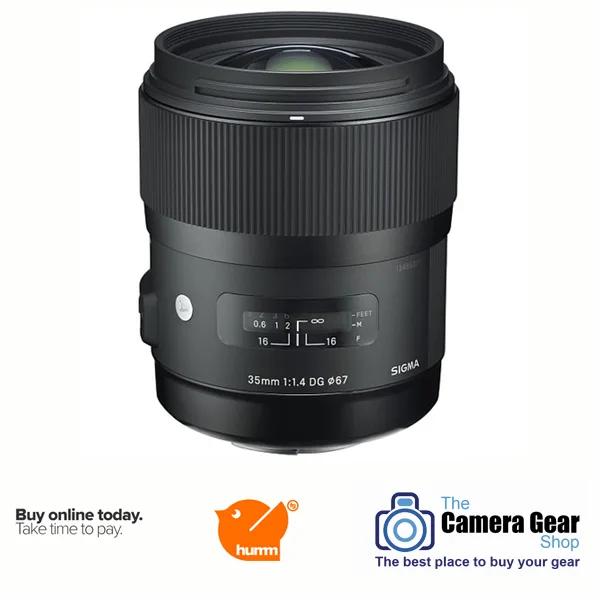
Sigma 35mm f/1.4 DG HSM Art Lens Canon Mount
-
Sigma 40mm f/1.4 DG HSM Art Lens Canon Mount: The Sigma 40mm f/1.4 DG HSM Art Lens is a wide normal-length lens characterized by a bright design and sophisticated optical layout. The fast f/1.4 maximum aperture helps to achieve shallow depth of field and selective focus effects, and also suits working in difficult lighting conditions. Its more advanced optical design is engineered to minimize aberrations, delivering exceptional sharpness and contrast even wide open, which is critical for high-resolution sensors and large prints.
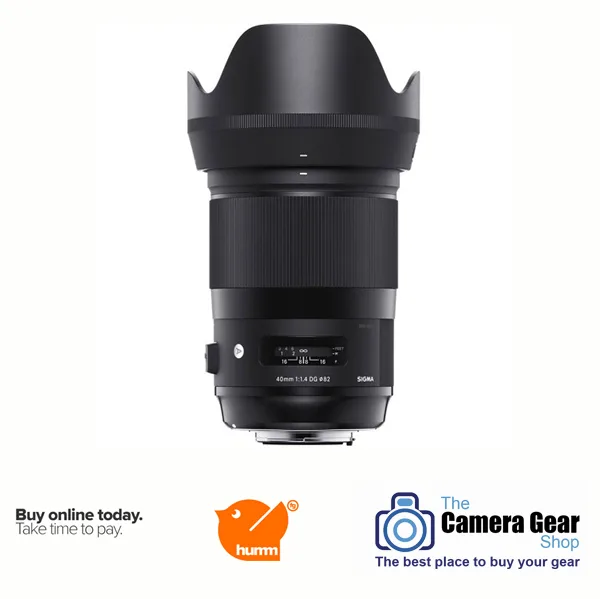
Sigma 40mm f/1.4 DG HSM Art Lens Canon Mount
Which one fits you?
Best for
- Budget-conscious photographers who want top-tier sharpness without the premium price – choose the Sigma 35mm f/1.4 Art.
- Portrait and wedding photographers who prefer a slightly tighter focal length and need maximum edge-to-edge quality – choose the Sigma 40mm f/1.4 Art.
Not for
- If you need a true wide-angle perspective for architecture or landscapes, neither lens is wide enough – consider a 24mm or 28mm prime.
- If you are on a tight budget, the 40mm f/1.4 Art may be overkill – the 35mm offers similar real-world performance for much less.