Why Build Simple Machines?
Simple machines are the building blocks of mechanical physics. Levers, pulleys, inclined planes, wedges, screws, and wheels-and-axles show how force and motion work. Building models of these machines gives kids a concrete understanding of abstract concepts like mechanical advantage and direction of force.
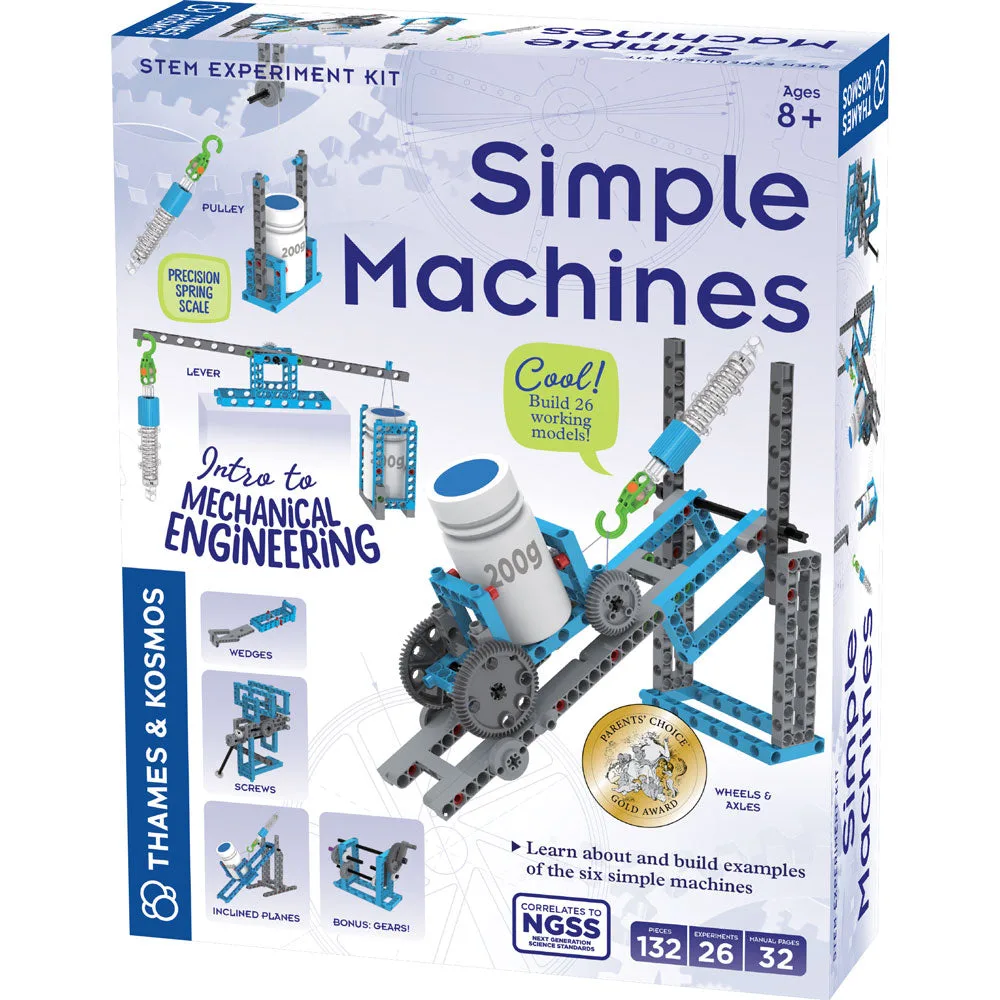
The Thames & Kosmos Simple Machines kit provides everything needed to build 26 different models. Each model demonstrates a specific principle, from how a seesaw (lever) works to how a flagpole (pulley) makes lifting easier.
What the Kit Includes
-
Simple Machines: 132 pieces including a spring scale to measure force The spring scale lets kids quantify how each machine changes the effort needed, turning play into real measurement.
Simple Machines
-
Simple Machines: 32-page full-color manual with 26 experiments The manual explains real-world examples and guides kids from simple to complex builds step by step.
A Practical Build Sequence
Start with simple models to understand the basic principle of each machine. Then combine machines to see how they work together.
- Start with the lever: Build a simple seesaw to understand fulcrum, load, and effort. Measure how moving the fulcrum changes the force needed.
- Move to the pulley: Assemble a fixed pulley and then a movable pulley. Use the spring scale to compare the force required to lift a weight.
- Explore the inclined plane: Build a ramp and measure how the angle affects the force needed to pull a load up. Compare with a wedge model.
- Combine machines: Try the wheel-and-axle with a lever or add a screw to a pulley system. The manual shows which models work together.
What to Expect from the Experiments
Each of the 26 experiments builds on the last. Early models focus on one machine, while later ones combine two or more. The manual includes everyday examples—like a wheelbarrow (lever and wheel) or a ramp (inclined plane)—to connect the build to real life.
Because the pieces are modular, kids can disassemble and reconfigure models endlessly. The spring scale allows them to test their own designs, not just the manual's instructions.
Practical Tips for Success
The kit is designed for ages 8 and up. Younger children may need help reading the manual or fitting pieces. The models are sturdy but not indestructible—gentle handling ensures they last for repeated builds.
If you're teaching a classroom, the Simple Machines - Classroom Bundle 10-Pack serves up to 30 students. For homeschool or individual use, the standard kit is sufficient.
No batteries are required, so setup is quick and the focus stays on the mechanics.