Same Speed, Opposite Frames
The Sirui Nightwalker 16mm and 75mm T1.2 are the wide and telephoto ends of the same cine lens family. Both share the T1.2 aperture, a consistent look, similar character, high sharpness, and minimal breathing. The decision is not about image quality between them; it is about which angle of view your first project actually needs.
If you shoot in tight interiors or need to establish a scene with a small crew, the 16mm gives you more room. If you prioritize isolating a subject and compressing the background, the 75mm does that. The twin lens kit makes sense when you already know you need both ends, but buying one first is a legitimate way to learn how you shoot.
16mm vs 75mm: The Practical Differences
- Focal length and framing: 16mm is a wide-angle lens; 75mm is a telephoto. The 16mm captures more of a room or landscape, while the 75mm narrows the field of view and pulls distant subjects closer. The catalog does not list a full-frame equivalent, so judge framing on your S35 sensor.
- Aperture: Both are T1.2, so low-light capability and shallow depth of field are shared. The difference is how much background compression you get at that aperture: the 75mm will isolate a subject more aggressively at the same T-stop.
- Mount options: The kit is available in Sony E Mount (APS-C) and Fuji X Mount. Confirm your camera body uses one of these before ordering; the supplied information does not confirm adapters or other mounts.
- Color: Both lenses come in black or metal gray. The black version is the one listed as the twin lens kit here; color is a cosmetic choice, not an optical one.
What the Nightwalker Kit Confirms
-
Sirui Nightwalker Series 16mm & 75mm T1.2 S35 Cine Twin Lens Kit (Black): The 16mm and 75mm are T1.2 fast aperture lenses and complete the Nightwalker range after the earlier 24mm, 35mm and 55mm. The shared T1.2 speed is the reason these two lenses can be compared on framing rather than exposure; the earlier focal lengths also tell you the family is designed as a set.
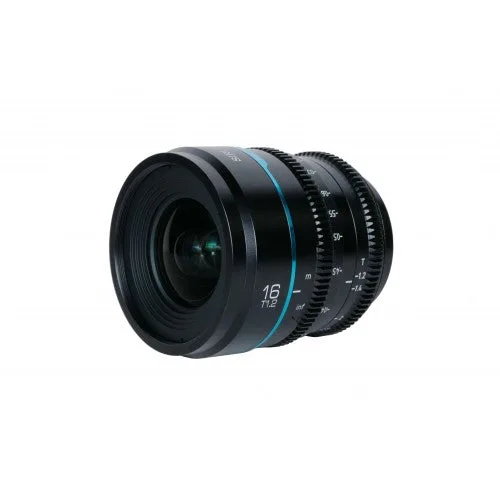
Sirui Nightwalker Series 16mm & 75mm T1.2 S35 Cine Twin Lens Kit (Black)
-
Sirui Nightwalker Series 16mm & 75mm T1.2 S35 Cine Twin Lens Kit (Black): Lenses in this kit feature a consistent look, similar character, high sharpness and minimal breathing effect. Matched character matters when you cut between a wide and a telephoto shot; it reduces the visual jump between focal lengths.
-
Sirui Nightwalker Series 16mm & 75mm T1.2 S35 Cine Twin Lens Kit (Black): The kit is offered in Sony E Mount (APS-C) and Fuji X Mount, in black or metal gray. Mount and color are the two order-time choices; neither changes the optical comparison between 16mm and 75mm.
Which One to Buy First
Choose based on the shots you miss most often, not on which lens sounds more impressive. The catalog does not include sample footage, minimum focus distance, or weight, so use your own shooting patterns to decide.
- Start with the 16mm if: You shoot interiors, cramped locations, or wide establishing shots, and you need to keep more of the scene in frame. Its wide angle is the practical choice when you cannot back up further.
- Start with the 75mm if: You shoot portraits, detail shots, or scenes where you want to isolate a subject from the background. The telephoto compression at T1.2 gives a distinctly different look from a wide lens.
- Buy the twin kit if: You already know you need both ends of the range and want a consistent look across a scene. The kit is the efficient path to a matched wide-and-tele pair, but only if both focal lengths earn their place in your bag.
What the Supplied Information Does Not Cover
The catalog does not confirm weather sealing, lens weight, filter thread size, minimum focus distance, or whether the lenses are parfocal. It also does not list camera-body compatibility beyond the two mounts above. If any of those details are decisive for your shoot, verify them with the manufacturer before ordering rather than assuming.
There is also no supplied information on image circle coverage beyond the S35/APS-C mounts listed, so do not assume the lenses cover full-frame sensors. Treat the mount variant as the compatibility boundary.