Quick answer
Paint a skeleton legion by working in batches: apply a mid-tone bone basecoat, wash the whole unit to define recesses, then layer and highlight bone only on raised surfaces. This keeps rank-and-file figures consistent and fast to finish.
Why batch painting beats figure-by-figure work
Painting a skeleton legion one figure at a time multiplies drying time and makes it hard to keep bone tones matched across the unit. Batch work lets you apply the same step to every model before moving on, so the whole unit advances together.
The trade-off is that you lose some individual character. For rank-and-file skeletons that is usually the right call; save extra detail for champions or characters.
Where bone layering usually goes wrong
The most common failure is applying layer paint too thickly to fix a patchy basecoat. That fills in the fine recesses that make bone read as bone. Thin the layer paint and build coverage over two passes instead.
Another frequent mistake is washing the entire model after the layer stage. Wash belongs before layering so the raised surfaces stay clean for highlights.
Bone layering steps for a skeleton legion
- Clean and prime the whole unit: Remove mold lines, then prime every skeleton in the batch with a light grey or bone-colored primer. A light primer makes the bone basecoat easier to judge. Check that recesses are not clogged with primer before you start painting.
- Basecoat bone in thin passes: Apply a mid-tone bone acrylic to all bone areas across the unit. Thin the paint and use two thin coats rather than one thick coat. Stop when the primer is just covered; a slightly uneven basecoat is fine at this stage.
- Wash the recesses: Apply a brown or sepia wash over the bone areas, letting it settle into joints, eye sockets, and rib gaps. Work one figure at a time so the wash does not dry before you move it. Wick away any wash pooling on flat surfaces with a clean brush.
- Layer the raised bone: Once the wash is fully dry, layer the original bone tone or a slightly lighter bone over raised surfaces, avoiding the recesses. Use a brush with a fine tip and thin the paint. Leave the wash visible in the deepest recesses; do not paint over them.
- Highlight the edges: Apply a final highlight of pale bone or off-white to the sharpest edges: brow ridges, cheekbones, knuckles, and rib edges. Keep the highlight narrow. If the highlight looks chalky, thin it further and apply less.
- Seal and check consistency: Once the unit is dry, apply a matte varnish to protect the paint. Line the figures up and check that bone tones match across the batch before gaming. Touch up any figure that reads noticeably darker or lighter than the rest.
Paint note for this method
-
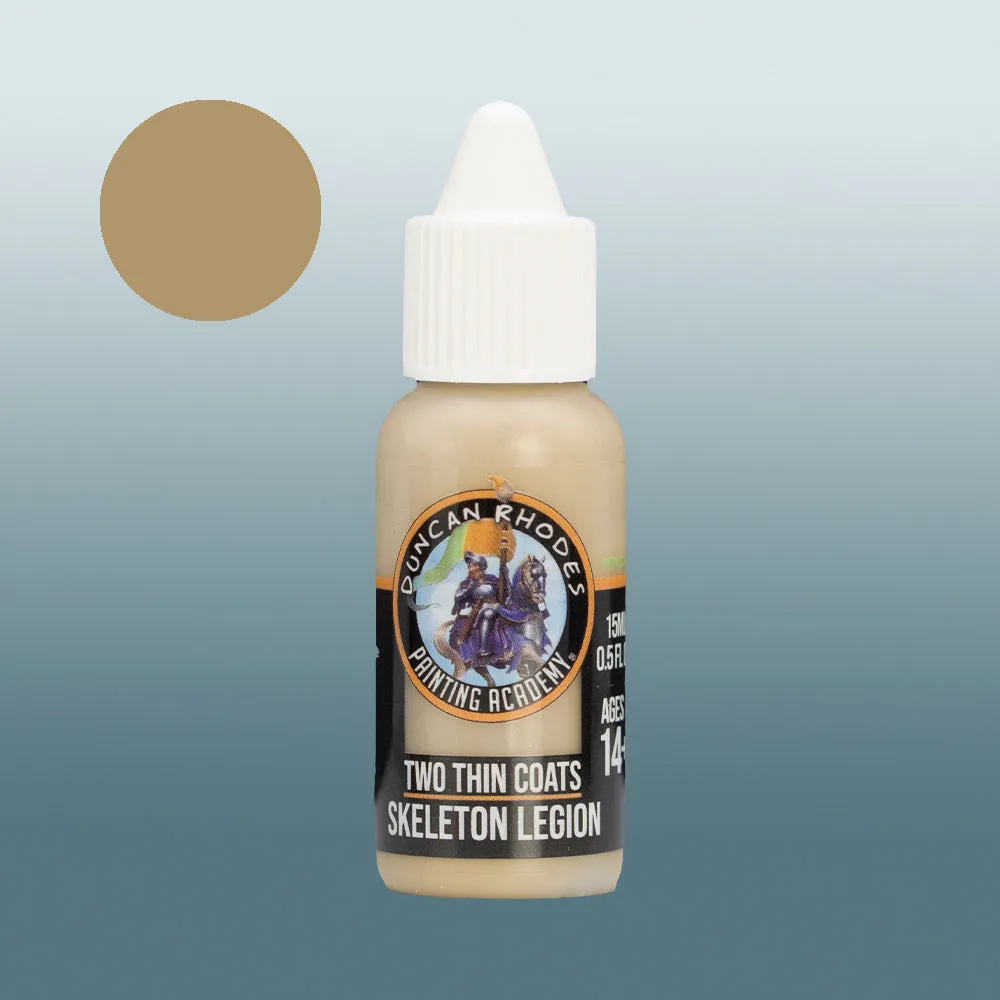
Skeleton Legion: Duncan Rhodes Two Thin Coats paint comes in 15ml bottles and is designed for any level of hobbyist. A 15ml bottle gives enough paint for a full skeleton unit, and the range is formulated for both beginners and experienced painters, so you can follow the same layering steps without switching paint systems.
Skeleton Legion