Why awkward silences happen—and what actually fixes them
Silence at a gathering usually isn't a sign that people don't like each other. It's a sign that nobody has been handed a clear next step. Groups drift when the conversation has no shared focus, especially when people don't know each other well or when the event mixes couples, families, friends, students, or colleagues.
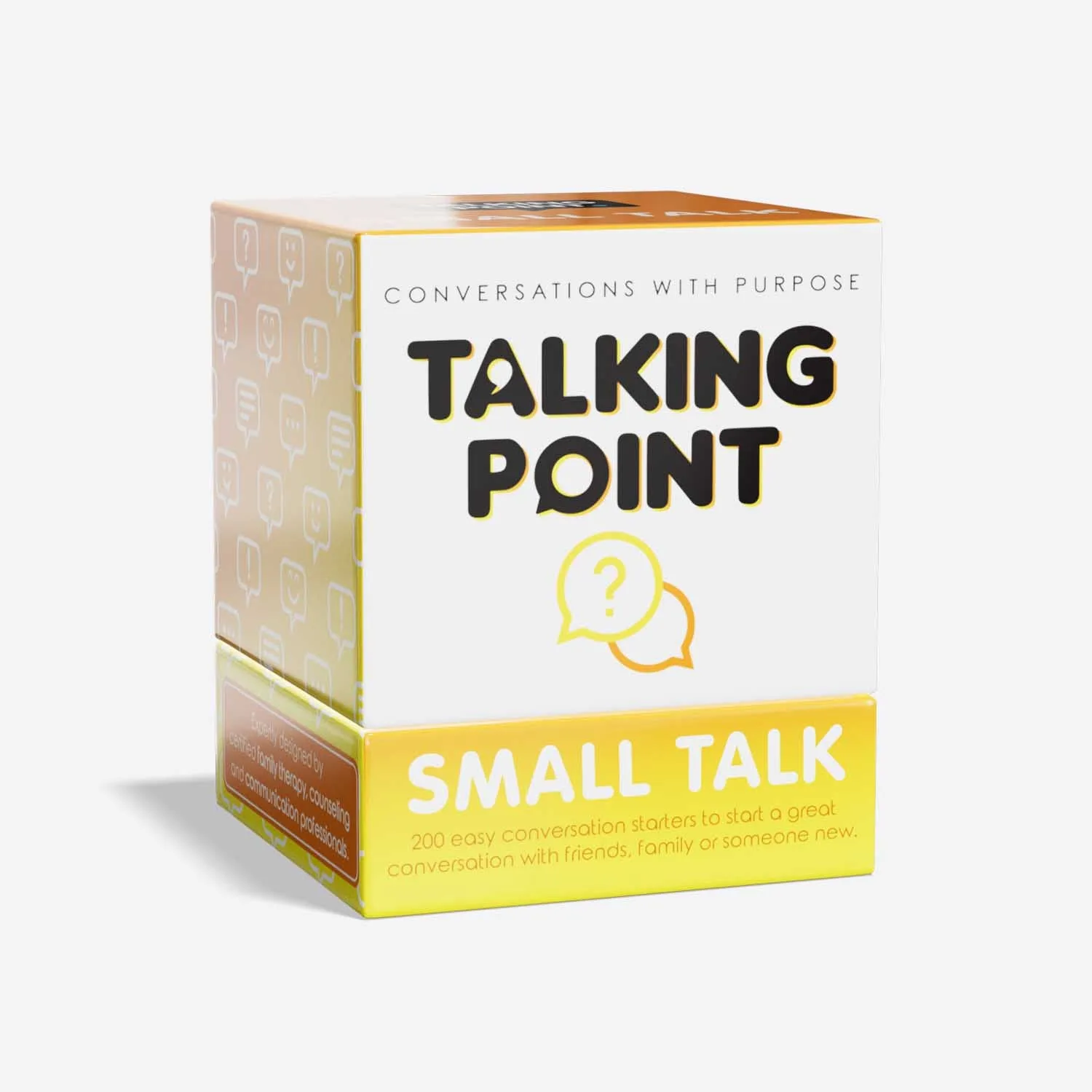
The Small Talk Edition from Talking Point Cards is designed for exactly that moment. It's a deck of conversation starter cards meant to spark natural, engaging exchanges and turn small talk into meaningful conversation. The practical question is how to use it so it feels like part of the evening, not a forced activity. That's what the routine below is for.
A simple routine for using the Small Talk deck
You don't need a script or a facilitator. The deck is described as compact and easy to use, so the routine can stay light. Treat these steps as a flexible sequence, not a rigid ceremony.
- 1. Set the deck out before the lull: Place the cards where people can reach them—on the dinner table, a coffee table, or near the snacks. The deck is designed to be a simple addition to any event or daily routine, so making it visible early removes the awkwardness of introducing it mid-silence.
- 2. Introduce it as an option, not an assignment: A low-pressure line works best: "There are some conversation cards here if we want them." The product is built to ease awkward silences at social or professional gatherings, but people engage more readily when they can opt in.
- 3. Draw one card and let the group answer: One card at a time keeps the focus shared. The deck is designed to spark natural, engaging conversations, so give the first answer room to breathe rather than rushing to the next card.
- 4. Follow the conversation, not the deck: If an answer opens a real thread, stay with it. The cards are a starting point for meaningful exchanges, not a quiz to finish. You can always return to the deck when the energy dips again.
- 5. Pass or skip without commentary: Not every prompt will suit every group. Let people pass and move on. The goal is genuine interaction, and forcing an answer undercuts that.
What the Small Talk Edition is built for
-
Small Talk: Designed to spark natural, engaging conversations and help turn small talk into meaningful exchanges. This is the core purpose of the deck, so use it to deepen a conversation rather than to fill time with rapid-fire questions.
Small Talk
-
Small Talk: Versatile for couples, families, friends, students, and workplace teams. One deck can cover mixed gatherings, which matters if your event includes different relationship groups.
-
Small Talk: Encourages genuine interaction and helps ease awkward silences at social or professional gatherings. It gives you a concrete tool for the exact moment this article addresses, without requiring a formal icebreaker game.
-
Small Talk: Compact and easy to use, making it a simple addition to any event or daily routine. Low setup effort means you're more likely to actually bring it out, whether at a dinner or a team meeting.
Matching the deck to the room
The same deck can work across settings, but how you introduce it should change with the group. The product record lists couples, families, friends, students, and workplace teams as intended users, so use that as your guide.
- Quiet dinner or date night: Keep the pace slow. Draw a card when conversation naturally pauses, and let one question carry the rest of the meal. The deck's stated purpose—turning small talk into meaningful exchanges—fits a two-person setting well.
- Family gathering: Set the deck in the middle of the table and let people draw in turn. Mixed ages and familiarity levels are exactly where a shared prompt helps, because everyone gets the same starting point.
- Party or social event: Leave the deck accessible and mention it once. Guests can use it in small clusters. The cards are described as suitable for casual get-togethers, so they don't need a formal host-led activity.
- Workplace team-building: Use one card at the start of a meeting or team lunch to ease awkward silences in a professional setting. The deck is listed for workplace teams and team-building activities, but keep the tone optional so colleagues can participate comfortably.
What to keep in mind before you buy
The supplied product information does not list an age range, a card count, or specific safety warnings for the Small Talk Edition. If those details matter for your group—for example, a family event with young children—check the product listing directly before purchasing rather than assuming.
The deck is also not described as a structured game with rules or scoring. It's a conversation tool. That's a strength for gatherings where a formal game would feel heavy, but it's a trade-off if your group expects clear instructions and a winner.
At the catalog price of USD 27.42 (compared with a catalog comparison price of USD 44.95), the deck is positioned as a reusable item rather than a one-time party supply. If you host regularly or want a simple routine for dinners and meetings, that reuse is where the value sits.