The real difference is how the bell gets rung
A hanging bell and an electronic dog doorbell both give your dog a way to signal potty time, but they ask for different actions. A hanging bell usually needs a nose or paw to push or swing the bell itself, and the sound comes from the bells moving. The Mighty Paw Smart Bell 2.0 uses a wireless transmitter that rings when your dog presses it with about 0.75 lbs of pressure, and a receiver that plays one of 38 ringtones at one of four volume settings.
That difference matters for dogs who are hesitant to touch a swinging object, and for owners who want to choose how loud the signal is. It also changes what you need to install and power, which is where the two options really part ways.
Side by side: trigger, power, and placement
- How your dog rings it: Smart Bell 2.0: a press of about 0.75 lbs with nose or paw on the wireless transmitter. Hanging bell: your dog pushes or swings the hanging bells, and the sound comes from the bells themselves.
- Power: Smart Bell 2.0: the transmitter operates without power or electricity, and the receiver plugs into a standard 110v outlet. No battery charging or replacement is required for the transmitter. A hanging bell needs no power at all.
- Installation: Smart Bell 2.0: 3M adhesive mounts the transmitter to a wall or door without screws or tools. A hanging bell typically hangs from a door handle or hook, so placement depends on what you can hang it from.
- Sound and volume: Smart Bell 2.0: four volume settings and 38 ringtones let you adjust the signal. A hanging bell's sound is whatever the bells make when moved.
- Indoor and outdoor use: Smart Bell 2.0: water-resistant design allows indoor or outdoor use, with communication range up to 1000 feet indoors. A hanging bell's suitability outdoors depends on its material, which the supplied information does not cover.
What the Smart Bell 2.0 record confirms
-
Smart Bell 2.0: Wireless transmitter operates without power or electricity; receiver plugs into a standard 110v outlet. You only need an outlet for the receiver, not batteries or charging for the part your dog presses.
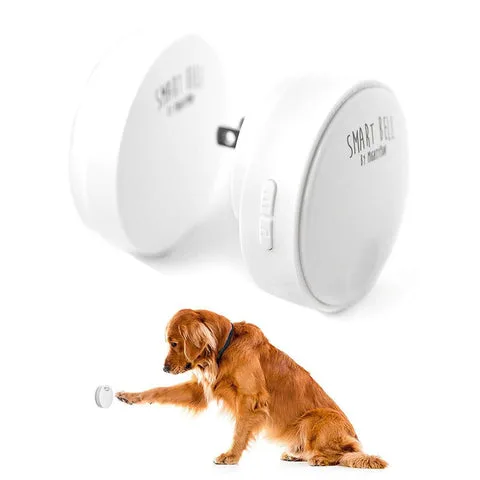
Smart Bell 2.0
-
Smart Bell 2.0: 3M adhesive for easy wall or door mounting, no screws or tools. Installation is renter-friendly and doesn't require drilling, which is a practical advantage over hanging hardware.
-
Smart Bell 2.0: Four volume settings and 38 ringtones. You can choose a signal that fits your home and your dog's response, rather than accepting one fixed bell sound.
-
Smart Bell 2.0: Just 0.75 lbs of pressure with the nose or paw rings the bell. A light touch is enough, which may suit small dogs or dogs learning to target with their nose.
Where a hanging bell still makes sense
A hanging bell has no receiver, no outlet, and no pairing step, so it can be the simpler choice if you want a purely mechanical signal and your dog already nudges or swats at hanging objects. It also travels easily if you need a potty signal at a friend's house or on a trip, provided you have something to hang it from.
The trade-off is control: you can't adjust volume or choose a ringtone, and the sound depends on how hard the bells move. The supplied information for the Smart Bell 2.0 does not describe a hanging bell's materials or mounting hardware, so check those details on any hanging bell you consider.
Which dog bell to choose for your routine
- Choose the Smart Bell 2.0 if your dog needs a light-touch target: The 0.75 lbs pressure requirement and the fixed transmitter give a consistent spot to press, which can help dogs who are learning to signal rather than scratch or bark.
- Choose the Smart Bell 2.0 if you want adjustable sound: Four volume settings and 38 ringtones let you set a signal you can hear without it being overwhelming, and the receiver plugs into a standard 110v outlet.
- Choose the Smart Bell 2.0 if you need indoor or outdoor flexibility: The water-resistant design and up to 1000 feet indoor range support use beyond a single door, as long as the receiver has an outlet.
- Choose a hanging bell if you want zero power and zero setup: A hanging bell needs no outlet and no adhesive, so it can be the faster option if your dog already rings it reliably and you don't need volume control.
- Choose a hanging bell if you need a portable signal: With no receiver to plug in, a hanging bell can move between doors or travel with you, provided you have a place to hang it.
What the comparison does not settle
The supplied information for the Smart Bell 2.0 does not include a training protocol, recommended pressure for specific dog sizes, or battery life for the receiver beyond plugging into a 110v outlet. It also does not describe how the adhesive performs on different surfaces over time. Those are practical questions to check against the product listing or the manufacturer's instructions before you buy.
For a hanging bell, the supplied information does not cover materials, bell size, or outdoor durability. Treat both options as tools that need a consistent routine, and pick the one whose trigger and power setup fit your dog and your home.