Quick answer
Choose a socket cap screw when you need a compact, high-clamp-load joint driven with a hex key in a tight or recessed space. Choose a hex bolt when you have room for a wrench, want a standard external hex head, and can accept a larger head footprint. If your assembly is machinery, tooling, or a precision jig, socket cap screws are usually the better fit.
Drive and head style decide the job
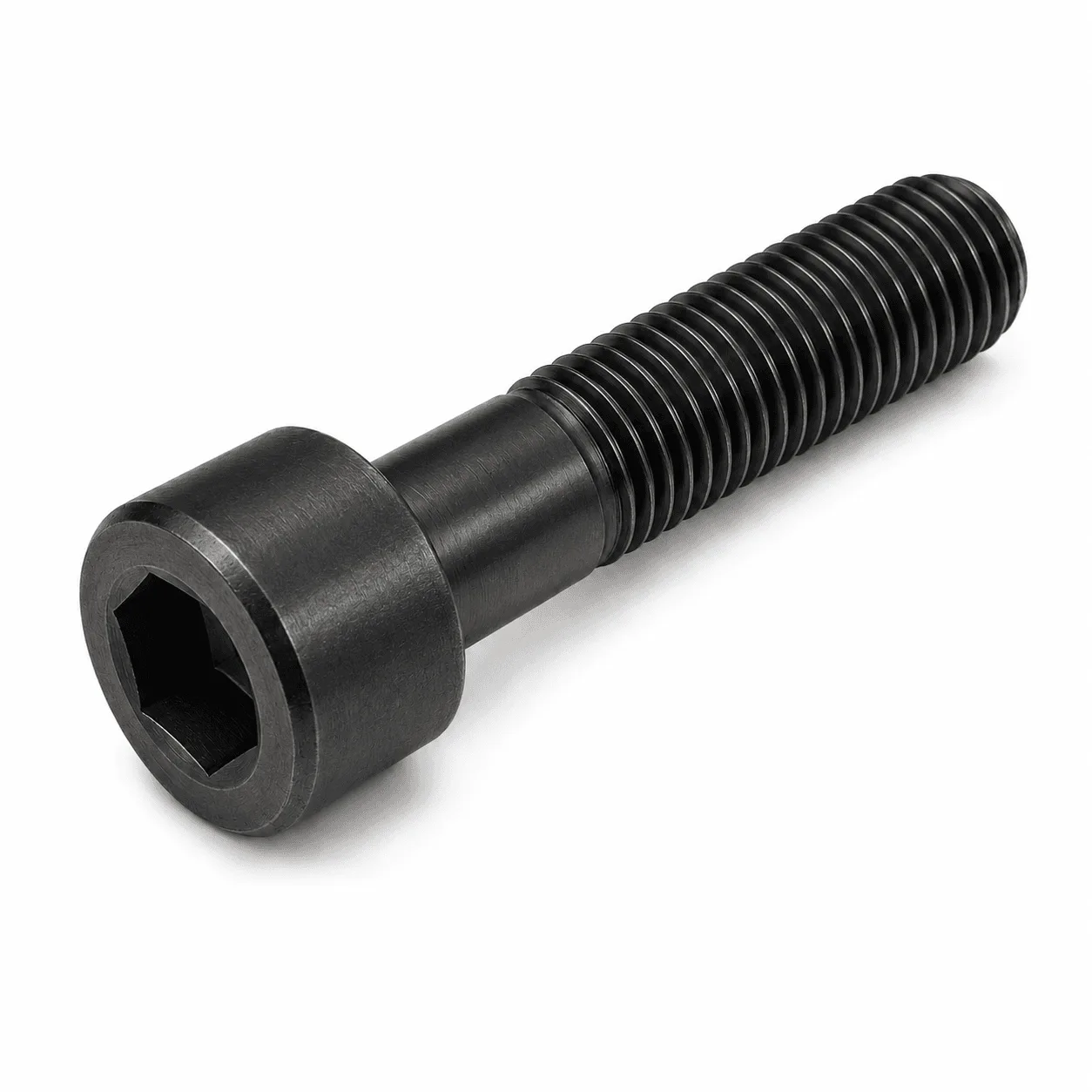
A socket cap screw uses an internal hex socket drive, so you turn it with an Allen key or hex bit. That lets the head stay small and cylindrical, which is useful when the screw sits in a counterbore, a recess, or beside a wall where a wrench cannot swing. A hex bolt uses an external hex head turned with a wrench or socket, so it needs more swing room and a wider bearing surface.
The practical result: socket cap screws win in tight envelopes and low-profile joints, while hex bolts win when you want fast wrench access, a familiar external head, and a broad clamping face.
Strength and material: match the class to the load
Strength is not a single number for either family. It comes from the material and the property class or grade. In the supplied catalog, the M2-0.4 and M8-1.25 socket cap screws are Class 12.9 alloy steel zinc plated, while the 3/8-16 x 5" and #10-32 x 1-1/2" socket cap screws are alloy steel with a thermal black oxide finish. Class 12.9 indicates a high-strength alloy steel socket screw; the black oxide and zinc plated finishes are surface treatments, not strength ratings.
Do not assume a socket cap screw is automatically stronger than a hex bolt just because it looks smaller. Compare the actual grade or class, the thread size, and the length of engagement. If a supplier does not list a property class or grade, treat that as missing data and confirm it before you rely on the joint for a critical load.
Button head vs flat head socket: pick by clearance and finish
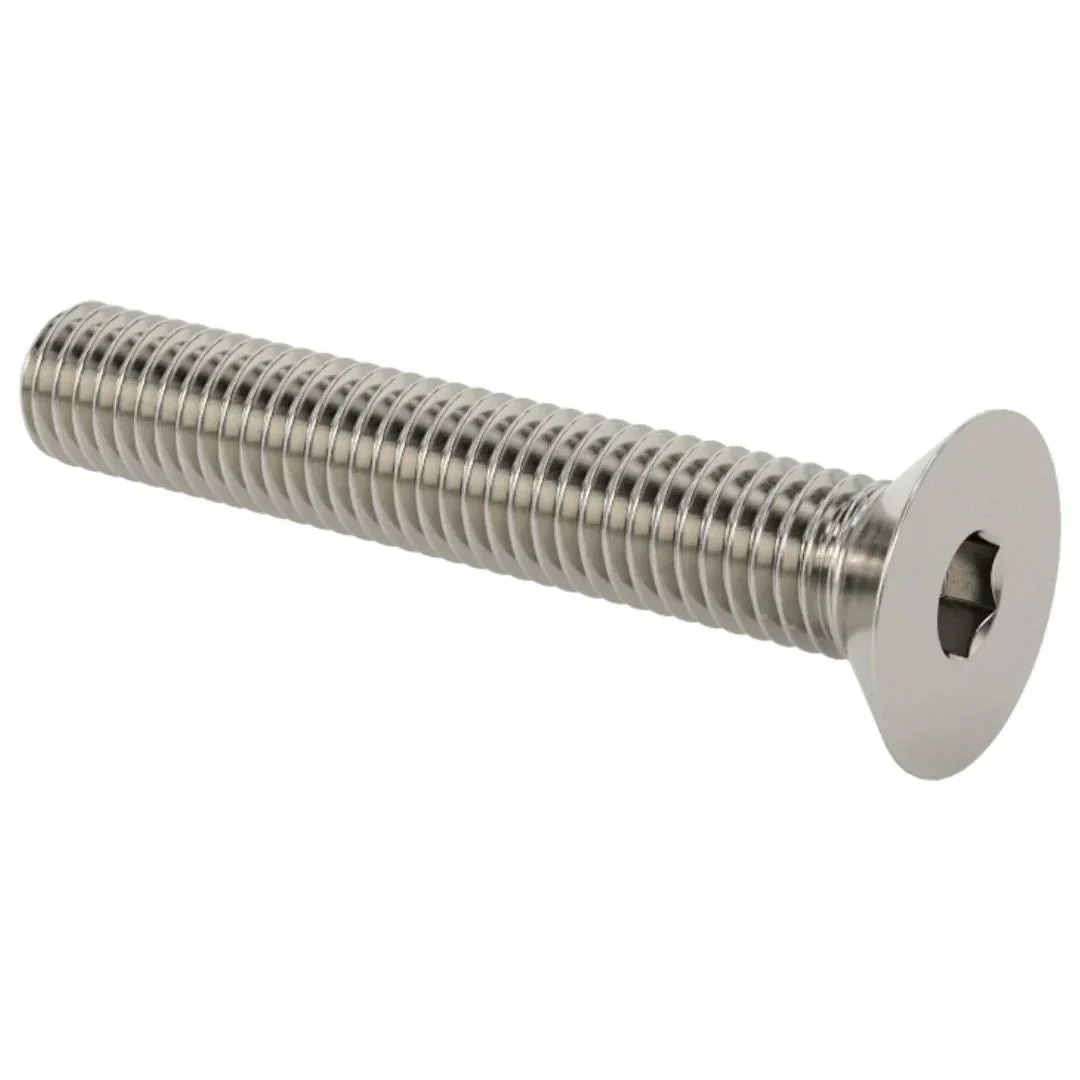
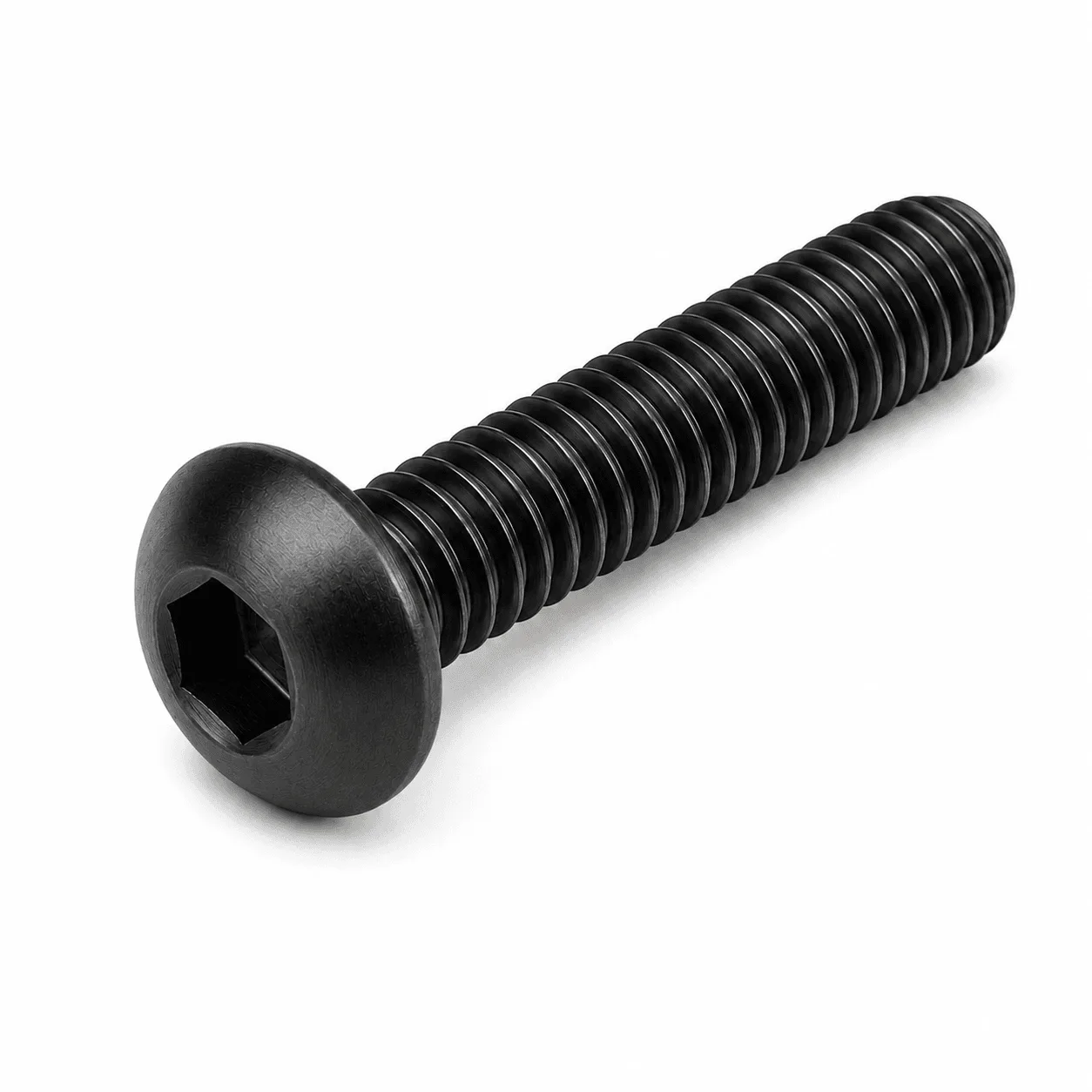
Within socket cap screws, head shape changes what the joint looks like and how it seats. A button head has a rounded, low-profile dome and typically uses a smaller hex key than a standard socket head of the same thread size. A flat head is countersunk, so it sits flush or below the surface when the hole is chamfered to match. The 3/8-16 x 5" screw here is a button head, while the M2-0.4 x 10mm and M8-1.25 x 75mm screws are flat head.
Choose flat head when you need a flush surface or a clean, snag-free face. Choose button head when you want a low dome that still sits above the surface and you do not want to cut a countersink. If the head must not protrude, a button head is the wrong choice.
Threading and installation details that change the answer
Thread style matters as much as head style. Fully threaded screws, like the 3/8-16 x 5" and M2-0.4 x 10mm items, grip along the whole shank and suit thinner stacks or adjustable positions. Partially threaded screws, like the M8-1.25 x 75mm and #10-32 x 1-1/2" items, have an unthreaded shank that can act as a dowel or shear pin and resist thread wear at the joint line.
The #10-32 x 1-1/2" screw also carries a nylon patch, a pre-applied locking element that resists loosening from vibration. That is a real advantage on machinery and tooling that shakes, but it also adds installation friction, so do not expect it to spin down as freely as a plain screw. Match the locking method to the vibration the joint will actually see.
How to decide in under a minute
Ask three questions. First, how much room do you have around the head? If a wrench cannot swing, go socket. Second, does the head need to sit flush? If yes, go flat head socket with a matching countersink. Third, what load and vibration will the joint see? If it is high load, confirm the class or grade; if it vibrates, consider a nylon patch or another locking method.
Then check the thread size and length against your hole depth and material thickness. Buying a longer screw than the hole allows is a common and avoidable mistake, especially with fully threaded screws that bottom out.
Trade-offs to weigh before you order
- Socket cap screw: compact drive, smaller head: Uses an internal hex key, so it works in tight recesses and counterbores where a wrench will not fit. The trade-off is that you need the right hex key or bit and you cannot apply the same external torque leverage as a hex bolt. Best when clearance is tight and the joint is machinery, tooling, or a precision assembly.
- Hex bolt: external head, wrench access: A standard hex head turns with a wrench or socket and spreads load over a wider bearing face. The trade-off is a larger head footprint and the swing room a wrench needs. Best when you have open access and want fast, familiar tightening.
- Button head vs flat head socket: Button head is a low dome that sits above the surface and uses a smaller hex key. Flat head is countersunk to sit flush but requires a matching chamfer in the hole. Pick flat head for flush surfaces; pick button head when you cannot or do not want to countersink.
- Fully threaded vs partially threaded: Fully threaded screws grip along the whole shank and suit thin stacks or adjustable positions. Partially threaded screws leave an unthreaded shank that can act as a dowel or shear pin. Match the thread style to the joint, not just the head style.
- Locking features such as a nylon patch: A nylon patch resists vibration loosening, which is valuable on machinery and tooling. The trade-off is added installation friction and a slightly higher cost per screw. Use locking features where vibration is real, not as a default on every joint.
Catalog examples that show the differences
- 3/8-16 X 5" Socket Cap Screws | Button Head Hex Socket Drive | Fully Threaded | Alloy Steel Thermal Black Oxide (100 / Pkg.): 3/8-16 x 5" socket cap screws, button head, hex socket drive, fully threaded, alloy steel thermal black oxide, 100 per package. A long, fully threaded button head screw for low-profile clamping where the head can sit above the surface and you want thread along the whole shank.
- M2-0.4 X 10mm Socket Cap Screws | Flat Head Hex Socket Drive | Fully Threaded | Class 12.9 Alloy Steel Zinc Plated (600 / Pkg.): M2-0.4 x 10mm socket cap screws, flat head, hex socket drive, fully threaded, Class 12.9 alloy steel zinc plated, 600 per package. A small, high-strength flat head screw for flush, precision assemblies such as electronics, small tooling, and compact jigs.
- M8-1.25 X 75mm Socket Cap Screws | Flat Head Hex Socket Drive | Partially Threaded | Class 12.9 Alloy Steel Zinc Plated (100 / Pkg.): M8-1.25 x 75mm socket cap screws, flat head, hex socket drive, partially threaded, Class 12.9 alloy steel zinc plated, 100 per package. The partial thread gives an unthreaded shank for shear or alignment, and the flat head sits flush in a countersunk hole.
- #10-32 X 1-1/2" Socket Cap Screws | Hex Socket Drive | Nylon Patch | Partially Threaded | Alloy Steel Thermal Black Oxide (200 / Pkg.): #10-32 x 1-1/2" socket cap screws, hex socket drive, nylon patch, partially threaded, alloy steel thermal black oxide, 200 per package. The nylon patch adds vibration resistance, which suits machinery and tooling that loosens plain fasteners over time.
Which should you buy?
Choose socket cap screws if
- You are assembling machinery, tooling, jigs, or precision equipment where head clearance is limited.
- You need a flush or low-profile head, such as a flat head in a countersunk hole.
- You want a high-strength alloy steel option such as Class 12.9 for a compact, high-clamp-load joint.
Choose hex bolts instead if
- You have open access and want to tighten quickly with a standard wrench or socket.
- You need a wide external bearing surface and do not mind a larger head footprint.
- You are working on a structural or outdoor application where a specific bolt grade and coating are required and a socket screw is not the specified fastener.