Quick Answer
Choose a sofa table when you need a surface directly behind your couch at roughly seat-back height; choose a console table when you need a slimmer, taller surface for an entryway, hallway, or wall. The two styles overlap in looks but differ in depth, height, and where they belong.
What Is a Sofa Table, and Where Does It Go?
A sofa table is designed to stand behind the couch, so its height should land close to the sofa back—typically around 30 to 34 inches, though the exact figure depends on your sofa. That placement makes it useful for lamps, drinks, and decor that you can reach from the seating area without a coffee table.
Depth matters as much as height. A sofa table behind couch setup usually needs a narrower footprint than a dining table but enough surface to hold a lamp base or a tray. If your sofa sits against a wall with no gap, a sofa table will not fit; you need clearance behind the couch.
Console Table Dimensions and Entryway Use
Console tables are commonly narrower in depth and taller than sofa tables, which suits an entryway console table against a wall where foot traffic passes in front. Typical console table dimensions are around 28 to 36 inches tall and 12 to 16 inches deep, but these vary by design, so measure your space rather than assuming.
The trade-off is stability and surface area: a very narrow console saves floor space but holds less, and a tall, light console can feel less grounded in a busy hallway. A deeper console gives more display room but eats into walkway width.
Sofa Table vs Console Table Trade-Offs
- Height and placement: A sofa table is sized to sit behind the couch near seat-back height, while a console table is usually taller and intended for a wall or entryway. Measure your sofa back height and the gap behind it before choosing a sofa table. If your sofa touches the wall, a console table elsewhere is the more practical buy.
- Depth and traffic flow: Console tables are typically shallower, which keeps an entryway console table from blocking a hallway, but that also limits what you can place on top. A sofa table can be deeper because it sits behind seating rather than in a walkway. In narrow hallways, prioritize depth over surface area.
- Style and material presence: Because a sofa table is often seen from the living room side, a design like the Burkhaus Sofa Table with a marble top and plinth base reads as a feature piece. A slim console may be chosen more for fit than for visual weight. Decide whether the table is a focal point or a space-saving necessity before you compare finishes.
Product Facts
-
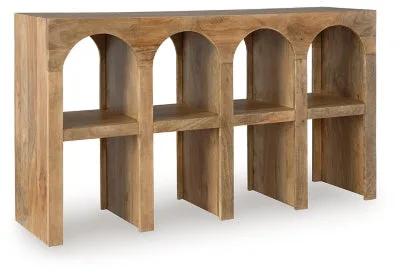
Burkhaus Sofa Table: This sofa table pairs a dark waxy brown oak finish with a natural marble tabletop and a clean-lined plinth base. The marble top and plinth base give it a substantial, furniture-like presence, so it suits a living room where the table is visible from the front rather than tucked against a wall.
Burkhaus Sofa Table
Which Should You Choose?
Best for
- Living rooms with clearance behind the couch where you want a reachable surface for lamps and decor
- Open-plan spaces where a sofa table can define the boundary between seating and the room behind it
Not for
- Sofas pushed flat against a wall with no gap behind them
- Narrow entryways where a deeper table would block foot traffic