Quick answer
For most commercial parking lots and pathways, a 200W solar street light with a stay-on feature or motion sensor offers the best balance of brightness, battery life, and cost. Choose the ES03 series for high lumens and long lifespan, or the Commercial Solar Street Light-Stay On if you need consistent overnight illumination.
Brightness vs. battery: the real trade-off
Commercial solar street lights typically range from 9,000 to 25,000 lumens. Higher lumens mean more light, but they also draw more power from the battery. A 200W light with 25,000 lumens can cover about 1,380 square feet at a 22-foot mounting height, while a 100W model covers roughly 1,080 square feet. If your area is larger or you need uniform coverage, go with higher wattage. But if your site has limited sun exposure, a lower-wattage light with a larger battery may run longer through the night.
Stay-on vs. motion sensor: which control suits your site?
Some solar street lights offer a stay-on mode that keeps the light at full brightness all night. Others include a motion sensor that dims the light to 30% when no movement is detected and switches to full brightness when someone approaches. Stay-on models are ideal for security-sensitive areas like parking lot entrances or walkways that need constant visibility. Motion-sensor models save battery life and are better for low-traffic zones like side paths or storage yards.
How to choose the right commercial solar street light
- Determine your coverage area: Measure the length and width of the area you need to light. For a parking lot of 1,000–1,500 sq ft, a 200W light (25,000 lm) works well. For smaller zones under 1,000 sq ft, a 100W or 150W model may suffice.
- Choose between stay-on and motion sensor: If security is a priority and you need constant light, pick a stay-on model like the Commercial Solar Street Light-Stay On. If you want to extend battery life and only need light when people or vehicles are present, choose a motion-sensor model (e.g., 4 PACK 60W with motion sensor).
- Check battery capacity and solar panel size: Look for at least 15,000–20,000 mAh battery for a 200W light. A larger battery (e.g., 30–60 Ah in the Commercial Solar Street Light) ensures longer runtime on cloudy days. The solar panel should match the battery: a 6V/15W panel is typical for 200W lights. If your site gets less than 4 hours of direct sun daily, prioritize a larger battery over higher lumens.
- Verify weather rating and lifespan: All commercial solar street lights should have at least IP65 waterproof rating. Look for a lifespan of 5+ years for both the LED and battery. The ES03 series and Commercial Solar Street Light both meet these criteria.
Product facts at a glance
-
200W solar street lights - ES03 Series: The ES03-200W delivers 25,000 lumens and has a 20,000 mAh battery with IP65 waterproof rating and a 5+ year lifespan. This combination provides bright, reliable lighting for medium-sized commercial areas and can withstand outdoor weather for years.
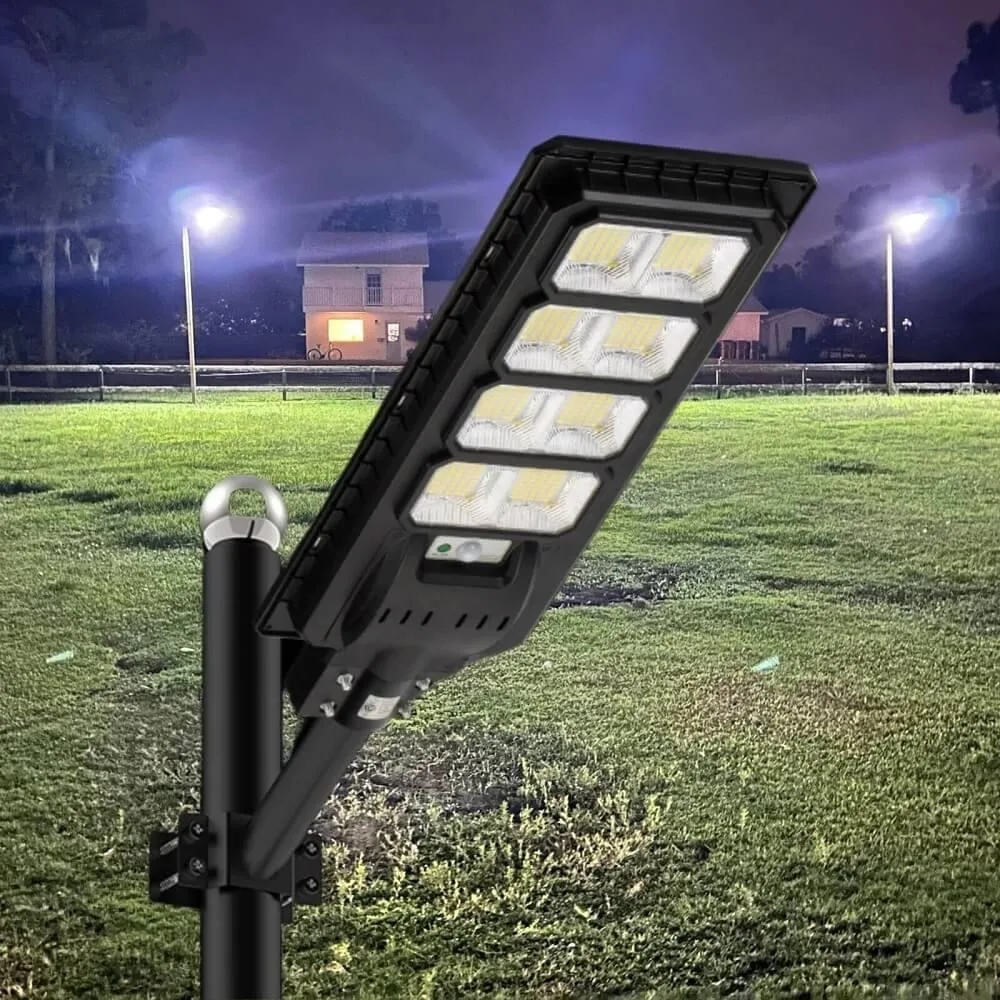
200W solar street lights - ES03 Series
-
100 W 150 W 200 W Commercial solar street light-Stay on: The Commercial Solar Street Light-Stay On offers 150 lm/W efficiency, a 22% mono solar panel, and a LiFePO₄ battery (30–60 Ah) with a 5+ year lifetime. Its high efficiency and stay-on capability make it a strong choice for locations that require uninterrupted overnight illumination.
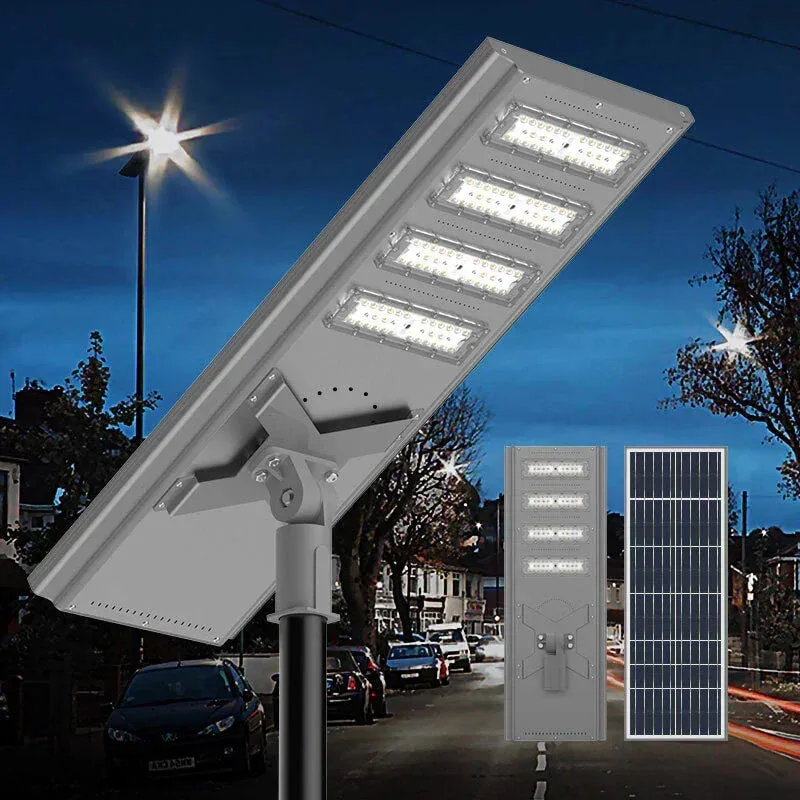
100 W 150 W 200 W Commercial solar street light-Stay on
Which light fits your project?
Best for
- Large parking lots or pathways needing 25,000 lumens and consistent coverage: ES03-200W or Commercial Solar Street Light-Stay On
- Security-sensitive areas requiring all-night full brightness: Commercial Solar Street Light-Stay On
- Budget-conscious buyers who need multiple lights: 4 PACK 60W solar street light with motion sensor
Not ideal for
- Very small areas under 500 sq ft: a single 60W or 90W light may be more cost-effective
- Sites with heavy tree cover or less than 3 hours of direct sun: consider a grid-tied or hybrid solution instead