What a Solderless 400 Point Breadboard Gives You
A solderless breadboard is a prototyping tool that lets you connect components without soldering. The Solderless 400 Point Breadboard provides 400 tie points, which are essentially holes where you can insert wires, component leads, or jumper wires to create temporary or permanent circuits. This makes it ideal for testing layouts, learning electronics, or building projects that may need reconfiguration.
Key Specifications for Your Setup
-
Solderless 400 Point Breadboard: Dimensions: 3.27 in x 2.09 in x 0.35 in (8.3 cm x 5.3 cm x 0.9 cm) This compact size fits on a small workbench or inside a project enclosure. Plan your component layout to fit within this area.
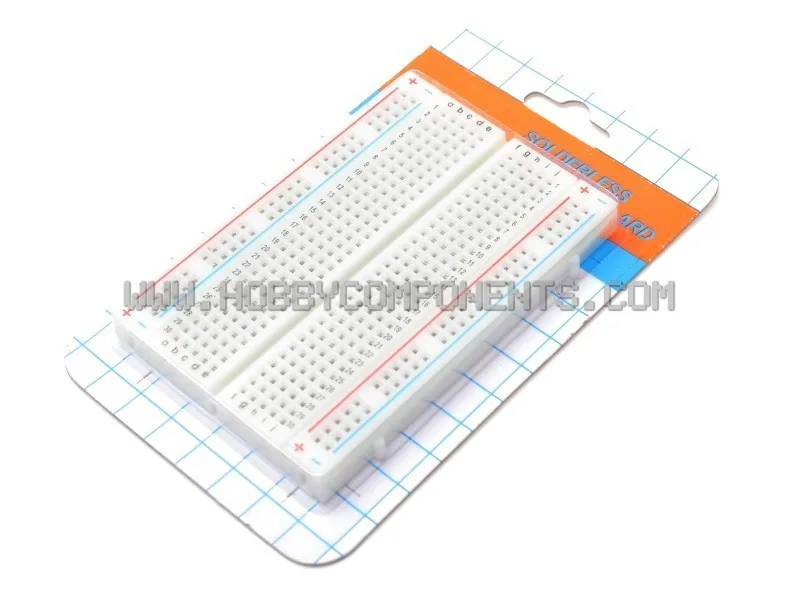
Solderless 400 Point Breadboard
-
Solderless 400 Point Breadboard: Solderless breadboard with 400 tie points 400 points give you plenty of connection options for small to medium circuits. You can run multiple signal paths without crowding.
-
Solderless 400 Point Breadboard: Self-adhesive backing for easy mounting The adhesive backing lets you attach the breadboard to a flat surface like a plastic project box or a piece of plywood, keeping it stable while you work.
First Project Setup Steps
Follow these steps to get your breadboard ready for a simple circuit.
- Prepare the mounting surface: Choose a clean, flat, non-porous surface (e.g., a plastic sheet or a piece of wood). Peel the protective film from the self-adhesive backing and press the breadboard firmly into place. Ensure it is level and secure.
- Plan your component layout: Sketch your circuit on paper, noting which component leads need to connect. The 400 tie points are arranged in a grid; use the grid to keep wiring organized. Leave space between components to avoid accidental shorts.
- Insert components and wires: Push component leads, jumper wires, or stripped wire ends into the tie points. The breadboard's holes are designed to hold wires firmly without solder. For delicate components, consider using small jumper wires to avoid stressing the leads.
- Test the circuit: Connect power and test your circuit. Because the breadboard is solderless, you can easily move wires or swap components if something doesn't work. This is a key advantage for prototyping.
Important Considerations
The 400 point breadboard is solderless, meaning connections rely on friction. For larger or heavier components, you may need to secure them with additional methods (e.g., small screws or tape) not covered by the supplied information. Also, the catalog does not confirm maximum wire gauge or current capacity; for high-power circuits, test connections for stability before relying on them.