Quick Answer
Use Spanish-English sight words flash cards in short, varied games—like Match and Snap—to build automatic word recognition and bilingual vocabulary in ESL learners.
Why Games Beat Drill for Sight Word Practice
Repeated drill can feel tedious, and young learners often tune out. Games add a layer of fun that keeps attention high and encourages more repetitions without the boredom. They also let learners practice in a low-pressure way, which is especially helpful for ESL students who may feel self-conscious about speaking.
A balanced approach is best: use games for warm-ups and review, but keep some focused drill time for new words. Games work well because they force quick recognition, but they should not replace direct instruction for brand-new vocabulary.
How to Adapt Games for Different Levels
The same game can be made easier or harder by changing the rules. For beginners, start with fewer cards and focus on matching pictures to words. For more advanced learners, use only the word cards and require a full sentence using the word.
Adjust the pace too. Slower games like Memory allow thinking time, while faster games like Snap build automaticity. Match the game speed to the learner's current confidence.
5 Games to Play with Spanish-English Flash Cards
- Match the Pair: Lay out all cards face up. The learner finds the Spanish and English cards that match the same word. Start with a small set of 10 cards and add more as they improve. Check that the learner says the word aloud when they make a match; if they stay silent, they may be matching by memory, not reading.
- Snap: Deal cards into two piles. Players take turns flipping a card and saying the word in either language. When two cards in a row show the same word (one in Spanish, one in English), the first to shout 'Snap!' wins the pile. If a player calls 'Snap' on a non-matching pair, that player loses a card. This keeps the game honest and reinforces careful attention.
- Memory Match: Place cards face down in a grid. Players take turns flipping two cards. If they show the same word in Spanish and English, they keep the pair and say the word in both languages. If not, they turn them back. Encourage players to say the word out loud even when they flip a non-match; this extra repetition builds vocabulary without making the game feel like drill.
- Sentence Builder: Show one card and ask the learner to use that word in a sentence in either language. For beginners, they can say 'I see a cat' or 'Veo un gato.' For more advanced learners, require a sentence in the opposite language of the card. Listen for correct word order. If the sentence is incorrect, gently repeat the sentence correctly and ask the learner to try again.
- Word Hunt: Place cards around the room. Call out a word in Spanish or English, and the learner must find the matching card and bring it to you. This gets learners moving and reinforces listening comprehension. If the learner brings the wrong card, say the word again slowly and point to the correct card. This turns the mistake into a learning moment.
The Flash Cards to Use
-
Spanish-English Sight Words Flash Cards – Bilingual Early Reading & ESL Learning, 56 Cards: These bilingual sight words flash cards show large, bold words side by side in Spanish and English for quick translation and repeated practice. The side-by-side format lets learners see the connection between languages instantly, which speeds up word recognition and builds bilingual vocabulary.
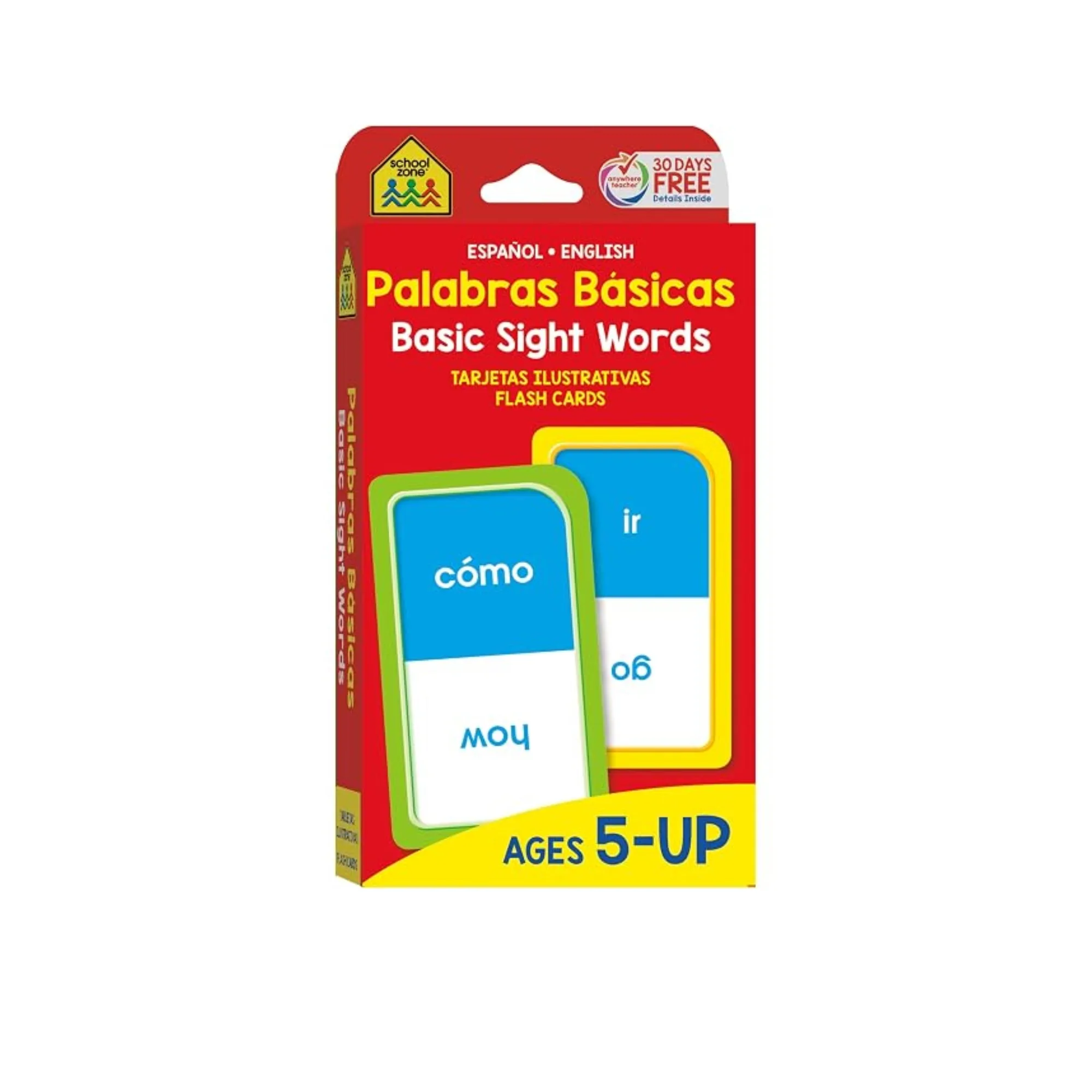
Spanish-English Sight Words Flash Cards – Bilingual Early Reading & ESL Learning, 56 Cards