Quick answer
Choose SPF 30 for everyday errands and SPF 70 for long outdoor sports or intense sun, but expect only a small UVB bump from the higher number. Neither SPF lasts longer on your skin, so spray reapplication every two hours matters more than the label.
What the SPF number actually measures
SPF is a laboratory measure of how much UVB a product blocks, not a timer. SPF 30 filters about 97% of UVB, while SPF 70 filters about 98.6%. That 1.6-point gap is real but modest, and it says nothing about UVA protection or how long the product stays on your skin.
That is why a high number can create false confidence. The SPF 30 vs SPF 70 sunscreen difference is smaller than most people expect, and neither rating survives sweat, swimming, or towel-drying without help from reapplication.
Higher SPF does not mean longer wear
A common myth is that SPF 70 lets you skip a reapplication. It does not. The number describes filtration strength at application, not durability. Water resistance claims on a label describe how long protection holds during swimming or sweating, and that clock starts from the moment you apply.
Practical takeaway: treat every spray the same on the reapplication schedule. If you are active outdoors, set a two-hour reminder regardless of whether the can says SPF 30 or SPF 70.
Why spray format changes the math
Sprays are convenient, but it is easy to under-apply because you cannot see the coverage. A light mist over each area may feel sufficient while leaving gaps. The fix is to spray generously and rub in, rather than relying on a quick pass.
This is where a higher-SPF spray can help slightly: if you tend to under-apply, a higher starting number gives a small buffer. But it never replaces full coverage or reapplication.
SPF 30 vs SPF 70 trade-offs
- UVB filtration: SPF 30 blocks about 97% of UVB; SPF 70 blocks about 98.6%. The gain is small but real for extended sun exposure. Do not pay a premium expecting a dramatic jump in protection.
- Wear time: Both SPF 30 and SPF 70 need reapplication at least every two hours, and sooner after swimming, sweating, or towel-drying. Set a timer rather than trusting the number.
- Spray coverage: Sprays make it easy to miss spots. Spray generously, then rub in, and use enough to cover each limb and the face evenly. A higher SPF does not compensate for thin coverage.
- Skin sensitivity: Higher-SPF formulas can feel heavier or include more filters. If your skin reacts, patch-test first or choose a formula labeled for sensitive skin. Comfort affects whether you reapply, so pick a texture you will actually use.
Product facts
-
Neutrogena Sport Active Defense SPF 70 Sunscreen Spray, Sweat & Water Resistant Spray Sunscreen with Broad Spectrum Protection for Sunburn Prevention, Oxybenzone-Free, Twin Pack, 2 x 5 oz: Neutrogena Sport Active Defense Sunscreen Spray is SPF 70, broad spectrum, water resistant, oxybenzone-free, and formulated as a lightweight, non-sticky, quick-drying spray. It suits active outdoor use where a high SPF and water resistance are useful, and the quick-drying finish makes reapplication less of a chore.
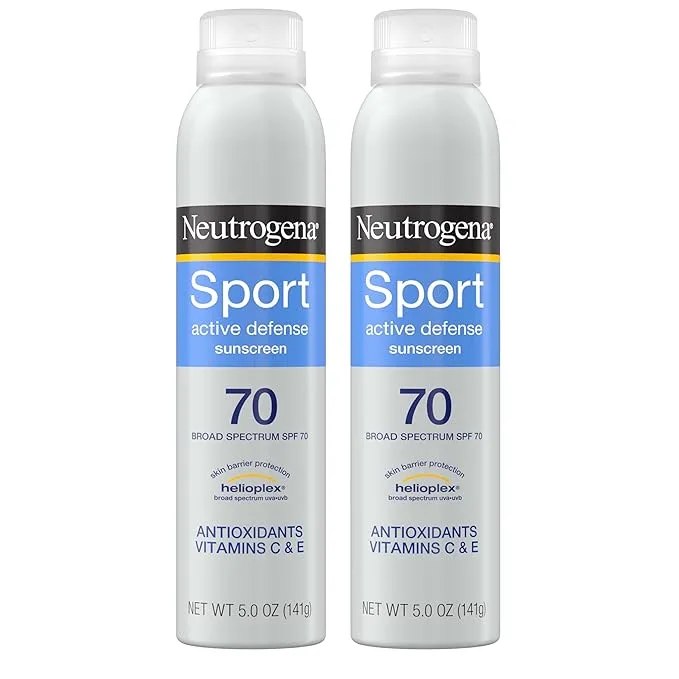
Neutrogena Sport Active Defense SPF 70 Sunscreen Spray, Sweat & Water Resistant Spray Sunscreen with Broad Spectrum Protection for Sunburn Prevention, Oxybenzone-Free, Twin Pack, 2 x 5 oz
Who should choose which
Best for
- Outdoor sports, hiking, or long beach days where a water-resistant SPF 70 spray like Neutrogena Sport Active Defense fits the activity
- People who want a quick-drying, non-sticky spray for easy reapplication
Not for
- Anyone expecting SPF 70 to replace reapplication every two hours
- Daily indoor or brief errand use where a lighter SPF 30 product may feel more comfortable