Why dice work for bedtime stories
Bedtime stories don't have to come from a book. The PlanToys Storytelling Dice turns story-making into a simple game: roll the dice, look at the images, and act out a narrative that connects them. The supplied product description notes that the game encourages players to recall memories from the past and sharpens communication skills through storytelling. For families, that means the dice provide a gentle structure for creative storytelling activity without a screen or a script.
The set is described as a game for the whole family, so it can work as a shared bedtime ritual rather than a solo activity. One person rolls, the group builds a story together, and the cloth bag keeps the pieces tidy for the next night.
What comes in the Storytelling Dice set
-
Storytelling Dice: Includes 9 action tiles, 6 story add-on blocks, and a cloth bag for storage. Knowing the piece count helps you plan a bedtime routine: the tiles and blocks are the prompts, and the bag makes cleanup part of the ritual.
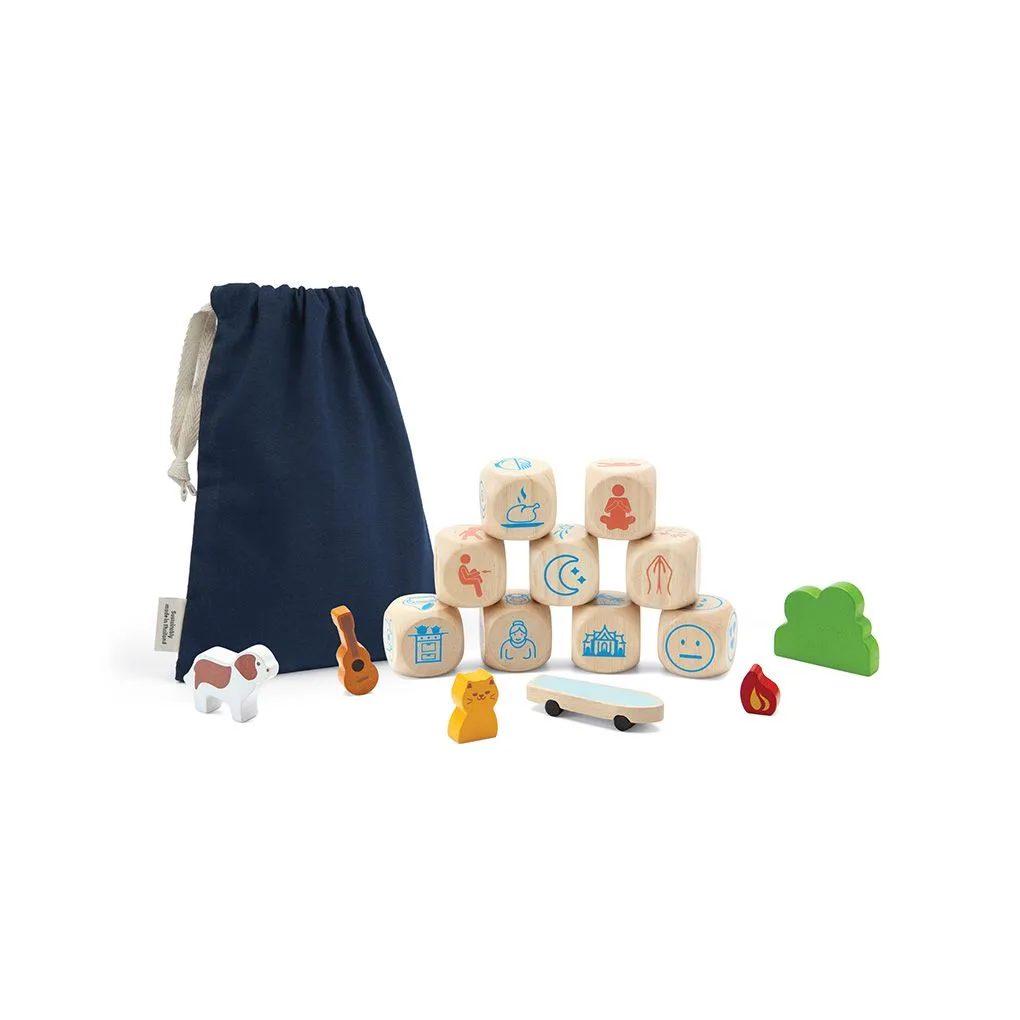
Storytelling Dice
-
Storytelling Dice: Players take turns rolling the dice and act out narratives that correspond to the images on each. This is the core loop of the game, so you can explain the rules to kids in one sentence.
-
Storytelling Dice: The game is described as strengthening multi-tasking and concentration skills by encouraging players to recall memories from the past. That memory-recall element can shape your prompts: ask kids to connect an image to something they remember, not just something imaginary.
A simple bedtime story routine with the dice
The supplied instructions are brief: roll the dice, then act out a narrative that matches the images. The steps below organize that into a repeatable bedtime flow. They are suggestions for using the set, not manufacturer requirements.
- Set out the tiles and blocks: Empty the cloth bag onto a low table or the floor so everyone can see the 9 action tiles and 6 story add-on blocks.
- Take turns rolling: One player rolls the dice. The images that come up become the prompts for that player's part of the story.
- Act out or tell the narrative: The player acts out or tells a short narrative that connects the images. The product description says players act out narratives corresponding to the images; you can let each child choose whether to speak, act, or both.
- Add a memory or a made-up detail: Because the game encourages recalling memories from the past, you can ask the storyteller to link one image to something they remember. This keeps the story grounded and gives quieter kids an easy entry point.
- Pass the story along: The next player rolls and continues the story, using their own images. The game is for the whole family, so adults can take a turn too.
- Close the bag together: Put the tiles and blocks back in the cloth bag. A consistent cleanup signals the end of the bedtime story session.
Adapting the dice for different ages and energy levels
The supplied product record does not specify an age range, so treat the following as general play adaptations rather than age-graded instructions. The set contains small tiles and blocks, so supervise young children who still put objects in their mouths.
- For a child who is new to storytelling: Let them roll and describe one image at a time. You can model a short sentence first, then invite them to add the next image.
- For a child who wants to move: Use the action tiles as physical prompts: act out the image instead of describing it. The product description explicitly supports acting out narratives.
- For a mixed-age group: Pair an older child with a younger one. The older child can weave the images into a longer story while the younger child chooses which image comes next.
- For a quiet wind-down: Skip the acting and tell the story in a low voice. The dice still provide the prompts, but the pace slows down.
Combining the dice with blocks for richer stories
The supplied product description suggests combining the dice with blocks that depict images of objects and nature to enhance the story. If you already have wooden blocks with pictures, set a few beside the dice and let players choose one to add to their narrative. This is an optional extension, not a requirement, and the Storytelling Dice set works on its own with the 9 action tiles and 6 story add-on blocks.
Materials and care notes
The Storytelling Dice is described as sustainably made in Thailand using chemical-free rubberwood, formaldehyde-free glue, organic pigments, and water-based dyes. The supplied record does not include specific cleaning instructions, so follow general care for wooden toys: wipe with a damp cloth and dry immediately, and store the pieces in the included cloth bag. Avoid soaking the wooden pieces or leaving them wet.