What Each Razor Is Designed to Do
A straight edge razor and a safety razor both aim for a close shave, but they achieve it through different blade exposure and technique. A straight edge razor uses a full exposed blade that you hold at a shallow angle, giving you direct control over every stroke. A safety razor uses a protective guard that limits blade exposure, making it more forgiving but also less precise for detailed beard lines.
The choice comes down to how much control you want versus how much protection from nicks you need. If you regularly shape cheek lines, necklines, or edge-ups, a straight edge razor lets you follow the exact contour of your beard. If you prefer a quick, consistent shave with less risk of cuts, a safety razor is the safer bet.
What the Straight Edge Razor Offers
-
Straight Edge Razor: Stainless steel straight edge razor with a fold-away handle; arrives shave-ready with five replaceable stainless steel blades. The replaceable blades keep the edge sharp without needing to strop or hone, and the stainless steel construction means the razor itself lasts longer than disposable cartridges. This makes it a practical entry point for someone new to straight razors.
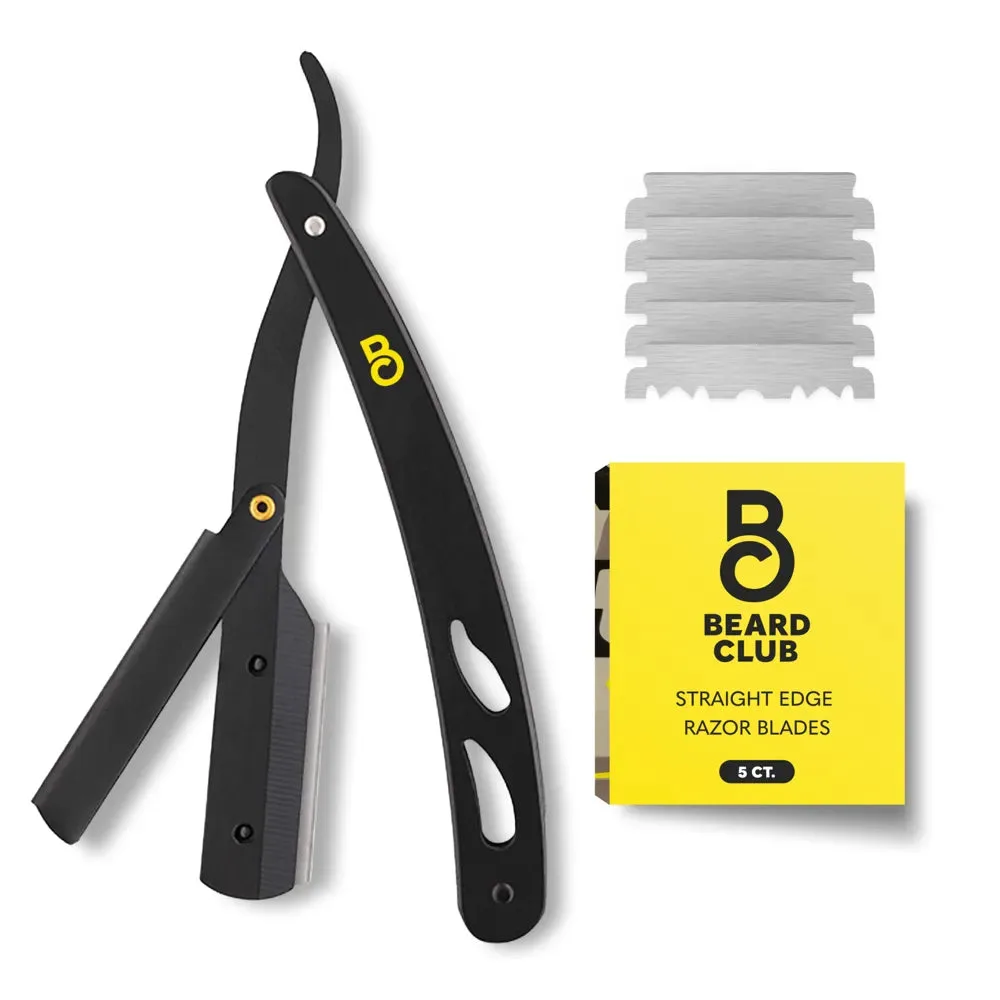
Straight Edge Razor
Straight Edge Razor vs Safety Razor at a Glance
Both tools can deliver a close shave, but the experience and results differ in key ways.
- Blade exposure: Straight edge: full exposed blade. Safety razor: guarded blade with fixed exposure.
- Control over angle: Straight edge: you set the angle with each stroke. Safety razor: the head sets a preset angle.
- Precision for beard lines: Straight edge: excellent for cheek lines, necklines, and edge-ups. Safety razor: less precise for detailed shaping.
- Learning curve: Straight edge: steeper; requires practice to avoid nicks. Safety razor: easier to learn, fewer cuts initially.
- Blade replacement: Straight edge: replaceable blades (e.g., five included). Safety razor: standard double-edge blades, widely available.
- Maintenance: Straight edge: rinse often, dry completely before folding, swap blade when it pulls. Safety razor: rinse and dry, replace blade every few shaves.
How the Straight Edge Razor Works for Beard Lines
A straight edge razor puts you in control of every line — cheek lines, necklines, edge-ups — the way your barber does it. The supplied instructions recommend lathering properly, holding the blade at a shallow angle to the skin, keeping the skin taut with your free hand, and taking short strokes with the grain.
Shave after a warm shower, when hair is soft and skin is clean. Make a second pass across the grain only if your skin tolerates it, then finish with cool water. Rinse the blade often, dry the razor completely before folding it away, and swap the blade as soon as it starts to pull instead of glide. These steps help you get a close shave without irritation.
When a Safety Razor Might Be the Better Choice
If you shave your entire face daily or have sensitive skin that reacts to an exposed blade, a safety razor offers more forgiveness. The guard reduces the risk of nicks, and the preset angle means you don't have to think about blade orientation. It's a solid choice for a consistent, comfortable shave with less practice.
However, for precise beard shaping — like defining a sharp cheek line or cleaning up a neckline — the safety razor's guard can block visibility and limit control. That's where a straight edge razor has a clear advantage.
The Verdict: Which Shaves Closer?
Both can achieve a close shave, but a straight edge razor gives you the potential for a closer shave because you can adjust the angle to cut hair at the skin line with no guard in the way. The tradeoff is that it requires more skill and attention. A safety razor delivers a reliably close shave with less risk, but it may not match the precision of a straight edge for detailed beard work.
If you value control and are willing to practice, the straight edge razor is the better tool for beard line precision. If you want a quick, low-risk shave, a safety razor is the practical choice.