Quick answer
Start with a peg board if your toddler is still learning to grip and release. Oversize pegs are easier to hold and place, so they build the hand control that stringing beads later requires. Move to lacing beads once your child can pick up a small object and deliberately let it go. If your child already grips well, you can introduce both at the same time and let them choose.
The grip gap between pegs and laces
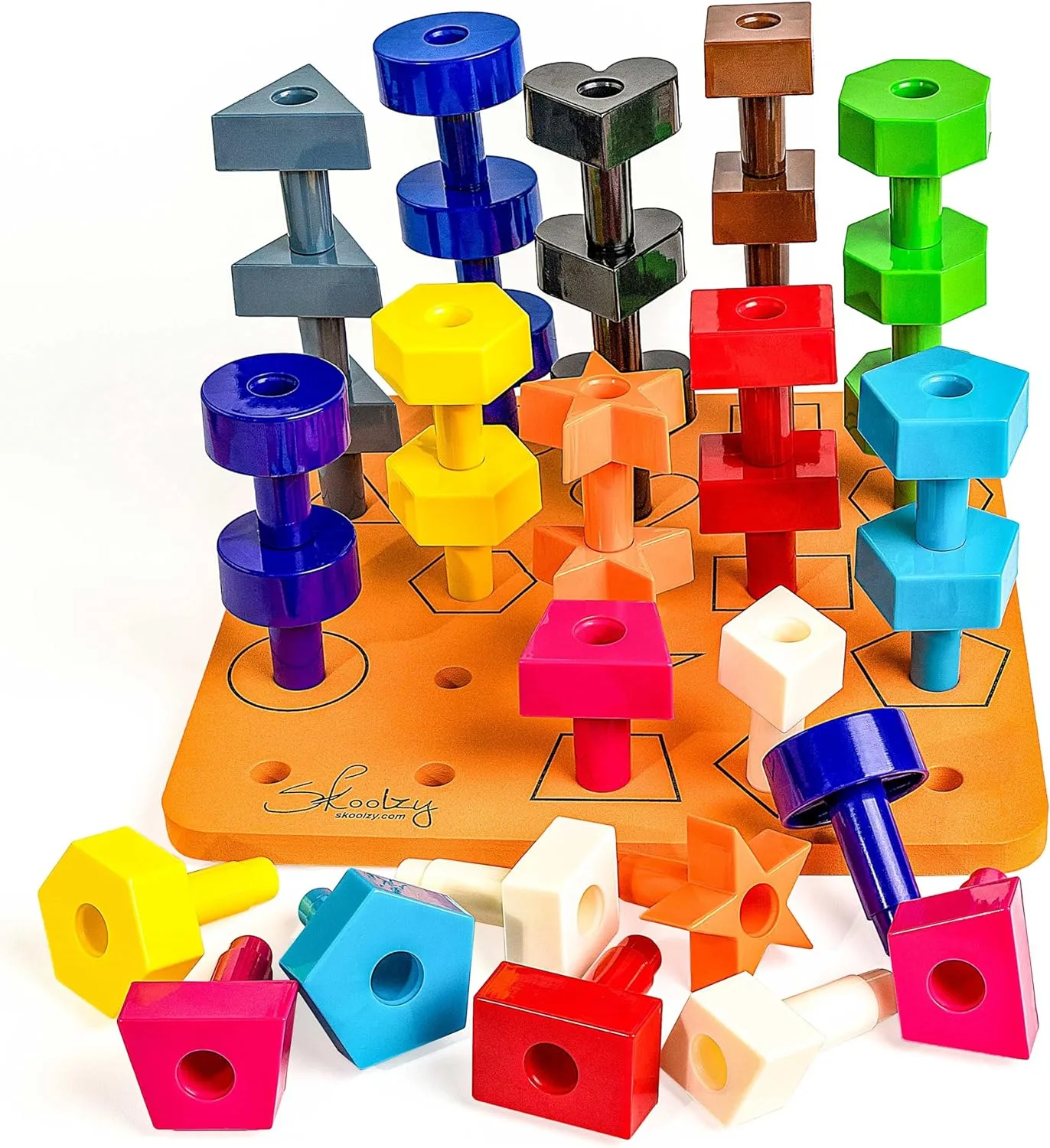
Peg boards ask a toddler to do one simple motion: pick up a chunky peg and press it onto a board. The oversize pegs in the Sensory Peg Board 33 Piece Set are easy for small fingers to grasp and stack, so the child can focus on aiming and releasing rather than holding on. Stringing beads adds a second step. A child must hold the bead, hold the lace, and pass the lace through the hole. That takes more hand separation and patience. The Rainbow Stringing Beads set uses chunky, large beads designed for a baby's first lacing, which lowers the difficulty, but the threading action is still more advanced than stacking a peg.
How to tell which toy fits right now
Watch your child during play. If they can pick up a small block and drop it into a cup on purpose, they are ready to try lacing beads. If they still sweep objects into their palm or lose their grip mid-reach, a peg board gives them more success. You do not need to wait for perfect peg skills before offering beads. A short bead session alongside peg play lets you see which one holds attention without frustration.
Building a fine motor routine with both tools
Use peg boards for short, focused practice and beads for quieter, longer play. A peg board set like the Toddler Peg Board 38 pcs works well as a five-minute warm-up because the child can stack and re-stack quickly. Beads work better when your child is calm and can sit with a tray. Keep both within reach and rotate them every few days. If you want a single set that covers sorting and counting too, the Skoolzy Rainbow Counting Bears add a different grip and a math layer, but they are not a substitute for threading practice.
Trade-offs to weigh before you buy
- Peg boards: easier grip, less portability: Oversize pegs are simple to hold, which builds confidence fast. But the board and pegs stay in one place, so this is a table-top toy rather than a take-along activity. Choose a peg board for focused home practice.
- Stringing beads: harder skill, more flexible play: Threading a lace through a bead demands more hand control, but the beads can be sorted, counted, and carried in a small bag. The Rainbow Stringing Beads set uses chunky beads to soften the learning curve. Choose beads once your child can release objects on purpose.
- Doing both at once: faster progress, more mess: Rotating a peg board and a bead set gives your child two different grips in the same week. The downside is more pieces to store and a higher chance of beads rolling under furniture. Use a tray or the included storage bag to keep pieces contained.
Product facts that affect the choice
- Rainbow Stringing Beads for Toddlers 46 Pcs | Stringing Beads: The Primary Lacing & Stringing Bead Set is an ideal first stringing set for your baby or toddler because of the chunky and large beads. The jumbo beads make it easy for little hands to grasp and handle. Large beads reduce the precision needed to thread, so this set is a better entry point than small lacing beads.
- Sensory Peg Board 33 Piece Set - Montessori Occupational Therapy Toys for Kids & Toddlers 2+: The OVERSIZE PEGS in the Toddler Pegboard Set are easy for small and tiny fingers to grasp and stack on the peg boards and stacking to build towers. Oversize pegs let a toddler practice the full pick-up-and-place motion without the added challenge of threading.
- Toddler Peg Board 38 pcs | Pegboard for Toddlers: With 36 colorful pegs, a foam board, and a handy bag, it's a complete package. The included bag makes it easy to keep the set together for short, repeatable practice sessions.
Which one should you start with?
Best for
- Toddlers who are still learning to grip and release small objects
- Families who want a table-top activity that stays in one place
- Children who get frustrated when a task has more than one step
Not for
- Children who already thread large beads easily and need a bigger challenge
- Families looking for a take-along toy with no loose board
- Toddlers who still mouth small objects and need a fully enclosed alternative